Month: September 2012

Autumn Equinox Thelemic Rituals of the Elements

The Rituals of the Elements: Autumn Equinox

Introduction

It is written in Liber AL vel Legis II:36, “There are rituals of the elements and feasts of the times.” Crowley comments, “The entry of the Sun into the cardinal signs of the elements at the Equinoxes and Solstices are suitable for festivals. The difference between ‘rituals’ and ‘feasts’ is this: by the one a particular form of energy is generated, while there is a general discharge of one’s superfluous force in the other. Yet a feast implies periodical nourishment.” This cycle of dramatic rituals are therefore invocations. They are intended to generate energy at the entrance of the Sun into the cardinal signs of elements at the four quarters of the year, i.e. the Equinoxes and Solstices.

The entire cycle of rituals simultaneously show:

  1. The macrocosmic cycle of the Sun going through the seasons
  2. The microcosmic cycle of Man going through the generations/Incarnation (birth/youth-adulthood-old age-death).
  3. The process of Attainment from 0=0 to 8=3 and back again.

The energies of each ritual correspond to each of these planes at once:

Equinox and Solstice rituals

Each ritual invokes a particular energy. Each ritual has a particular Word of Power associated therewith and it is intoned in between the scenes. The Word also appears once in each ritual within a particular Scene.

Each of the four rituals has 3 scenes for a total of 12 scenes for the entire cycle, one for each of the signs of the Zodiac. The middle scene of each ritual is the sign of the Equinox or Solstice – for example, the middle scene in Autumn is Libra. The first scene is therefore Virgo, the sign before Libra, and the last scene is Scorpio, the sign after Libra. In general, the first scene represents events leading up to the Equinox or Solstice, the middle scene represents the actual turning-point, and the last scene represents events leading to the next Equinox or Solstice.

The Basic Characters

  • (☉/♂) Priest/King – the conscious Self. The Child who grows to become King who attains and becomes a Priest and then dies and is reborn as the Child.
  • (☽/♀) Priestess/Queen the Non-Self (the unconscious self, the “higher self,” etc.). The Mother of the Child, the Queen/Beloved of the King, the High Priestess of the Priest.
  • (+ and -) 2 Children – the duality of the World. Various roles throughout the entire cycle.
  • () The People (participants) – the inhabitants of the World; they identify (at least their conscious selves) with the Priest.
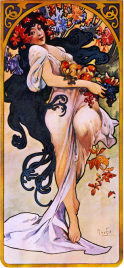
 

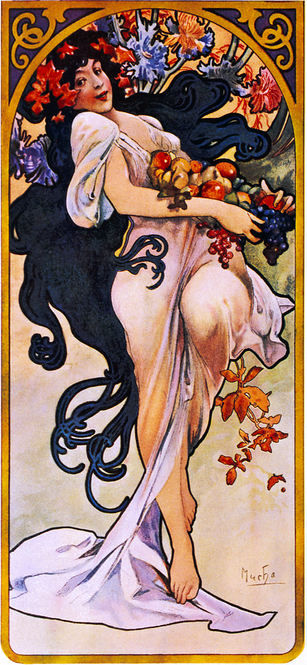
Autumn Equinox MuchaTHE AUTUMN EQUINOX CEREMONY

Also known as “The Hour of Truth”

The Word of this ceremony is ‘THELEMA’ (Theh-lay-muh). It is intoned three times in between scenes, i.e. between Scenes 1 & 2 and between Scenes 2 & 3, by the People/Congregants. 

The Talisman of this ceremony is an ostrich plume (or a smaller representation thereof).


SCENE 1: Virgo.
The End of Summer, the Threat of Winter/Death, the possibility of Immortality.

SETTING: The Kingdom at Sunset1; it is almost the time of harvest2. The King is entering Old Age. The room is lit, but dimly; the primary light comes from the West, i.e. the setting Sun. There are fields of wheat3 surrounding everyone or up on the Throne. Leaves are scattered about that are colored by Autumn. The King is enthroned in the East, facing Westward; he is wearing a white robe under his scarlet robe; the Queen is wearing a green robe over white and her hair is filled with 12 white flowers in a crown. + holds the Sword, – holds the Balances; the Staff and Lantern are hidden behind the Throne.

+ and – stand on either side of the King and speak as if announcing news to the Kingdom.

+: “Thrust in thy sickle and reap: for the time is come for thee to reap; the harvest of the earth is ripe.”4

–: “Thrust in thy sharp sickle, and gather the clusters of the vine of the earth; for her grapes are fully ripe.”5

KING: “Let there goeth forth a sickle that shall reap every flower!”6

+ and – march to the West side of the Temple and turn to face East. The Queen paces around, looking very worried.

KING: My Queen! The fruits of our labors are ripened. It is a time for reaping and rejoicing, yet you appear discontent.

QUEEN: Harvest time is indeed upon us… yet I tremble in fear at the thought of enduring another winter storm. What if our harvest does not last until the next blooming of flowers? What if you fail of an heir and we are left in darkness?

The King looks disappointed but does not respond. + and – take a few steps forward while + says:

+: My Queen, we may know of a certain solution to your sorrows.

+ and – stop before – speaks.

–: Indeed, the legend we have heard in our youth of the potion that provides permanence.

QUEEN: Ah! Yes! Yes! The Elixir of Immortality. I know this legend; how I could I have forgotten! If you could but find and drink of it, Eternal life would be granted. Winter storm would pose no threat; fear of having no heir would be banished at last!

KING: This sounds good, too good to be true. Where might I find this Elixir and what must I do?

QUEEN: It is said there is but one soul upon the Earth who has the Wisdom7 to create this Elixir.

+ and – are becoming excited by the Queen’s tale, taking further steps towards the East while + says:

+: The Priestess Nuit!

+ and – stop before – speaks.

–: Yet she lives afar off!

QUEEN: Across the great span of the wilderness to the West, you may find her at the summit of the highest, most holy mountain. There, where the Earth meets the Heavens!8 I must warn you, though, that I have heard many have tried and all have failed, for they did not persist.

+ and – take their final steps to be right next to the King in the East while + says:

+: They were turned aside by adversity.

+ and – stop before – speaks.

–: They settled for something less than that ultimate end.

+ and – turn around simultaneously to face the West.

KING: I will seek only Nuit. I will “turn not aside for aught”9.

QUEEN: Ah! Our perpetual predicament may be resolved at last! Save your Kingdom from disrepair; save your Queen from utter despair. The wasteland awaits thee, my King! Follow the footsteps of the Camel10 that lead the way through the desert.11

KING: Let the preparations be made at once!

QUEEN: But, my King, if you are gone, who will rule in your stead?

+ steps forward and raises the Sword.

+: I will rule with the severe sword!

– steps forward and raises the Balances.

–: I will rule with the benevolent balances!

KING: Only they who have the right of God and might of Will may take the throne. [+ and – step back to the sides] My Queen, you must rule in my stead.

QUEEN: How should I be worthy to ascend to the throne and administer the royal decrees to our Brothers and Sisters?

KING: The most potent power derives from the most solemn service12. Divest yourself of all pursuit of pleasure and all sin of selfishness.

QUEEN: I see “nothing but a blank midnight in this Emptying of the Soul!”13

KING: “This is the necessary condition of Illumination.”14 Even as the Sun is swallowed in Sea [The King points to the West] you too must undergo the darkness of the Night of Pan, purged of all egoity!

The King takes the Queen by the hand and slowly leads her into the West. As they walk, drums beat slowly and softly but become louder and faster.

QUEEN: “Why do I sweat with blood and dew? Blind horror catches at my breath. The path of the abyss runs through things darker, dismaller than death! …There is no memory possible of this unfathomable hell. Even the shadows that arise are things too dreadful to recount!”15

The drums become louder and more chaotic. The King and Queen approach the West; the rhythm of their words carry them onward.

KING: “This is the end of all our pain, the dissolution of the brain! For lo! in this no mortar sticks; Down come the house – a hail of bricks!”16

The drums are loud and completely chaotic; there is no rhythm.

QUEEN: “But my soul faints, my stomach sinks. Let me pass on! [The Queen pushes away the King to make the final steps to the West alone] My being drinks the nectar-poison of the Sphinx. This is a bitter medicine! Black, black, intolerably black! Go, spectre of the ages, go!”17

The drums stop suddenly. The Queen arises solemnly and turns to the East in the attitude of Resurrection, i.e. the sign of Osiris Risen.

KING: You have passed beyond… Beloved, thy stature spans the sky.18

QUEEN: Verily; but it is not I. The ego dissolves – pale phantom form blown from the black mouth of the storm. It is another that arises! …Ay, there is no more potent spell. Through life, through death, by land and sea, most surely will I follow thee.19

KING: Follow thyself, not me!20 It is complete! The Kingdom will obey thine command! My departure is nigh at hand!

END SCENE. Congregants repeatedly intone ‘THELEMA’ in between scenes.

SCENE 2: Libra.
The Installment of the Queen as Ruler of the Kingdom.

The light from the West is slightly darker; the Sun is halfway concealed by the horizon. The King stands in front of the Throne in the East and the Queen stands before him. + and – stand on either side of the Queen, facing her. + holds the Sword, – holds the Balances.

KING: The preparations for my departure into the wilderness of the West are almost complete. My final act is to raise you to the throne as Ruler21 of this Kingdom.

The King comes down from the Throne. He takes the Queen’s hand and sets her in the Throne where she sits. The King turns to address the People.

KING: I say that ‘Every man and every woman is a star.’ I do not fool and flatter women; I do not despise and abuse them. To me a woman is Herself, absolute, original, independent, free, self-justified, exactly as a man is. I dare not thwart Her Going, [The King turns to face the Queen] Goddess thee! I arrogate no right upon your will; I claim not to deflect your development, to dispose of your desires, or to determine your destiny. You are your own sole arbiter. I do not want you as a slave; I want you free and royal, whether your love fight death in my arms by night, or your loyalty ride by day beside me in the Charge of the Battle of Life.22

+ advances and hands the Sword to the Queen who holds it between her legs.

KING: Let your rule be strong yet precise. O be thou proud and mighty among men!23

advances and hands the Balances to the Queen who holds it against the hilt of the Sword. She holds both Sword and Balances at once.24

KING: Let your rule be merciful yet fair. Bring the glory of the stars into the hearts of men!25

The King takes a Crown of ostrich plumes26 and places it on the Queen’s head.

KING: May Truth stand upon your crown, eternally alert. Truth is your Path, and Truth is your Goal; [The King kneels while + and – give smaller versions of the ostrich plume to each Congregant.] Ay! there shall come to you a moment of great Light when, understanding what is Truth, you will understand your Self, for you are Truth!27

The King pauses and smiles.

KING: It is accomplished! [The King genuflects and extends his arms towards the Queen while saying:] “Unto thee is all power given.”28

The King, +, , and the People applaud.

QUEEN: “I will glorify myself and live deliciously. I sit a queen, and am no widow, and shall see no sorrow.”29 I will rule firmly with severity yet justly with mercy. I will not only uphold thine power, but it shall wax in strength to cover the world. Remember, my King: Seek only Nuit! Turn not aside for aught! I entrust unto thee this staff to support you in daytime [+ takes the staff]. I impart unto thee this lantern to guide you in darkness [– takes the lantern]30. I empower thee with this most holy word of force and fire31 that thou mayst endure unto the End: THELEMA.”

The Queen kisses the King.

QUEEN: The wasteland awaits thee, my King! Follow the footsteps of the Camel that lead the way through the desert.

END SCENE. Congregants repeatedly intone ‘THELEMA’ in between scenes.

SCENE 3: Scorpio.
The Kings leaves to wander in the wilderness.

The Light from the West is even darker; the Sun is almost set on the horizon. The King is prepared to leave the Queen32 and the Kingdom to wander in the wilderness33 for 50 days34. The King faces the Queen who is enthroned in the East.

The King closes the Veil, hiding the Queen from sight. He then turns towards the West.

KING: My Kingdom is secure with Justice enthroned.35 Her eyes of equity are etched into my brain. Her Word awakens my intent. Her kiss lingers on my lips. “Now, I goeth solitary…”36 Bearing my staff as support by day [+ raises the staff] and my lantern as guide by night [– raises the lantern].

The King points to the ground in the West.

KING: Look! The footprints of a Camel! The initiation of my journey is at hand.

The King lifts his Lance, pointing it to the Western horizon.

KING: “With my burning spear, to the wilderness I wander!”37

The King then holds the Lance upright with both hands, right over left, and begins to slowly march towards the West where the Sun sets completely and darkness envelops the Kingdom. + and – hold the staff and lantern and walk on either side of the King. + and – slowly and solemnly chant the word ‘THELEMA,’ starting loudly and slowly becoming silent.

+ and : THELEMA… THELEMA… THELEMA…

END SCENE.

Notes

1In the symbolism of day and night, this ceremony corresponds to Sunset as, in the symbolism of the seasons, it corresponds to Autumn.

2Virgo is the sign just before Libra, which is the traditional time of harvest.

3Wheat and corn are attributed to Virgo.

4Adapted from Revelation 14:15.

5Adapted from Revelation 14:18.

6From The Vision and the Voice, 7th Aethyr. The reference is to the coming month of Libra that is of harvest; Saturn, whose weapon is the sickle, is exalted in Libra.

7Virgo is Atu IX: The Hermit, Mercury or Wisdom.

8The mountain is the Holy Mountain, Abiegnus of the Rosicrucians; the Summit is where the Goat-God Pan lives, i.e. Capricorn the Winter Solstice, and it is seen symbolically as the High Altar in the Gnostic Mass.

9c.f. The Vision and the Voice, 20th Aethyr.

10The Book of Lies, chapter 73. It is not realized that Death rides this Camel of Initiation.

11This refers to the Gimel that literally means “camel,” which is the path of Atu II: The High Priestess that leads from Tiphareth across the Abyss to the Supernals.

12A reference to “Liber 194: An Intimation with Reference to the Constitution of the Order” where, when speaking about governmental positions in O.T.O., Crowley writes, “with us Government is Service, and nothing else.”

13From “AHA!”

14From “AHA!”

15From “AHA!”

16From “AHA!”

17From “AHA!”

18From “AHA!”

19From “AHA!”

20From “AHA!”

21This is seen in the Gnostic Mass when the Priest upraises the Priestess and sets her upon the summit of the Earth.

22This entire speech is adapted from the New Comment on Liber AL III:55.

23Liber AL II:77.

24This is Woman as Justice, seen in Atu VIII: Adjustment, to which is attributed the sign of Libra. It also is a reference to the liberation of Women from the subservience of the Old Aeon, c.f. Liber AL III:10, “Let the woman be girt with a sword before me.”

25Liber AL I:15.

26These are the feathers of Maat, c.f. The Book of Thoth, “She is crowned with the ostrich plumes of Maat, the Egyptian goddess of Justice.”

27This speech is adapted from the chapter “Truth” in Little Essays Towards Truth.

28A reference to Liber AL I:15, “…and in his woman called the Scarlet Woman is all power given.”

29Adapted from Revelation 18:7 where it refers to Babylon.

30The lantern and staff are the weapons of the Hermit as seen in Atu IX: The Hermit. They also reflect the Pillar of Fire that guided Moses in the desert by night and the Pillar of Cloud that guided him in the desert by day.

31Liber AL II:20.

32This is seen in the Gnostic Mass when the Priest closes the veil after raising Priestess to the summit of the Earth.

33The wilderness represents spiritual austerities as when Jesus fasted in the desert and Buddha meditated under the Bodhi tree. In terms of Thelema, it represents the Abyss. Crowley associates the Yod, which is attributed to Atu IX: The Hermit, with “Parzival in the desert. Christ taking refuge in Egypt, and on the Mount tempted by the Devil. The unconscious Will, or Word” in Magick in Theory and Practice.

3450 is the number of Nun, which is attributed to Atu XIII: Death and therefore Scorpio. It is also a reference to Christ’s wandering 40 days in the wilderness and Buddha’s 49 days of meditation under the Bodhi tree before enlightenment. In both cases this period directly precedes their temptation by Satan/Mara. This period is also seen in the Gnostic Mass after the Veil is drawn (the Sunlight dwindling in Sunset/Autumn) and the Priest circumambulating 3 times; it is seen at the beginning of the Winter Solstice ceremony.

35This represents the attainment of 7=4. The next step is to cross the Abyss and attain 8=3, which is shown in the Winter Solstice ceremony.

36A reference to The Vision and the Voice, 13th Aethyr, “The hermit goeth solitary, and giveth only of his light unto men”; it is therefore also a reference to the attainment of the Grade of Hermit.

37Adapted from The Vision and the Voice, 10th Aethyr.

Liber LXV parables

The Parables and Lessons of Liber LXV (part 5)

Liber LXV: The Heart Girt with a Serpent

The Parable of the White Swan of Ecstasy and the Little Crazy Boy of Reason

Also the Holy One came upon me, and I beheld a white swan floating in the blue. Between its wings I sate, and the æons fled away. Then the swan flew and dived and soared, yet no whither we went. A little crazy boy that rode with me spake unto the swan, and said: Who art thou that dost float and fly and dive and soar in the inane? Behold, these many æons have passed; whence camest thou? Whither wilt thou go? And laughing I chid him, saying: No whence! No whither! The swan being silent, he answered: Then, if with no goal, why this eternal journey? And I laid my head against the Head of the Swan, and laughed, saying: Is there not joy ineffable in this aimless winging? Is there not weariness and impatience for who would attain to some goal? And the swan was ever silent. Ah! but we floated in the infinite Abyss. Joy! Joy! White swan, bear thou ever me up between thy wings!

Liber LXV, II:17-25

This Parable of the White Swan of Ecstasy and the Little Crazy Boy of Reason is one of my personal favorite passages from the Holy Books of Thelema. Crowley refers to this passage in several places including his commentary on Blavatsky’s “The Voice of the Silence” and his commentary on The Book of the Law. There is also a chapter in The Book of Lies entitled “The Swan” (chapter 17) that is expands the symbolism of this passage, which I encourage you to read if this Parable particularly interests you.

Also the Holy One came upon me, and I beheld a white swan floating in the blue. Between its wings I sate, and the æons fled away.” The phrase “the Holy One came upon me” is a way to say that the Adept has entered into an ecstatic state of consciousness, similar to saying that the Holy Spirit has entered one’s heart or descended upon oneself. The Adept sees a “white swan,” which represents Ecstasy. This symbolism is developed in The Book of Lies where Crowley writes, “There is a Swan whose name is Ecstasy: it wingeth from the Deserts of the North; it wingeth through the blue; it wingeth over the fields of rice; at its coming they push forth the green.”1 Crowley comments further that “This Swan is Aum,”2 which is both the name of the swan and its nature, i.e. it is the Holy Mantra of the Hindus and whose symbolism is too deep and complex for this basic essay. Crowley comments, “The swan is the ecstatic Consciousness of the Adept.”3

This white swan “floats,” meaning it moves effortlessly. The swan floats “in the blue,” which represents infinite space (i.e. Nuit). This parallels the line from The Book of Lies where the swan “wingeth through the blue.” Crowley comments, “It is poised in infinite space.”4 The Adept sits between the wings of the swan, carried by its effortless floating of ecstasy. “The æons fled away” means that the Adept, through Ecstasy, has transcended Time. Entire aeons go past without any care or worry. Crowley comments, “In Ecstasy time does not count.”5

“Then the swan flew and dived and soared, yet no whither we went.” Despite the swan’s movements of flying, diving, and soaring, it remains essentially motionless. The aeons having fled away means Ecstasy transcends Time and now we see that this Ecstasy also transcends Space. Each movement of the Swan of Ecstasy is Joy even though there is no real movement or progress. From the perspective of the infinite, there is no goal to be attained, yet each movement through time and space is joy. From this point-of-view, one can truly say, “Existence is pure joy.”6 Crowley comments, “The Ecstasy moves from one sublimity of Joy to another; but there is no progress possible in perfection, therefore no aim to be attained by such movements.”7

“A little crazy boy that rode with me spake unto the swan, and said: Who art thou that dost float and fly and dive and soar in the inane? Behold, these many æons have passed; whence camest thou? Whither wilt thou go?” We are now introduced to a new character, the “little crazy boy” who represents the mind or Ruach, especially insofar as it is the realm of Reason. This boy of Reason questions the Swan and essentially asks, “Who are you? All this time has passed but where did you come from and where are you going?” Reason cannot understand the initiated point-of-view, just as – esoterically – the Ruach of Knowledge can never reach above the Abyss to the Supernal Triad of Understanding. The mind is embedded in space and time: it cannot comprehend That which transcends both. Crowley comments, “The boy is the human reason, which demands measurement as the first condition of intelligible consciousness. Aware of time, he cannot understand why all this motion has not brought the swan nearer to some fixed point, or how the relation of the point of origin to its present position is not an ever-present anxiety. He cannot conceive of motion without reference to fixed axes.”8

“And laughing I chid him, saying: No whence! No whither!” The Adept replies for the swan and “chids him,” which means that he rebukes or scoffs at Reason. The Adept says that He and the swan did not come from anywhere in particular nor are they going anywhere in particular, for they are beyond past and future insofar as they transcend Time itself. In being carried by spiritual Ecstasy, one does not strive to attain certain goals but partakes in each action and moment with Joy. Crowley comments, “I reply that, apprehending the continuum (Nuit) as such, no ‘space-marks’ exist.”9 Crowley is referencing The Book of the Law where it is written, “If this be not aright; if ye confound the space-marks, saying: They are one; or saying, They are many; if the ritual be not ever unto me: then expect the direful judgments of Ra Hoor Khuit!”10 The Adept and the swan are beyond the multiciplity of space, time, and causality so there are no “space-marks” to separate any one thing from any other thing. As it says in The Book of the Law, “Bind nothing! Let there be no difference made among you between any one thing & any other thing; for thereby there cometh hurt.”11

“The swan being silent, he answered: Then, if with no goal, why this eternal journey?” The swan is always silent for it is caught up in Ecstasy that transcends the duality of thought and speech. Silence represents None or non-duality as Speech represents Two or duality/multiplicity. The little crazy boy of Reason then asks why go through these motions if there is no goal or end intended? Crowley comments, “The swan is of course silent: Ecstasy transcends expression. Reason asks the motive of motion, in the absence of all destination.”12

“And I laid my head against the Head of the Swan, and laughed, saying: Is there not joy ineffable in this aimless winging? Is there not weariness and impatience for who would attain to some goal?” The Adept puts his head against that of the swan, implying that he is one with the transcendent Ecstasy represented thereby. The Adept laughs because the nature of Ecstasy is Joy, and laughing a natural response of the illuminated or enlightened consciousness in response to the questioning of the ego/mind/Ruach. The Adept asks a rhetorical question, implying that there is no aim to the “winging” or motion of existence, yet there is Joy in each motion. This is the pure will where one is “unassuaged of purpose.”13 Crowley comments, “The Adept bringing this thought closes to Ecstasy, laughs, both for pure joy, and as amused by the incongruous absurdities of ‘rational’ arguments from which he is now for ever free, expresses his idea thus: Thus free exercise of some object thereby, it would imply the pain of desire, the strain of effort, and the fear of failure.”14 One might say that if there is no target, there is no possibility of missing the mark. The mind is always caught up in worrying about goals and aims and purposes, thereby leading to anxiety over the possibility of not attaining these aims, strain over attempting to attain them, and sorrow over having not achieved them. This ecstatic consciousness to which the Adept has attained does not worry itself with these things, but – instead – takes Joy in all instances of motion and existence no matter whether they are considered “success” or “failure” by the rational mind. This line is the true core or “moral” of this Parable: one should strive to attain that ecstatic consciousness whereby the fretting over finding and finishing goals falls away.

“And the swan was ever silent. Ah! but we floated in the infinite Abyss. Joy! Joy! White swan, bear thou ever me up between thy wings!The swan, as mentioned before, is always silent, for it abides in its Ecstasy that transcends all illusion, all multiplicity, and therefore all worry. The Adept then gets absorbed into the Ecstasy of the swan, calling to the swan to always bear the mind of the Adept in its Ecstasy. Crowley comments, “Ecstasy remains undisturbed. But the dialogue has caused the Adept to reflect more deeply on his state of bliss, so that the Ecstasy becomes motionless, realising its perfect relation to the Infinity of the continuum. The Adept demands that ecstasy shall be constant.”15

SUMMARY: The Adept, being carried on the Ecstasy that transcends space and time, is not focused on the past or future, especially attaining specific goals, but instead takes Joy in every experience. While Reason is always worrying about specific aims or goals, the ecstatic consciousness of the Adept rejoices in the “aimless winging” of existence. This Parable counsels us to attain that intoxicated spiritual Ecstasy whereby we transcend our rational anxieties, strains, and sorrows so that we might take Joy in every moment. While this is a certainly lofty attainment, the Parable also has a more mundane and practical import: We must strive to see the Joy of experience in itself no matter what its character may be, which comes from not being overly absorbed in and worrying over attaining specific goals. We all have many notions about what we “should be” doing or achieving, and it is not inherently wrong to have certain aims or purposes to guide behavior. Despite this, it is easy to become entirely engrossed in these notions of what should or should not be happening, and we then get caught up in the “lust of result” whereby we become attached to a certain outcome. The Parable therefore counsels us to be on guard against the constant questioning and criticism of the mind, which always seeks as “why” or “wherefore” or “because” to justify action, yet to become caught up in this is to lead into stagnation and sorrow where the inherent Joy of all instances of experience – both comedic and tragic – is forgotten.

Crowley – in an unusual bout of clarity – explains this idea which I will quote to end this particular section:

There is no ‘reason’ why a Star should continue in its orbit. Let her rip! Every time the conscious acts, it interferes with the Subconscious, which is Hadit. It is the voice of Man, and not of a God. Any man who ‘listens to reason’ ceases to be a revolutionary… It is ridiculous to ask a dog why it barks. One must fulfil one’s true Nature, one must do one’s Will. To question this is to destroy confidence, and so to create an inhibition… We are not to calculate, to argue, to criticise; these things lead to division of will and to stagnation. They are shackles of our Going. They hamstring our Pegasus. We are to rise up — to Go — to Love — we are to be awake, alert… This is the ready test of a Star, that it whirls flaming through the sky. You cannot mistake it for an Old Maid objecting to Everything. This Universe is a wild revel of atoms, men, and stars, each one a Soul of Light and Mirth, horsed on Eternity.” 16

1The Book of Lies, chapter 17.

2The Book of Lies, commentary to chapter 17.

3Commentary to Liber LXV, II:17.

4Commentary to Liber LXV, II:17.

5Commentary to Liber LXV, II:18.

6Liber AL vel Legis, II:9.

7Commentary to Liber LXV, II:19.

8Commentary to Liber LXV, II:20.

9Commentary to Liber LXV, II:22.

10Liber AL vel Legis, I:52.

11Liber AL vel Legis, I:22.

12Commentary to Liber LXV, II:23.

13The reference is to Liber AL, I:44, “For pure will, unassuaged of purpose, delivered from the lust of result, is every way perfect.”

14Commentary to Liber LXV, II:24.

15Commentary to Liber LXV, II:25.

16New Comment to Liber AL, II:30-34.

Liber LXV parables

The Parables and Lessons of Liber LXV (part 4)

Liber LXV: The Heart Girt with a Serpent

The Parable of the Reaper and the Wise Man

Adonai spake yet again with V.V.V.V.V. and said: The earth is ripe for vintage; let us eat of her grapes, and be drunken thereon. And V.V.V.V.V. answered and said: O my lord, my dove, my excellent one, how shall this word seem unto the children of men?And He answered him: Not as thou canst see. It is certain that every letter of this cipher hath some value; but who shall determine the value? For it varieth ever, according to the subtlety of Him that made it. And He answered Him: Have I not the key thereof? I am clothed with the body of flesh; I am one with the Eternal and Omnipotent God. Then said Adonai: Thou hast the Head of the Hawk, and thy Phallus is the Phallus of Asar. Thou knowest the white, and thou knowest the black, and thou knowest that these are one. But why seekest thou the knowledge of their equivalence?And he said: That my Work may be right. And Adonai said: The strong brown reaper swept his swathe and rejoiced. The wise man counted his muscles, and pondered, and understood not, and was sad. Reap thou, and rejoice!

Liber LXV, I:50-56

 This entire parable consists of an exchange of the advanced Adept (V.V.V.V.V.) with God, (Adonai). Crowley comments that this exchange is “An elaborate Parable in dialogue.”1 The real parable comes at the very end: “The strong brown reaper swept his swathe and rejoiced. The wise man counted his muscles, and pondered, and understood not, and was sad. Reap thou, and rejoice!” However, the dialogue preceding this parable gives context to it:

“And V.V.V.V.V. answered and said: O my lord, my dove, my excellent one, how shall this word seem unto the children of men?” The Adept answers God, and wonders whether his “word” or message will be understood by humanity, i.e. “the children of men.” The Adept “returning to earth” or mundane life may doubt that her initiated expression of Truth will be received and understood rightly by the uninitiated. This can be seen, for example, in how many people misunderstand the Word of V.V.V.V.V.’s Truth, Do what thou wilt. Crowley comments, “The Adept doubts whether his doctrine will be understood rightly by mankind.”1

“And He answered him: Not as thou canst see. It is certain that every letter of this cipher hath some value; but who shall determine the value? For it varieth ever, according to the subtlety of Him that made it.” God answers the Adept and agrees that humanity may not understand his “word.” God goes further by saying that each individual interprets things differently – “it varieth ever” – reflecting the idea stated in the Parable of Light and Colors that each individual sees the one Light reflected into different colors according to their own understanding. Each individual is at a certain level of “subtlety,” i.e. of understanding or initiation. Each individual will understand the Word of the Adept in proportion to how far they have tread the Path of the Great Work, yet – even then – each individual will interpret things uniquely according to their own particular nature, history, and circumstance. Crowley comments, “The Angel agrees; but is more sceptical still, suggesting that any event may be taken as meaning anything one chooses.”2

“And He answered Him: Have I not the key thereof? I am clothed with the body of flesh; I am one with the Eternal and Omnipotent God.” The Adept answers God’s skepticism by asserting that he has the true “key” of understanding things. Although the “value” of the Adept’s “word” may be valued differently by each individual, the Adept claims that he knows the one true “value” as opposed to the many partial and false interpretations or “values.” Crowley comments, “The Adept claims to be able to interpret phenomena rightly; that there is one special relation which is true, and all others false.”3

The Adept then asserts his Adepthood insofar that he understands himself simultaneously as a finite mind and body as well as the infinite Godhead, i.e. the Adept understands that he is both None and Two. Esoterically, the Adept realizes that he is both in Malkuth as a “body of flesh” as well as in Kether as “the Eternal and Omnipotent God.” This fact of simultaneous identity with spiritual and material, None and Two, is a characteristic of advanced Adepts. Crowley comments, “He reminds the Angel that he realises Himself (as an unique Being always identical with Itself) alike in the lowest matter and the highest spirit.”4

“Then said Adonai: Thou hast the Head of the Hawk, and thy Phallus is the Phallus of Asar. Thou knowest the white, and thou knowest the black, and thou knowest that these are one. But why seekest thou the knowledge of their equivalence?” God responds to the Adept’s assertion of his initiated understanding by acknowledge his Adepthood. God says that the Adept has “the Head of the Hawk,” which is a reference to Horus and generally means that the Adept has attained the “sight” or perspective of an Adept. God says that the Adept’s “Phallus is the Phallus of Asar,” which is a reference to the phallus of Osiris that was used by Isis to give birth to Horus. This generally means that the Adept has awakened the sexual-generative power of the Unconscious or Secret Self and thereby has the ability to “make fertile” the earth, i.e. bring the Word of God down to the people of mundane existence to revitalize the world. Finally, God acknowledges that the Adept understands the pairs of opposites – black and white, yin and yang, etc. – and that he understands their ultimate equivalence. This is another way to say that the Adept understands the world as both None (where black and white “are one”) and Two (where black and white are opposites).

Despite God’s acknowledgment of the Adept’s attainment, He also questions the Adept by asking why the Adept who has attained such great spiritual heights would trouble himself with the relations between things of duality. To the mind, all things appear as multiplicity or duality, and while this is true “on its own plane,” the Adept knows that all multiplicity is actually unity. Since the Adept understands that all opposites are actually one, why would he seek to understand the relations between these illusory opposites? Crowley comments, “The Angel asks why one who possesses absolute Sight and Lordship and power to soar (the Head of the Hawk) who has creative energy able to fertilize Nature, his mother, sister, and wife (The Phallus of Asar) one who knows the pairs of opposites, and the fact of their identity, should trouble to calculate the equations which express the relations between the illusory symbols of diversity.”5

“And he said: That my Work may be right.” The Adept responds to God’s challenge by asserting that, regarding the pairs of opposites, he “seeks the knowledge of their equivalence” so that his “Work may be right.” That is, the Adept needs to understand the laws of duality (the mundane world of illusion) so that he can work effectively in the realm of duality. For example, an Adept might know that the bow, arrow, and target are actually all One Thing yet still seek to understand the relation between bow and arrow so that she may hit the target accurately. Consider also, for example, how the rules of Chess are essentially made-up illusions, but one must know and follow the rules in order to play the game. The better one knows the relationships of the different pieces and the possible combinations, the more skilled one becomes at playing Chess even though one can step back from the board and realize it is all a game. Crowley comments, “The Adept replies that he must understand the laws of illusion in order to work in the world of illusion.”6

“And Adonai said: The strong brown reaper swept his swathe and rejoiced. The wise man counted his muscles, and pondered, and understood not, and was sad. Reap thou, and rejoice!” God replies to the Adept’s assertion that he seeks to understand the laws of illusion in order to work in the realm of illusion. This is – as stated previously – the true parable of this section of the text. This parable contrasts “the strong brown reaper” with the “the wise man.”

The strong brown reaper is an image of an individual who acts without over-thinking things. He is “strong” because physical strength implies an ability to act and the actual use of one’s muscles. He is “brown” because the fertile earth is brown and able to bear harvest. He is a “reaper” because he reaps the harvest of the earth, i.e. he does his work and reaps the reward. This strong brown reaper simply “swept his swathe and rejoiced.” That is, the strong brown reaper is characterized by action, not over-thinking. Esoterically, the strong brown reaper is an image of a Master of the Temple insofar as this grade is attributed to Binah, for brown is a color of Binah and the reaper carries a scythe which is the weapon of Death.

This strong brown reaper is contrasted with the “wise man” who is focused on rational calculations. Over-thinking and hyper-rationalism is seen under the figure of the wise man counting, pondering, and not understanding: this leads to sorrow. The wise man has muscles but does not use them; instead he tries to understand them through counting and pondering.

Esoterically, the wise man is a symbol of the mind or the Ruach, which cannot reach above the Abyss that separates the bottom of the Tree of Life from the Supernal Triangle wherein the Master of the Temple abides. This refers to the Qabalistic idea that Da’ath – or “knowledge” – is the crown of the Ruach or mind, but it cannot reach beyond the mind to the Supernal Triangle for knowledge is always mired in duality or multiplicity. Binah – or “understanding” – represents the illuminated Adept that transcends the duality of thought and speech to the non-duality of the City of the Pyramids in the Supernal Triangle of the Tree of Life. This parallels the curse against Reason in The Book of the Law where it is written, “There is great danger in me; for who doth not understand these runes shall make a great miss. He shall fall down into the pit called Because, and there he shall perish with the dogs of Reason. Now a curse upon Because and his kin! May Because be accursed for ever! If Will stops and cries Why, invoking Because, then Will stops & does nought.. If Power asks why, then is Power weakness. Also reason is a lie; for there is a factor infinite & unknown; & all their words are skew-wise. Enough of Because! Be he damned for a dog! But ye, o my people, rise up & awake!”7

God then counsels, “Reap thou, and rejoice!” That is, one is to be the strong brown reaper who acts and does not over-think things. We must “rise up & awake” rather than being stuck in “the pit called Because” with “the dogs of Reason.” The first word of the Law of Thelema is “Do,” and we must do what we will, not be mired in the minutia of the mind. This parallels what is said in The Book of the Law, “Success is thy proof: argue not; convert not; talk not over much!”8 The wise man calculates, ponders, and does not understand so he is left in sadness and sorrow. The strong brown reaper simply acts in accordance with his Nature and thereby rejoices. The reason why we should not be too overly concerned with the rational calculations of the mind – the relations between illusions previously mentioned – is because they lead us to become stuck in the realm of duality rather than realizing the true Understanding of one’s identity with the non-dual Godhead. Crowley comments, “The Angel replies that such calculations lead one to believe in the reality of the illusions, to become confused by their complex falsities, and ultimately, mistrusting one’s own powers, to fail to act for fear of making mistakes; whereas it does not really matter what one does, since one set of illusions is just as good as another. The business of the Adept is to do his Work manfully and joyously, without lust of result or fear of accident. He should exercise his faculties to the full; the free fulfilment of their functions is sufficient justification. To become conscious of any organ is evidence that it is out of order.”9

SUMMARY: Adepts need to return to the material, mundane word and spread their “word” to humanity who may misunderstand the message. This may concern the Adept who claims to be able to interpret things rightly, but ultimately focusing on the “correct,” rational interpretation and knowledge of things leads us to become mired in unnecessary calculations and doubt that impede the free and full expression of the Will. If the aspirant focuses too much on calculation, analysis, and knowledge, she will fall prey the “dogs of Reason” and forget her true identity with Godhood, her Star. One should therefore not be the “wise man” who ponders over the endless and ultimately meaningless aspects of rational knowledge, but – instead – one should be the “strong brown reaper” who acts freely without over-thinking or excessive doubtfulness. That is, one should express one’s Nature in actions proper to that Nature, and one should not get caught up in the rational minutia of existence that brings no true satisfaction. By acting in accordance with our Nature, by doing our Wills, we naturally are filled with joy.

1Commentary to Liber LXV, I:51.

2Commentary to Liber LXV, I:52.

3Commentary to Liber LXV, I:53.

4Commentary to Liber LXV, I:53.

5Commentary to Liber LXV, I:54.

6Commentary to Liber LXV, I:54.

7Liber AL vel Legis, II:27-34.

8Liber AL vel Legis, III:42.

9Commentary to Liber LXV, I:56.

1Commentary to Liber LXV, I:50-58.