Month: May 2013

Promulgation of Thelema on the Internet

Promulgation of Thelema on the Internet

Do what thou wilt shall be the whole of the Law.

There are a few individuals who have qualms about promulgation of the Law of Thelema on the Internet, specifically through social media outlets such as Facebook. The basic argument against doing this is that promulgating on Facebook “dumbs down” the Law by just using a single quotation or image.

I understand this concern, and I agree to some extent. It would be better for people to read the source texts of Crowley’s writings rather than simply to click “Like” on an image on Facebook. That is a fairly unarguable point in itself, yet – within the context of the Internet – there are many reasons why this argument misses the point.

First of all, here are some relevant quotations from Crowley himself on promulgation:

  • Crowley wrote to Frater Achad in June of 1916: “Observe: the business before the meetings is this: How shall we put into effect the Law of Thelema. We have the Law already; I don’t see that we need any more knowledge; but we need very badly the power to administer it. I think I’ve been making a fool of myself, thinking and talking and writing. What I need is efficiency in promulgation.”
  • Crowley also wrote on August 28, 1936: “One thing I will say: that I do not expect anything to come of qabalistic speculations. I think that they may even be extremely mischievous in times like the present. Our sole business should be to use the Law to reconstruct the world from the chaos into which it is already half tumbled. That formula is a simple one, and requires no specialised training. The work requires the cooperation of tens of thousands of people who have never heard of the Qabalah, and they have to be addressed in language which they can understand.”
  • Crowley also wrote to Grady McMurtry (Hymenaeus Alpha) in August of 1945:It is necessary to broaden the scope of presentation of the Law of Thelema so that people of all types may be able to appreciate that particular part which they can understand. In this manner the thought processes of the majority will be so directed that all those who can Understand the Law will be given the opportunity to do so while at the same time providing a guide for those whose Understanding is incomplete.”

Sabazius X° has also written in Agape X:4, “While we have no duty to ‘convert,’ we do have a duty to disseminate the Law as widely as possible throughout human society, not just within specific sub-cultures, classes, and social groups.”

From these quotations, we can see that Crowley was interested in several things regarding promulgation of the Law:

  • Crowley wanted more power and efficiency in spreading the Law.
  • Crowley wanted the cooperation of tens of thousands of people who do not need to understand specialized things such as the Qabalah.
  • Crowley wanted the Law to be presented in a way that people of all types can appreciate the parts of the Law that they can understand.

Therefore, good promulgation requires (1) a powerful medium (or diverse media) to spread the Law, (2) the ability to reach thousands of people, and (3) presentation in a simple and straightforward way.

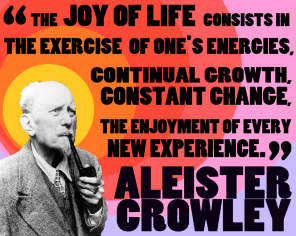
I personally believe that the Internet is a perfect medium to fulfill all 3 of these requisites for good promulgation. Facebook in particular is currently a medium that allows many people to not only see bits and pieces of the Law through quotations and images, but it also allows individuals to easily share these things to further promulgation. For example, the image that heads this essay was seen by over 10,000 different individuals in a single posting. It (1) used a powerful medium of Facebook that (2) reached over 10,000 people and (3) was a quotation that most people, even without any knowledge of Thelema or more technical subjects such as Magick or Qabalah, could appreciate. 

The potential reach of Facebook is actually fairly astonishing. To give an example, the “Aleister Crowley” Facebook page currently has an average weekly reach of around 45,000 individuals. That means that, in any given week, some post (whether text, link, video, or image) is seen on the News Feed of around 45,000 unique users. What other promulgation effort can reach 45,000 people every week? To continue with this example, any time that someone clicks “Like,” comments, or shares a post on the “Aleister Crowley” Facebook page, it can be seen by any of that person’s Facebook Friends. How many Friends of people who are “Fans” of this Facebook page are there? Over 24 million. Friends of these Fans can then click “Like,” comment, or share so the number of possible viewers is actually higher than 24 million. This is only a single Facebook Page (let alone all the others and people’s individual Facebook Profiles), and the numbers should, in my opinion, speak for themselves. Does it not say in The Book of the Law, “Success is your proof”? It is possible that this is, in fact, the largest and most widespread promulgation effort that Thelema has seen in its entire history. 

What do these efforts do that are beneficial toward the end of promulgating the Law?

  • Thousands of people will see content, whether a link to a full text or a quotation or whatever else, that they otherwise would not have seen or thought about.
  • Thousands of people who have never heard about Thelema or Aleister Crowley are given a chance to see a small bit of what the Law is about.
  • Thousands of people are given an opportunity to promulgate the Law themselves (who would often not do so otherwise) by spreading the content.
  • Everyone can choose whether to follow these Facebook pages, and they can choose to comment or share on them. It is, in a way, the pinnacle of promulgation as opposed to proselytization. No one is being forced to do or see or listen to anything.

Is this a replacement for people reading the source materials, engaging in their local communities, doing the practices of Yoga and Magick, and generally integrating the Law into their lives? Of course not. But neither is any other form of outreach, including the most beautifully bound and articulately written book. It is just as likely for someone to read an entire book on Magick and never perform a ritual as it is for someone to share a quotation on Facebook and not really integrate it into their lives.

We have no power to force Thelema on anyone: it is the Work of each individual to study, understand, and integrate it into their lives and no amount of work by other people can ever replace that. It never has and it never will. These Internet promulgation efforts simply give more and more opportunities for individuals to spread the Law to “people of all types” as Crowley wanted. It is, in a way, even more powerful than books because it is free, efficient, allows people to perpetuate the ideas with little to no effort, and can reach many individuals who would not otherwise have even heard of Crowley or the Law of Liberty. Also – although it may come as a shock or an insult to many Thelemites – not everyone is an intellectual who has time to read long, obtuse essays or books. Whether from lack of education, interest, or proclivity, there are many people – in fact, I would say most people – who are not bibliophile eggheads like myself (and many current Thelemites). “The Law is for all,” and that does not mean only bibliophile eggheads. 

Some people are concerned whether these Internet promulgation efforts have led to increased initiates at the local OTO body or even more Thelemites. At the core of this is a concern as to how much people are really integrating these ideas and putting them into practice. As I just said: it is the Work of each individual to study, understand, and integrate it into their lives and no amount of work by other people can ever replace that. More importantly, there is absolutely no way to ever know for sure. Aside from the fact that we don’t systematically ask every single new face at an event what specific things led to them showing up, there is also the fact that many people are not exactly sure, cannot remember, or do not even want to say (perhaps in part because of the chance of being met with sanctimoniousness!) There is also no way to know how these promulgation efforts affect existing members of organizations like OTO. I personally think that if some Facebook post got someone to think a little bit about Thelema that day, even if it is only for a few moments, then that is better than them not thinking about it. Perhaps they have never even encountered that particular link or quotation before. Further: Aside from organizations like OTO, there is absolutely no way to determine how this affects Thelemites (and non-Thelemites) who are not associated with any particular organization. 

In short, as I’ve already said, there is absolutely no way to ever know sure. What we do know is the incredible extent to which these Internet promulgation efforts have reached people in some way or another, Thelemite and non-Thelemite alike. It is a certain fact that “tens of thousands of people” (just as Crowley wanted) are seeing this content when they otherwise would not have seen it. The Book of the Law says, “and to each man and woman that thou meetest, were it but to dine or to drink at them, it is the Law to give. Then they shall chance to abide in this bliss or no; it is no odds.” Really, should we be concerned about whether or not other people are truly engaging with the material anyhow? Are we not affording individuals a “chance to abide in this bliss or no” and, whether or not they do anything at all with it, “it is no odds”? Isn’t the insistence that individuals do a certain thing or act in a particular way a fundamental breach of acknowledging “Do what thou wilt shall be the whole of the Law”? 

The Book of the Law says, “Success is thy proof: argue not; convert not; talk not overmuch!” Let’s engage in a little thought experiment: Consider the difference between (a) an individual who, for example, creates an image with a quotation about the Law and spreads it on Facebook versus (b) an individual who criticizes this effort. Person A is creating an opportunity or chance for someone to hear about the Law, think about the Law, and share the Law without any attempt to convert anyone (“Success is thy proof”). Person B is, first of all, reactive – they are setting the causal principle of their actions outside of themselves by re-acting instead of acting. Person B is arguing rather than spreading the Law (“argue not”), trying to enforce and impose their standard of how to behave as “a real Thelemite” on others (“convert not”), and are spending time and energy chastising others (“talk not overmuch”) instead creating their own material that would, obviously, be so much better. If 10,000 people see something about Thelema because of the posting of an image, how many people are really being reached through criticizing it? 

Fresh Fever From the Skies: The Collected Writings of IAO131While constructive criticism is always beneficial to honing the efficiency of an approach, there is a lot of criticism that is simply emotional and reactive (i.e. not constructive). There seem to be some people who, whether consciously or not, want to keep Thelema as a cloistered, elitist, and tiny clique. That is their prerogative – Do what thou wilt, of course – but I believe that I, along with tens of thousands of other people, are doing a lot of substantial work to spread the Law of Thelema to the rest of the world in accordance with the attitude of the Prophet (as seen in the quotations above). “The Law is for all” after all, and I say: If we truly believe that Thelema is the Law of Liberty – the Key to our evolution as individuals and a species – we should give as many people as possible the “chance to abide in this bliss or no.”

Love is the law, love under will.

IAO131 on Patreon

If you enjoy these writings, please consider pledging $1+ on my Patreon
Thelemic Mysticism

Thelemic Mysticism – part 4: Mysticism in Practice – The Lover

Thelemic Mysticism

[ ← Part 3: Mysticism in Practice – Intro & The Man of Earth ← |
Part 5: Mysticism in Practice – Crossing the Abyss & The Hermit → ]

PART 4: MYSTICISM IN PRACTICE – The Lover

2) The Lover: Communion with the Holy Guardian Angel

• “O my Lord, my beloved! How shall I indite songs, when even the memory of the shadow of thy glory is a thing beyond all music of speech or of silence?”
Liber Cordis Cincti Serpente sub figura LXV, II:48
• “And the Beloved shall abide with Thee.”
Liber Stellae Rubeae sub figura LXVI, line 32
• “He shall await the sword of the Beloved and bare his throat for the stroke.”
Liber Liberi vel Lapidus Lazuli sub figura VII, III:47

If one persists in the work of the first Stage, continuing one’s meditation/devotion with increasing fervor and dedication, one will inevitably come to this second Stage. The second Stage can be likened to the Grade of “Lover.” This is the middle of the Path where one communes with the Divine, the Absolute, the One, et cetera, as a Lover with the Beloved.

In Thelemic Mysticism, this Love or Communion is understood under the figure of “the Knowledge and Conversation of the Holy Guardian Angel,” and it is often symbolized by a heart encircled by a serpent or the Rose-Cross. This is appropriate to the Grade of “Lover” because this stage is often described as the meeting or union between Lover (the Mystic) and Beloved (the Object of aspiration); this is the “Spiritual Marriage” spoken of by many Mystics.

“Union”: It should be clearly understood that “union” has two related but distinct meanings that are often conflated.

1) Two united but distinct: At this second Stage of the Mystic Path, “union” refers to two things uniting but remaining distinct. In the language of Thelemic Mysticism, the Adept and the Holy Guardian Angel are united like lovers, they meet and interact and enjoy one another but they remain separate as Adept and Angel. “Love” requires the interaction and union of “Lover” and “Beloved,” though they are united. “Communion” may be a more accurate term. The persistence in this Love so that it becomes complete and perfect, so to speak, leads to the next stage.

2) Two united into One (or None) without distinction: In the third Stage of the Mystic Path (which we will explore later), “union” refers to these two things uniting so completely that there is a dissolution of separateness, leaving only One Thing (or “No-Thing”). “Absorption” or “annihilation” may be more accurate terms.

The distinction between these two notions of “union” is important because, as mentioned previously, they are often conflated by both readers and writers of Mysticism. For now, it should be understood that “union” in the second Stage of the Lover refers to the first definition, where two things are united that still remain distinct (soul & God, subject & object, ego & non-ego, et cetera).

The Nature of the Second Stage:

This second stage of the Mystic Path is often called Knowledge and Conversation of the Holy Guardian Angel in Thelemic Mysticism. In Christian Mysticism, it is often called “Illumination.”

“And again I was caught up into the presence of my Lord Adonai, and the knowledge and Conversation of the Holy One, the Angel that Guardeth me.”
Liber Cordis Cincti Serpente sub figura LXV, V:41

The primary characteristic of this Illumination is the distinct and immediate perception of the “presence” of the Divine (or God/Absolute/Lord/Truth, et cetera).

This “presence” is not a mere metaphor or artistic flourish: it is a distinct, direct, experiential certainty of the presence of the Absolute, though this is expressed in various ways by various Mystics. This distinct, direct, experiential certainty is one aspect of the “Sense of Objectivity/Reality” mentioned in the previous section on “Mysticism in Theory.

• “Even as evil kisses corrupt the blood, so do my words devour the spirit of man.
Liber LXV, I:14
• “I was stricken as a bird by the bolt of the thunderer; I was pierced as the thief by the Lord of the Garden.”
Liber LXV, IV:40
“All this while did Adonai pierce my being with his sword…”
Liber LXV, V:14

This “presence” is often felt as the Divine “intruding” into the consciousness, so metaphors often involve “piercing” and “penetrating.” The use of the metaphor of the Divine as the Bridegroom and the Mystic as the Bride consummating their Spiritual Marriage should therefore come as no surprise.

This “Spiritual Marriage” corresponds to the second step of concentration in the Hindu system of Yoga: dhyana. In the first step of Yoga, dharana, one concentrates all of one’s thought upon a single Object, and there is much difficulty; this corresponds with the first Stage of the Mystic Path, the Man of Earth. This second step of concentration is called dhyana. In this second Stage of the Mystic Path, the Lover, there come times where the “subject” appears to disappear and only the Object remains, often co-occurring with a sense of ananda  (bliss). Dhyana also can be felt as a union of subject and object but not a complete union where both are annihilated. Dhyana represents a powerful and distinct stage of meditation, that is often said to be a lesser form of Samadhi, the total union of subject and object that is the Goal of Mysticism, characteristic of the third Stage of the Mystic Path, the Hermit.

The are various secondary characteristics of this Illumination:

“Then the adept was rapt away in bliss, and the beyond of bliss, and exceeded the excess of excess. Also his body shook and staggered with the burden of that bliss and that excess and that ultimate nameless.”
Liber LXV, II:45-46

1) “Joy,” “bliss,” or “ecstasy”: Joy, bliss, and ecstasy are not the primary factors of Illumination, they are Illumination’s natural by-products. That is, they do not constitute Illumination itself, but they often accompany Illumination. Crowley often likens  Illumination to the union of chemical elements, which naturally gives off light and heat. The “union of chemical elements” is analogous to Illumination itself, while the “light and heat” refer to the joy, bliss, and ecstasy that are by-products of the union. This feeling is felt as a joy that transcends one’s normal likes and dislikes, one’s typical pleasures and pains. Conversely, many of the anxieties, worries, and fears that plague the Mystic will fall away or seem petty in contrast to this Mystic communion.

“Having attained the Knowledge and Conversation of the Holy Guardian Angel (by a male effort so to speak) the Adept becomes receptive, feminine, patient, surrendering his will wholly to that of his Angel… The aspiration towards Him is masculine. At the moment of achievement it is replaced by passivity…”
Commentaries to Liber LXV, II:45-46

2) Passivity: The Mystic will often feel a sense of “surrender” or “passivity.” The achievement of this Stage requires great will and endurance, but it culminates in a surrender of that will. This is the surrender of the “personal will,” the volition or will-power of the individual, which allows for the Divine Will to take its place; it is the difference between one’s personal wishes/whims and the True Will. This release of “personal will” is virtually universal across all Mystics, especially Christian Mystics. It is because of this “surrender” or “passivity” that the image of a virgin is often used to describe the Mystic at this point: the virgin is “pure” insofar as her desire is only for One Thing, the Object of the Mystic Goal. In Western terms, the “virgin” is chaste except for God, and she passively awaits the coming of the Lord, so to speak. In the New Aeon, we understand this Divine Will to be nothing other than our own True Will, a more perfect expression of ourselves, rather than being something from “outside” of the self. We might say, “Let Thy Will, which is mine, be done.”

• “Neschamah: This is the faculty of under-standing the Word of Chiah [True Will]. It is the intelligence or intuition of what Jechidah [True Self] wishes to discover about itself.”
Little Essays Towards Truth, “Man”
• “The intuitions of the Neschamah are guaranteed by interior certainty.”
Confessions, chapter 64

3) Increased intuition: The term “intuition” means many things, but it seems to be the best word to describe this sense. Upon achieving the Stage of Illumination, the Mystic may receive many intuitive glimpses, whether through dreams, fantasy, certain thoughts, visions, et cetera. These are distinct from the normal “conscience” that Freud describes as the “super-ego,” which is essentially that little voice in your head that tells you what is right or wrong based on what you have been taught by your family, peers, and society. These intuitions – sometimes heard as voices but not necessarily – are a “voice” that represents the promptings of one’s “deeper Self,” a truer, more holistic sense of Self represented by the Holy Guardian Angel in Thelema. One may also start to see the deeper, more symbolic meanings of things, perceiving “divine truths” in the most mundane affairs; psychologically, this relates to the fact that the Mystic has opened channels to her Unconscious mind, which innately perceives the various interconnections and relations between things just as the conscious mind sees their differences. In Qabalistic terms, this is the “Neschamah” (the “spiritual intuition” or “divine intelligence”) that is attributed to Binah on the Tree of Life.

“A Man who is doing his True Will has the inertia of the Universe to assist him.”
Magick in Theory and Practice, “Introduction and Theorems”, III:9

4) Flow: Related to passivity and increased intuition, there is often a sense that life “flows” much more freely and naturally. Things seems to fall into place without much or any effort. This is the result of “unifying the Will,” specifically the harmony between conscious mind and the Unconscious. The immense inertia that is felt in the first Stage, where one is fighting against the world and one’s lower nature, seems to temporarily give way to a sense that one is flowing with the momentum of the world.

“In this Light naught exists, for It is homogeneous: and therefore have men called it Silence, and Darkness, and Nothing. But in this, as in all other effort to name it, is the root of every falsity and misapprehension, since all words imply some duality. Therefore, though I call it Light, it is not Light, nor absence of Light. Many also have sought to describe it by contradictions, since through transcendent negation of all speech it may by some natures be attained. Also by images and symbols have men striven to express it: but always in vain.”
Liber CL: De Lege Libellum

5) Light: The metaphor of this stage is almost invariably one of Light, hence the name “Illumination.” This is sometimes literally perceived by the Mystic at the moment of Illumination. It sometimes involves blinding light or an increasing light like a “Golden Dawn.” The Light may also be used by some Mystics as a metaphor for their sudden sense of clarity, of seeing beyond the normal ego-self and perceiving a much greater “presence.” Sometimes the Light is used as metaphor for the joy/bliss/rapture itself. Sometimes the Light is a metaphor for the “Creative energy” with which one feels one is infused in this Illumination or Communion (or “Knowledge and Conversation”). Nonetheless, this Light – sometimes called LVX – is virtually always present in some form or another in this second Stage of “Illumination,” whether literal or metaphorical. This “Light” is one reason among many that this stage is typically related to Solar imagery; Qabalistically, this is Tiphareth on the Tree of Life.

“I was also granted what mystics describe as ‘the Beatific Vision’ which is the most characteristic of those attributed to Tiphereth, the archetypal idea of beauty and harmony. In this vision one retains one’s normal consciousness, but every impression of daily life is as enchanting and exquisite as an ode of Keats. The incidents of life become a harmonious unity; one is lost in a rosy dream of romantic happiness. One may compare it to the effect produced by wine on some people. There is, however, no unreality in the vision. One is not blinded to the facts of existence. It is simply that the normal incoherence and discrepancy between them has been harmonized.”
Confessions, chapter 78

6) Beauty: Typically, the Mystic will perceive a certain sense of beauty in all things. This is sometimes called the Beatific Vision by Crowley. The term “Beatific Vision” originally comes from Christianity, used by people like Thomas Aquinas, and it was used to refer to the immediate knowledge of God that souls enjoy in Heaven. The Mystic naturally and effortlessly sees the Divine permeating all things in the world. This is sometimes expressed as Unity-in-Diversity, where there are distinct things seen in the world but one intuitively grasps their underlying unity in the One/Absolute/God. This is often described by Christian Mystics as Earth being “transfigured” into a new Heaven, or Heaven (or “New Jerusalem”) descending to Earth, or realizing the Kingdom of Heaven is all around. As one example, Blake describes this Beatific Vision when he writes, “To see a world in a grain of sand, / And a heaven in a wild flower, / Hold infinity in the palm of your hand, / And eternity in an hour.” Similarly, Henry Vaughan wrote, “Each bush and oak doth know I AM.” One can see that Infinity is perceived, yet “Finity” or duality remains; there is still multiplicity but there is Unity perceived therein. Mystics who remain at this stage are typically pantheists, meaning they see all things as identical with God/Absolute and themselves as part thereof. If one persists to the third Stage, one comes to identity with the Absolute itself rather than being simply a part thereof.

Because many of these by-products of Illumination are overwhelming and enrapturing, the Mystic is liable think that this is the end of the Path. It is helpful to remember that this is only the middle pylon along the Path, and that the true Unitive Life has still not been achieved. This is why Crowley calls this stage “The Next Step” and not “The Last Step.”

“It is impossible to lay down precise rules by which a man may attain to the knowledge and conversation of His Holy Guardian Angel; for that is the particular secret of each one of us; a secret not to be told or even divined by any other, whatever his grade. It is the Holy of Holies, whereof each man is his own High Priest, and none knoweth the Name of his brother’s God, or the Rite that invokes Him.”
One Star in Sight

Uniqueness of this Experience: It should be noted that this particular Stage is often very personal and unique, regardless of the underlying unity of various Mystics’ descriptions.

The way in which one understands or perceives the Presence of this Mystic Object depends entirely on one’s own history, make-up, development, intelligence, and understanding. One may see this as becoming the Bride of Christ, and another may see this as being pierced by a Divine sword; one may see this as a blinding Light, and another as a joyful Darkness. One may see this as an obliteration of one’s reality, and another may see this as awakening to Reality.

To set up expectations as to what Illumination (or Knowledge and Conversation) may entail is, in a sense, an impediment to being open and surrendering to what truly is. The descriptions of these Mystic states are, therefore, simply to be used as guideposts along the Path, not as absolutes to construct an intellectual system around. The sole rule in all cases is “Invoke often.”

Perfection isn’t immediate: Even if one has experienced the most blindingly exalted and ultimate version of this Illumination, one is not suddenly purged of all “bad” qualities (meaning, in the New Aeon, all aspects of oneself that are detrimental to or inhibiting of the True Will).

Although some habits may be “blasted” out of one’s system by the Illumination, some habits remain or return shortly after the experience of Illumination. There is further work to align the various aspects of oneself – body, emotions, thoughts, desires, et cetera  – under the “guidance” of this Divine Presence, of the Holy Guardian Angel.

It is typical of a Mystic at this Stage to think that she will never again see herself as separate from the Divine, that she will always be one with her True Will, that she is perfected, but the time always comes where this Illumination slowly fades away. This is a “non-abiding” union, and one inevitably “comes down” from it. The “abiding union” comes if one persists to the third Stage of the Mystic Path.

One must therefore be always vigilant to bring oneself to live more and more in this Light of Illumination, continuing the work of Purification and Consecration until All is One.

The Work: To a Mystic that has achieved this second Stage of the Path and entered through the Middle Pylon of Illumination or the Knowledge and Conversation of the Holy Guardian Angel, there is still the final “crisis” of the Path. This final Crisis is known as the Crossing of the Abyss, the dissolution of a sense of a separate self, and a successful “Crossing” means that one has attained the third Stage of the Path.

“The Self surrendered must not be less than the All-Self; one must not come before the altar of the Most High with an impure or an imperfect offering. As it is written in Liber LXV, ‘To await Thee is the end, not the beginning.'”
Liber ABA: Book 4, Part II, chapter 6: The Wand

To Cross the Abyss, one must surrender all that one has and all that one is.  In order to surrender all that one has and is, though, one must first build oneself into a Whole.

If one has not performed the Purification of all “adverse” elements from oneself and Consecrated all other elements of oneself to one’s Single Goal, the surrender will not be complete or total. The Work of the Lover, after having achieved Knowledge and Conversation, is therefore one of Equilibrium: one must build up all opposites (or “complements”) within oneself to become Whole, not being attached or obsessed by anything incomplete or partial.

• “The Adept is not a perfection of what he feels to be the noblest part of him, but a Microcosm. He [must] complete the formation of himself as an image of the All.”
Commentaries to Liber LXV, II:45-46
• “For Perfection abideth not in the Pinnacles, or in the Foundations, but in the ordered Harmony of one with all.”
Liber LXI vel Causae, line 32
• “The microcosm is an exact image of the Macrocosm; the Great Work is the raising of the whole man in perfect balance to the power of Infinity.”
Magick in Theory & Practice, chapter 0: The Magical Theory of the Universe
• “[There is] the Necessity of extending constantly thy Nature to new Mates upon every Plane of Being, so that thou mayst become the perfect Microcosm, an Image without Flaw of all that is.”
Liber Aleph, ch. 44, “De Sapientia in Re Sexuali”
• “Imagine listening to Beethoven with the prepossession that C is a good note and F a bad one; yet this is exactly the stand point from which all uninitiates contemplate the universe. Obviously, they miss the music.”
Confessions, chapter 86

This Work of achieving Equilibrium or Wholeness of the self is the idea in Magick that is understood as becoming a perfect Microcosm of the Universe (or “Macrocosm”). This means that all aspects of the self must be balanced, especially the moral and intellectual aspects of the self. If one clings to the light and ignores the darkness, one is not equilibrated; if one clings to virtues and ignores vices, one is not equilibrated; if one clings to one belief and ignores its opposite, one is not equilibrated.

This is the reason that the “Higher Self” is a misleading term: this is often taken to mean that one’s “Higher Self” includes all of one’s best and noblest qualities elevated to the highest degree. In fact, one is seeking the Whole, both upright and averse, and not simply the Highest. 

This is what is generally said by Mystics to be the necessity of having a Love of All. This “Love” is not a sentimental or romantic kind of attitude which most people mean by the term. In the broadest sense, this Love is acceptance. In the emotions, a lack of Love or acceptance shows itself in the feeling of disgust.  This is why Liber LXV instructs us to “Go thou unto the outermost places and subdue all things. Subdue thy fear and thy disgust. Then—yield!” One must fully embrace all aspects of Nature, both the Nature of the Universe and one’s own Nature. The way to destroy demons is through Love.

This is the basic work of Equilibrium so that one may become a perfect Microcosm, the “All-Self,” in order that one may fully surrender all that one has and is. This why St. Francis of Assisi visited lepers, the sight of which disgusted him. This is why Buddhists meditate in the presence of decaying corpses. This is why Aleister Crowley deliberately ate Leah Hirsig’s feces to show he was indifferent to all material differences (Yes, that really happened). In short, we must confront everything that makes us squeamish, all that brings us a sense of disgust, all that we consider Evil… and unite with it in “love under will” so that no element of the Universe is not also part of ourselves. As perfect and complete microcosms of the Cosmos, we can then truly proclaim what is said in the Gnostic Mass, “There is no part of me that is not of the gods.”

Crowley lays out the essence this practice in Liber V vel Reguli when he writes, “The Magician should devise for himself a definite technique for destroying ‘evil.’ The essence of such a practice will consist in training the mind and the body to confront things which case fear, pain, disgust, shame and the like. He must learn to endure them, then to become indifferent to them, then to analyze them until they give pleasure and instruction, and finally to appreciate them for their own sake, as aspects of Truth. When this has been done, he should abandon them, if they are really harmful in relation to health and comfort.”

The Ordeal: The Ordeal of this Grade is a crucial one, known as the Crossing of the Abyss, and it will be discussed in the next section as the prelude to the third and final Grade or Stage of the Mystic Path.

← Part 3: Mysticism in Practice – Intro & The Man of Earth ← |
Part 5: Mysticism in Practice – Crossing the Abyss & The Hermit → ]