Author: IAO131

http://www.IAO131.com

Visions and Trances on the Path of Initiation (pt.2)

Qabalistic Map of Initiation

Do what thou wilt shall be the whole of the Law.

← Part 1  | → Part 3 → ]

Interlude: Visions of the Three Orders

The Three Orders on the Tree of Life

The Three Orders on the Tree of Life

The Tree of Life is often split into three different portions that correspond loosely (although not exactly) with the three Orders of systems like Golden Dawn and A∴A∴, the Hebrew parts of the Soul, and Tetragrammaton (YHVH):

  • The 3rd Order is in Malkuth (the 10th Sephirah). It corresponds with the Nephesh, or “Animal Soul,” in terms of the parts of the Soul, and it corresponds with the Final Heh of YHVH.
  • The 2nd Order is centered in Tiphareth (the 6th Sephirah) and encompasses the surrounding Sephiroth (Chesed, Geburah, Netzach, Hod, and Yesod). It corresponds with the Ruach, or the mind with its many faculties (e.g. memory, volition, reason, etc.), and it also corresponds with the Vav of YHVH.
  • The 1st Order includes the Supernal Triad of Kether, Chokmah, and Binah (the first three Sephiroth). It corresponds with the triad of the immortal Soul including Jechidah (the Individuality of Kether), the Chiah (the Life-Force of Chokmah), and the Neshamah (the Intuition of Binah). It also corresponds with the Yod and Heh of YHVH.

Each of the three Orders has a Trance that is characteristic of it: the 3rd Order has the Trance of Sorrow mentioned previously. The 2nd Order has Knowledge & Conversation of the Holy Guardian Angel in Tiphareth. The 1st Order has the successful crossing of the Abyss.

One could say that each of these Orders and their characteristic Trances is distinguished by a certain view of life while upon the Path of initiation:

  • 3rd Order: Man versus World. The world is seen as a force to be overcome, and it is full of sorrow, disappointment, stress, and failure. This is the Grade of Man of Earth, and it corresponds to the Trance of Sorrow.
  • 2nd Order: Man and World. The world is seen as harmonious where one is united constantly with various elements thereof, and it is full of beauty and a constant source of joy. This is the Grade of Lover, and it corresponds to Knowledge & Conversation of the Holy Guardian Angel.
  • 1st Order: Man is World. The duality or distinction between “self” & “not-self” or “ego” & “environment” or “subject” & “object” is completely dissolved: the union has become so full that there is no difference between self and other so all that is, is Unity. This is the Grade of Hermit, and it corresponds to the successful crossing of the Abyss.

Second Order Visions

There are Visions within each of the three Orders, but the Second Order has a series of Visions corresponding with each Sephirah that are all highly interrelated. These 2nd Order Visions are all centered around Tiphareth, and they all have to do with certain insights into the nature of the Cosmos. These Visions are:

  • Yesod: The Vision of the Machinery of the Universe
  • Hod: The Vision of Splendour
  • Netzach: The Vision of Beauty Triumphant
  • Tiphareth: The Vision of the Harmony of Things
  • Geburah: The Vision of Power
  • Chesed: The Vision of Love

We will go into each of these in more depth in the following sections.

2) Yesod (2°=9: Luna)

The Vision of the Machinery of the Universe

In 777, we can see that “The Vision of the Machinery of the Universe” is attributed to Yesod, the 9th Sephirah on the Tree of Life. It may also be called “The Vision of Change” or “The Vision of Stability in Change.” It is the first of several Visions that involves noetic insight into the nature of the Universe (the only previous Vision, the Vision of Adonai, deals with one’s personal pursuit of the Great Work rather than being an insight into the nature of the world).

First, some esoteric symbolism: The 9th Sephirah is called Yesod, which literally means “Foundation.” This term implies stability. Nonetheless, the Moon (also known as “Luna”) is attributed to Yesod and is characterized by its constant waxing and waning along with its effect on the constant ebb and flow of the tides: therefore, this implies constant flux or change. This Sephirah therefore contains both the ideas of stability and change. This is an esoteric way of pointing to the paradox which is often phrased as something like “Stability is Change and Change Stability” (Liber CL: De Lege Libellum). The final resolution of this antinomy or paradox is said to come in the 2nd Sephirah of Chokmah, which shows how Yesod is a reflection of Chokmah “on a lower scale,” so to speak. Esoterically, this can be seen in that the grade attributed to Yesod is 2°=9☐  and the grade attributed to Chokmah is 9°=2. This paradox has many levels of truth, but one of the most basic forms, appropriate to the “lower” sphere of Yesod, is the idea that “The Stability of the Universe is Change” (The Heart of the Master). Crowley writes further concerning this idea:

“Of all important doctrines concerning equilibrium, this is the easiest to understand, that change is stability; that stability is guaranteed by change; that if anything should stop changing for the fraction of a split second, it would go to pieces. It is the intense energy of the primal elements of Nature, call them electrons, atoms, anything you will, it makes no difference; change guarantees the order of Nature. This is why, in learning to ride a bicycle, one falls in an extremely awkward and ridiculous manner. Balance is made difficult by not going fast enough. So also, one cannot draw a straight line if one’s hand shakes.”
—Aleister Crowley, The Book of Thoth, “Small Cards”

Yesod: The Vision of the Machinery of the Universe

Yesod: The Vision of the Machinery of the Universe

With this in mind, the Vision of the Stability in Change is characterized by the perception that the Universe is a constant change or flux of all things. It is therefore equatable to understanding one of the Three Characteristics of Buddhism, that of anicca, the impermanence of everything. The self – considered as one’s mind and body – is an intertwined, constantly changing, and inseparable part of the whole. This is related to the Trance of Sorrow insofar as sorrow or dukkha stems from the fact that all things are subject to impermanence or anicca and therefore are ultimately insubstantial or unsatisfactory, yet this Vision differs from the Trance of Sorrow insofar as its focus is upon mutability, change, flux, and motion (anicca) rather than on sorrow and dissatisfaction (dukkha). As Crowley says above, this idea that everything is in flux is fairly easy to understand but, yet again, the intellectual comprehension of this idea is not the same as the Vision itself, where the fact of the impermanence of all things is known or felt or understood in the core of one’s being.

One meditation that resembles such a Vision is through the contemplation of the world as constituted by atoms: consider how everything you perceive, including your own body, is composed of atoms – the machinery of the universe, in a sense – that are swirling around at incomprehensible speeds. All the objects around you with their apparently motionless solidity are actually, when considered at the atomic level, in constant, unstoppable motion. Extend this idea to yourself, the objects around you, everything on earth, and everything in the universe. Consider how all of this perpetual flux interacts and intertwines with itself in such a perfect fashion as to create what we know as the Universe, from the most basic rock to the most elaborate technology, from the most basic amoeba to the most complex pattern of neuronal firings and structure of the human brain. In this way, we come to peer into the Machinery of the Universe, perceiving that “The Universe is Change” (The Heart of the Master) and that the structure of the Universe is a result of it.

3) Hod (3°=8: Mercury)

The Vision of Splendor

In 777, we can see that “The Vision of Splendour” is attributed to Hod, the 8th Sephirah on the Tree of Life. The planet Mercury is attributed to this sphere, and Mercury is generally associated with things like communication, language, knowledge, and intellect.

Hod: The Vision of Splendor

Hod: The Vision of Splendor

In a way, the Vision of the Machinery of the Universe in Yesod is the foundation (pun intended) of the next few visions that all developments or even reactions to it. In perceiving the Universe as constant flux, one is struct by the wonder and glory that things are constituted in this way. The mind boggles in amazement at the sheer complexity, intricacy, and even strangeness that the world works. It is, in a way, a Vision of intellectual awe. The Vision of Splendor is characterized by the mind becoming awe-stricken and enraptured by the sheer wonder and splendor of the Nature of the Universe.

Just as a scientific contemplation was used in the previous section to attempt to approximate the nature of the Vision, various scientists have spontaneously or naturally attained the Vision of Splendor – or some form thereof – through their understanding and contemplation of the Universe. A classic example is the well-known scientist Carl Sagan who was famous for instilling a sense of awe and wonder about the Universe. He wrote in Pale Blue Dot, “How is it that hardly any major religion has looked at science and concluded, ‘This is better than we thought! The Universe is much bigger than our prophets said, grander, more subtle, more elegant?’ Instead they say, ‘No, no, no! My god is a little god, and I want him to stay that way.’ A religion, old or new, that stressed the magnificence of the Universe as revealed by modern science might be able to draw forth reserves of reverence and awe hardly tapped by the conventional faiths.” Other examples include the biologist Richard Dawkins who wrote in Unweaving the Rainbow, “The feeling of awed wonder that science can give us is one of the highest experiences of which the human psyche is capable.” Another example is the astrophysicist Neil Degrasse Tyson who has said, among other things, “I know that the molecules in my body are traceable to phenomena in the cosmos. That makes me want to grab people on the street and say: ‘Have you HEARD THIS?'” These are, in a way, all expressions of the Vision of Splendor.

In this, we can see that the Vision of Splendor is like what Crowley calls “The Trance of Wonder,” at least on a “lower scale.” In speaking about this Trance of Wonder, Crowley writes:

“In all Trances of importance, and most especially in this, the Postulant should have acquired the greatest possible knowledge and Understanding of the Universe properly so called. His rational mind should have been trained thoroughly in intellectual apprehension: that is, he should be familiar with all Science. This is evidently impossible on the face of it; but he should aspire to the closest approximation to perfect Adeptship in this matter. The method most possible is to make a detached study of some chosen branch of Science, and a general study of epistemology. Then by analogy, fortified by contemplation, a certain inner apprehension of the Unity of Nature may grow up in the mind, one which will not be unduly presumptuous and misleading.”
—Aleister Crowley, Little Essays Toward Truth, “Wonder”

Crowley himself therefore saw the importance of an understanding of Science and its relationship to aiding in the attainment of Trances or Visions. This Vision of Splendor corresponding to Hod – the sphere of intellect, science, communication, mathematics, et cetera – shows that this Vision corresponds to a somewhat intellectual nature insofar as the mind is stricken with wonder and awe at the composition, patterns, and flux of the Universe. It is, in a way, the intellectual complement to the Vision of Beauty in Netzach that is similar but of the nature of aesthetics or emotion.

4) Netzach (4°=7: Venus)

The Vision of Beauty

Netzach: The Vision of Beauty

Netzach: The Vision of Beauty

In 777, we can see that “The Vision of Beauty” or “The Vision of Beauty Triumphant” is attributed to Netzach, the 7th Sephirah on the Tree of Life. The planet Venus is attributed to this sphere, and Venus is generally associated with things like sensuality, physical beauty, aesthetics, love, and devotion.

This Vision of Beauty must be distinguished from the “Beatific Vision” that is attributed to Tiphareth, for “beatific” implies holy bliss rather than the aesthetic beauty that is characteristic of this Vision of Beauty in Netzach. Just as the Vision of Splendor mentioned previously is an appreciation of the Nature of the Universe in terms of intellectual awe and wonder, the Vision of Beauty is characterized by the aesthetic appreciation and emotional rapture that results from a contemplation of the Nature of the world.

Specifically, this Beauty is not limited to what we normally consider as “beautiful” as opposed to “ugly,” but – instead – this rapture or Vision of Beauty includes absolutely all things in the cosmos from the smallest to largest, the lowest to the highest, the most peaceful to the most turbulent, the ugliest to the most beautiful. Crowley writes of this very idea when writes, “The New Aeon proclaims Man as Immortal God, eternally active to do His Will. All’s Joy, all’s Beauty; this Will we celebrate” (New Comment to Liber AL, II:35). Or: “All is a never ending Play of Love wherein our Lady Nuit and Her Lord Hadit rejoice; and every Part of the Play is Play. All pain is but sharp Sauce to the Dish of Pleasure; for it is the Nature of the Universe that hath devised this everlasting Banquet of Joy” (Liber Aleph). Or when he writes:

“The artist is he who can discover Beauty in all things, for nothing is common or unclean; and by unvarying determination to discover beauty man comes to the heaven of the artist. By beauty, moreover, We mean not any conventional type of sensuous beauty: it lies in the dwarfs of Velasquez and the monsters of Rabelais as in the women of Titian and the heroes of Homer; nor shall one brother do otherwise than lament if he be so limited in vision that he cannot see beauty in that which enchants another.”
—Aleister Crowley, Liber CXXIV: Of Eden and the Sacred Oak

This Vision of Beauty is therefore where we enraptured with beauty, “perceiving Beauty in the Harmony of the Diverse” (Liber Aleph), which is the emotional-aesthetic complement to the mental-intellectual Vision of Splendor that is based on the mind being bewildered by awe and wonder from contemplating the Universe.

[← Part 1  | → Part 3 →]

Love is the law, love under will.

Visions and Trances on the Path of Initiation (pt.1)

Qabalistic Map of Initiation

Do what thou wilt shall be the whole of the Law.

0) Introduction

In the Western tradition, the path of initiation (also known as “the Great Work”) is often laid out symbolically as “climbing” the Tree of Life from the bottom back to the top. While the map is not (nor can ever be) the territory, this map of the Tree of Life can be very useful to help elucidate the stages of the Path. The different “grades” of the Path are attributed to the different spheres or “Sephiroth” of the Tree of Life and can be characterized, to a certain extent, by the Qabalistic attributions of that Sephirah.

The Importance of Trances

If one is truly walking on the Path, one will not simply be able to pass simple tests of physical ability and mental knowledge. While these things are assuredly part of the Path and necessary thereto, real progress on this Path can be seen in changes of consciousness or the acquisition of new perspectives. Therefore, one of the indicators of having “achieved” a grade in an informal sense (i.e. outside of the rules of attaining a grade in any particular formal organization such as Golden Dawn or A∴A∴) is the attainment of a Vision and/or Trance characteristic of that grade. The importance of these Trances is stated clearly by Aleister Crowley:

“The word Trance implies a passing beyond: scil., the conditions which oppress. The whole and sole object of all true Magical and Mystical training is to become free from every kind of limitation… every Magical Operation soever is only complete when it is characterised (in one sense or another) by the occurrence of Trance.”
—Aleister Crowley, Little Essays Toward Truth, “Trance”

Definitions of Trance and Vision

Trance: A Trance is therefore an event within consciousness where one transcends the normal state of awareness, often in a “quasispasmodic” manner – that is, Trances are often (though not always) entered somewhat suddenly and the entering into Trance often comes at an unknown time. Samadhi can be seen as a special form or type of Trance characterized by “the supersession of dualistic human consciousness by the impersonal and monistic state” (Little Essays Toward Truth, “Trance”). A Trance is not necessarily in line with – and often in contradiction to – rational thinking: Samadhi is a characteristic example where whenever someone speaks about its nature they speak in paradox and contradiction. Trances are also characterized by their noetic nature – that is, they grant a felt sense of interior certainty regarding the truth of its content.

Vision: A Vision might be defined as a lesser form of Trance, where the acquisition of a new point-of-view or perspective does not necessarily require entering into a different state of consciousness, but it is still characterized by being noetic (i.e. granting a sense of interior certitude). Therefore, this distinguishes this definition of Vision from “astral visions,” which are not necessarily noetic in nature but may contain instances of Trance or Vision within them. It must also be stated that, although the term “Vision” implies sight, it really refers more to a particular type of experience or insight rather than being a series of visual sights, whether physical or mental (or astral). It is similar to the term “visualization” in occultism, which is often taken to mean focusing on visual images in the imagination but actually, in practice, refers to imagining things pertaining to all senses. Trances and Visions can therefore be distinguished from mere intellectual apprehension, for something can be intellectually grasped but not truly understood and felt as a certainty. To move beyond intellectual apprehension, one usually needs to have an experience for oneself that confirms the original idea but grants it a subject sense of truly “grasping” the idea or truly understanding it. As an illustration: a child might be told “you need to listen more carefully to others!” and grasp the idea intellectually, but not truly understand it. It requires the child having an experience – e.g., missing something important because of not listening carefully – to move from intellectual comprehension to real, certain understanding.

These definitions are not absolute, and there are blurry areas. People – including Crowley – often use these terms interchangeably. The main point is that Trance and Vision are states of consciousness that differ from normal, waking awareness and are characterized by (a) being noetic (felt sense of interior certitude) and (b) attaining a new point-of-view or perspective. This distinguishes them from both “astral visions” (both waking and dreaming) as well as from mere intellectual comprehension. The very fact of having attained a Trance or Vision inherently shows progress upon the Path insofar as they, by definition, imply a change within the individual – a shift of perspective or consciousness – whereas having an astral vision or intellectually grasping something do not necessarily imply any kind of real change in the individual at all.

We can now start to look at the various Trances or Visions in the context of the Tree of Life. Although the metaphor of “climbing the Tree of Life” implies that these steps are sequential, I believe that most of these Trances or Visions may happen at any time (depending on the right circumstances and intent), some may happen before others, some may even at the same time as others, and some may occur multiple times. There is no real test as to whether another person has attained any of these Trances or Visions, as tests must inherently be physical or intellectual, and I believe we all know that anyone can enter into a Yogic asana (physical) or say they are a Master (intellectual) but not actually be a Master at all. Therefore, this essay is intended to serve as a map for oneself – a kind of periodic table of Visions and Trances – both to show the possibilities of these Trances or Visions as well as to help understand various experiences that one may have had in the past or will have in the future (or perhaps presently if the reading of this essay somehow sends one spasmodically into a Trance – I wouldn’t exclude the possibility a priori!)

1) Malkuth (1°=10: Earth)

The Trance of Sorrow

The first Sephirah we encounter when “climbing the Tree of Life” is the 10th Sephirah that is called “Malkuth” (literally, “Kingdom”). We may attribute the Trance of Sorrow to Malkuth. The Trance of Sorrow may be defined as the Trance wherein one perceives that any and every endeavor, accomplishment, joy, connection, et cetera are ultimately insubstantial and will therefore eventually dissolve or end; essentially the Trance of Sorrow is where one realizes that nothing whatsoever lasts.

We may understand “Sorrow” as being a translation the Buddhist term dukkha, which is often translated as “suffering” (or “sorrow,” “misery,” “discontent,” “stress,” “dissatisfaction,” “anxiety,” etc.). In this way, the Trance of Sorrow represents an experiential understanding and appreciation of the First Noble Truth, which can be stated in many ways but ultimately means that “All things contain or are subject to suffering.”

The Trance of Sorrow helps to illustrate two points mentioned previously. Firstly, the “Trance of Sorrow” is called such by Crowley throughout his works, yet it is called the “Vision of Sorrow” in 777 and the “Vision of Universal Sorrow” elsewhere. This illustrates the point that “Trance” and “Vision” are terms that are often used interchangeably: one should not get too caught up in the words. Secondly, the Trance of Sorrow is a good example of how Trance is different from mere intellectual comprehension. One may intellectually grasp what has been said above – one may have previously encountered the First Noble Truth of Buddhism and grasped the idea being conveyed – yet the Trance of Sorrow goes beyond mere comprehension to a felt sense at the core of one’s being. The Trance involves an encompassing and even overwhelming sense of sorrow, dread, and even hopelessness. Although one can reach the Trance through intellectual contemplation, the Trance itself shows when this felt sense of certitude kicks in and one truly experiences the idea not merely as an idea but as an inescapable truth. A certain poetic explanation of this state can be found in Crowley’s “One Star in Sight” which begins with the lines, “Thy feet in mire, thine head in murk, / O man, how piteous thy plight, / The doubts that daunt, the ills that irk, / Thou hast nor wit nor will to fight— / How hope in heart, or worth in work? / No star in sight!”

To go further into the nature of the Trance of Sorrow: Nothing whatsoever lasts. You will inevitably die. Your family will die, your loved ones will die, your friends will die, your enemies will die, and all the people you’ve never known will all die: everyone will die. Every place you have been will change and pass away. The cycle of Life never stops; the Wheel of Samsara will never stop turning. Everything you know will eventually transform and perish.  The greatest joy and happiness you ever will achieve will eventually pass. No food, drink, idea, love, or anything else will ever truly satisfy you. Everything that you are striving for – all of your hopes, goals, and ambitions – will either remain unaccomplished or will be accomplished but will not last for long. No job lasts forever, no art piece lasts forever, no political change lasts forever, et cetera. Even if you were to become the most powerful and famous person on Earth, your memory will be distorted throughout time and eventually forgotten. If not within a few years, then it will happen in a few centuries; if not in a few centuries, it will happen when the human race no longer exists. While we may already know this to some extent and while one may grasp this idea while reading this essay, the Trance of Sorrow begins when it is truly felt and understood on a deep level that shakes the core of one’s very being.

In a sense, this Trance is one of the most crucial of all, for it is the Trance that leads one to tread the Path of the Great Work in the first place. Striving to attain the Light requires the acknowledgment that one is in Darkness. If one is completely content with oneself and one’s surroundings, there is no need to change anything or attain anything: this is the inertia of ignorance. Thus it has been said by Aleister Crowley that, “The Aspiration to become a Master is rooted in the Trance of Sorrow” (Little Essays Toward Truth, “Sorrow”) and also, “It is the Trance of sorrow that has determined one to undertake the task of emancipation. This is the energising force of Law; it is the rigidity of the fact that everything is sorrow which moves one to the task, and keeps one on the Path” (Eight Lectures on Yoga, “Niyama”). It is when one enters into this Trance that one determines to find a way to transcend it: one seeks to be liberated from the Wheel of Samsara in terms of Eastern phraseology; one seeks to find one’s immortal soul that is not subject to change, death, and sorrow in terms of Western phraseology. As Crowley once put it, one determines to enter upon the Path of “the Great Work, understanding thereby the Work of becoming a Spiritual Being, free from the constraints, accidents, and deceptions of material existence” (Magick in Theory & Practice, “Introduction and Theorems”).

As somewhat of a sidenote: In 777, the “Vision of Sorrow” is attributed to the 3rd Sephirah, Binah, and not the 10th, Malkuth. There is, in many ways, a resonance or harmony between Binah and Malkuth: they are both attributed to Heh’s in YHVH (the first Heh is attributed to Binah, the Mother, and the second or final Heh is attributed to Malkuth), and Malkuth is called the Daughter that is uplifted to the throne of Binah, the Mother (As in the 4th Aethyr of The Vision and the Voice, “And this is that which is written: Malkuth shall be uplifted and set upon the throne of Binah”). This shows that, although they are not the same, the Trance of Sorrow of Malkuth is related or harmonious with a Trance or Vision that is characteristic of Binah. In a sense, it is the Trance of Sorrow in Malkuth that gives one the impetus or motive to tread the Path of the Great Work that leads eventually to “crossing the Abyss” and landing in Binah as a Master of the Temple. To make the distinction clear, the Trance of Sorrow in Malkuth involves perceiving the insubstantiality or unsatisfactoriness of all phenomena and is therefore within the realm of duality; Binah is above the Abyss and therefore beyond duality and so not subject to “facts” or “rules” of the realm of duality. To distinguish between the two, the Trance related to Malkuth is called the “Trance of Sorrow” whereas that related to Binah is the “Trance of Compassion.” We should not get too far ahead of ourselves, though. The Path is tread step by step, and one should always seek to take the Next Step: first things first.

The Vision of Adonai / The Vision of the Holy Guardian Angel

The other Trance or Vision is called “The Vision of Adonai” or “The Vision of the Holy Guardian Angel.” Adonai is a name for God or the Lord that comes from Hebrew, and The Holy Guardian Angel is often called Adonai (for example, it is repeatedly named “Adonai” in Liber LXV, a Holy Book of Thelema). Again, it is not useful to get caught up in names: the point is that “The Vision of Adonai” and “The Vision of the Holy Guardian Angel” are two names for the same Vision.

Malkuth: The Trance of Sorrow & The Vision of Adonai

Malkuth: The Trance of Sorrow & The Vision of Adonai

The Vision of the Holy Guardian Angel is characterized by a certain awareness or perception of the Goal of the Path of the Great Work. One may get a glimpse of a certain state of consciousness that transcends the sorrow of duality, or one may even meet an aspect or form of Adonai in an astral vision or dream. Within the world of Darkness and sorrow, one catches sight of a Star that gives direction and hope: there is now “one star in sight.” In a way, the Vision of Adonai is a sort of answer to the Trance of Sorrow. Although one does not transcend the Trance of Sorrow, this Vision gives one the hope or notion of the possibility of transcending it. The Trance of Sorrow is the gravity that pulls one onto the Path that starts at Malkuth and the Vision of Adonai is the force that propels one forward to begin the climb upwards (so to speak).

To be clear: The Vision of the Holy Guardian Angel that is attributed to Malkuth is different from Knowledge and Conversation of the Holy Guardian Angel, which is attributed to Tiphareth (the 6th Sephirah). An analogy from the Golden Dawn may be useful to help explain. In the first initiation of the Hermetic Order of Golden Dawn, the “Neophyte” ritual, one is blindfolded to symbolize the darkness of ignorance. Eventually, the blindfold is removed and one is met with the sight of the Hierophant who symbolizes the Higher or True Self of the candidate. Crowley wrote:

“[The Adept] acclaims his Angel as ‘Himself Made Perfect’; adding that this Individuality is inscrutable and inviolable. In the Neophyte Ritual of G[olden] D[awn] the Hierophant is the perfected Osiris, who brings the candidate, the natural Osiris, to identity with himself. But in the new Aeon the Hierophant is Horus, therefore the Candidate will be Horus too.”
—Aleister Crowley, Liber Samekh, Point II, Part A, line 5

That is, one is given a glimpse of the goal – the True Self with whom one must become united and identified – but one has not yet attained thereto. As it is said, “the End of the ‘Path of the Wise’ is identity with Him” (“Temple of Solomon the King” in Equinox I:1). This shows how Malkuth reflects Kether in a sense (just as the grade 1°=10 has both the number of Kether,1, and Malkuth, 10), for the Goal can be grasped at the beginning of the Path, although one’s understanding of it is inherently limited by ignorance and misconception. One therefore sets upon the path to reach the Sun (the Sun or Sol is attributed to Tiphareth, the sphere where Knowledge and Conversation of the Holy Guardian Angel is attained, which is Kether “on a lower scale,” so to speak): the star is in sight and one is determined to reach it. When one has experienced the Trance of Sorrow and been granted the Vision of Adonai, one may truly be called a “neophyte,” a newly planted seed that may one day, if cultivated carefully and consistently, grow into a Flower of Truth.

→ Part 2 → ]

Love is the law, love under will.
IAO131 on Patreon

If you enjoy these writings, please consider pledging $1+ on my Patreon

Liber LXV parables

The Parables and Lessons of Liber LXV (part 7)

Liber LXV: The Heart Girt with a Serpent

The Parable of the Waters, the Priest, and the Pyramid

Also I heard the voice of Adonai the Lord the desirable one concerning that which is beyond. Let not the dwellers in Thebai and the temples thereof prate ever of the Pillars of Hercules and the Ocean of the West. Is not the Nile a beautiful water?Let not the priest of Isis uncover the nakedness of Nuit, for every step is a death and a birth.The priest of Isis lifted the veil of Isis, and was slain by the kisses of her mouth. Then was he the priest of Nuit, and drank of the milk of the stars. Let not the failure and the pain turn aside the worshippers. The foundations of the pyramid were hewn in the living rock ere sunset; did the king weep at dawn that the crown of the pyramid was yet unquarried in the distant land?

Liber LXV, V:48-51

This is the second Parable dealing with the Next Step, which refers to the next step in humanity’s spiritual evolution. This should be read in conjunction with “The Parable of the Dolphin and the Harper which deals with a similar subject but has a different lesson. This Parable actually contains three separate Parables all combined together, all relating similar and interconnected lessons regarding the Next Step.

Also I heard the voice of Adonai the Lord the desirable one concerning that which is .”

This Parable begins with the Adept hearing the voice of God, i.e. “Adonai the Lord,” about attainment. “That which is beyond” refers to that which is beyond all images specifically, for the final attainment is beyond all names and forms and images. There is an explicit reference to this same idea earlier in Liber LXV when it is written, “Debate not of the image, saying Beyond! Beyond!”1 It is also referenced later in Liber LXV where it is written that Adepts “beheld not God; they beheld not the Image of God; therefore were they arisen to the Palace of the Splendour Ineffable.”2 Crowley comments on this line, “This passage is simple instruction. It should be read in connection with Cap: I, v. 9 [which has already been referenced] and similar texts where there is question of ‘that which is beyond.’”3

Crowley very explicitly comments about the relation of this line to the idea of the Next Step and it is worthwhile to quote in full:

I am told here that my Mission to Mankind concerns the Next Step on Jacob’s Ladder of the Spiritual Ascent of the Race. They must progress in a sane and orderly manner, not soaring Icarus-like toward ill-defined perfections like Nibbana, but In my experience, I have found this error to be the most dangerous to which really promising young Magicians are liable; while making any progress at all.” 4

Crowley informs us that his Mission or True Will is to bring humanity to the Next Step in its spiritual evolution, “the Next Step on Jacob’s Ladder of the Spiritual Ascent of the Race”5 as he puts it. The main idea is that we are to take the Next Step – “progress[ing] in a sane and orderly manner”6 – rather than focusing on the end goal or the “Last Step” – “not soaring Icarus-like toward ill-defined perfections like Nibbana.”7 Icarus’ folly was to fly too high and too close to the Sun before his wings were adequately fashioned for such heights. This same idea is conveyed in “The Parable of the Dolphin and the Harper” where the “harper” or initiator must guide the initiate based on their level of spiritual progress, bringing them step by step to further progress rather than simply giving the end goal as the only worthy attainment (which Crowley often likens to trying to attain Nibbana/Nirvana or Samadhi without having been adequately instructed in the necessity of basic practices such as the steadying of the body, breath, and mind). Crowley comments that aspirants should progress “steadily and critically using their existing faculties to the best advantage, fulfilling each function adequately, accurately, with intelligent aspiration, not shirking the hard work of evolution, not trying to run before they can walk, making sure of every step as it is taken, and fortifying each position as it is won before proceeding to attach the next line of entrenchments… In my experience, I have found this error to be the most dangerous to which really promising young Magicians are liable; while making any progress at all.”8

The main point is that one should progress slowly, for if one tries to get to the end without taking the proper precautions there will be inevitable ruin. We can see that Crowley attempted to create such a step-by-step system in the Order known as the A∴A∴ where aspirants progress steadily through various grades, each with their own set of practices and goals.

“Let not the dwellers in Thebai and the temples thereof prate ever of the Pillars of Hercules and the Ocean of the West. Is not the Nile a beautiful water?”

God now gives the Adept the first parable that counsels to work towards practical goals Liber LXV parable of the Watersrather than ones that are ambiguous, ideal, and far-off in the distance. Those who dwell in “Thebai” or Thebes are close to the Nile. The “Pillars of Hercules” refers to the Strait of Gibraltar that separates Europe and North Africa, and the “Ocean of the West” refers to the Atlantic Ocean. This is essentially saying that those who dwell in Thebes by the Nile shouldn’t “prate” or talk foolishly about distant waters, for the Nile is closeby and is “a beautiful water.” The general idea is that one should work with the real, the practical, and the immediate rather than what is ideal and distant. Crowley’s comment to this line begins with, “Cf. Cap: II, vv.37-44,”9 which is a direct reference to the Parable of the Dolphin and the Harper that gives a similar lesson.

Crowley goes on to give several ways of saying the same thing when he comments, “A bird in the hand is worth two in the bush. Take care of the pence and the pounds will take care of themselves. Those who despise detail are eventually destroyed by these vary things which they thought trivial; and their discomfiture and disgrace are all the more humiliating. Lord Nose-in-the-Air stumbled over his own door-stop.”10 Again, the idea is to focus on the immediate rather than the abstract goals such as Nirvana or Samadhi. Crowley makes this analogous to the steady, systematic progress through A∴A∴, as previously mentioned. Doing otherwise is symbolically attempting to form the capstone of the Pyramid of Initiation without having built its foundations for it to rest upon. Crowley further comments on this line, “Living in Thebes, seek your water in the Nile instead of wasting your time in vast vague vapourish vagaries about the Atlantic. In Plain English, follow out precisely and patiently the systematic course of Initiation prescribed by the A.A∴. Be THOROUGH.”11

“Let not the priest of Isis uncover the nakedness of Nuit, for every step is a death and a birth. The priest of Isis lifted the veil of Isis, and was slain by the kisses of her mouth. Then was he the priest of Nuit, and drank of the milk of the stars.”

The same idea is given in a related but distinct set of imagery; this is the second part of the parable that deals with similar and interconnected lessons regading the Next Step. The basic idea remains that one must experience the ordeals and do the work of one’s grade, not seeking to jump ahead. In regards to Isis and Nuit, “Isis” is the same thing as “Nuit” but on a “lower plane”; as Crowley comments, “Isis [is] a ‘Lower’ manifestation of the principle Yin than Nuit is”12 meaning they are both expressions of “Yin” or the feminine, passive, dark side of things (as opposed to “Yang”), but Nuit is a “higher” or more abstract expression thereof. Esoterically, Isis refers to the 3rd Sephirah of Binah on the Qabalistic Tree of Life while Nuit refers to the Negative Veils (often attributed to the number 0) on the Tree of Life.

Crowley comments, “Every incident in life is of combined importance. No man can afford to lose the experience proper to his actual stage of initiation.”13 That is, one must work within one’s current grade or stage of initiation; for example, one should not seek to do the work of a Zelator, the 2nd grade of A∴A∴, (or Magister Templi, one of the final grades of A∴A∴, etc.) when one is a Neophyte, the 1st grade of A∴A∴. If one is a Neophyte, every incident in your life is proper to your stage of initiation, and to do the work of another grade or aim at a goal beyond the immediate is to “lose the experience proper” to your current stage. If one “soars Icarus-like,” seeking to do the work of a Magister Templi when one is a Neophyte (to continue the example), there will be failure and ruin. An example of this is of Frater Achad (or Frater O.I.V.V.I.O.) took the Oath of the Abyss, which because of “his ignorance of the details of the intermediate Grades, led him constantly into the most deplorable errors, from the devastating penalties of which he was saved by the loving vigilance of his Superior in the Order, at least insofar as the more critical catastrophes were concerned.”14

Overall, the specific lesson of this second parable regarding the Next Step is that one must first work with the Lower (Isis) before the Higher (Nuit), and that by working with the Lower one will naturally come to the Higher.

“Let not the failure and the pain turn aside the worshippers. The foundations of the pyramid were hewn in the living rock ere sunset; did the king weep at dawn that the crown of the pyramid was yet unquarried in the distant land?”

This is the third part of the parable dealing with the Next Step. On the path of initiation, there is inevitably much failure and pain, but we are counseled to not let these things turn us aside from our work. Crowley comments, “The Parable of the Pyramid requires no commentary: it is as lucid as it is sublime.”15 While this may be so, it can’t hurt to give a brief commentary thereupon.

Firstly, the pyramid is a common symbol of initiation, both because it requires careful building and because the tomb inside is often related to the process whereby one’s ego is dissolved in love, which is often given under the figure of draining out one’s blood or individuality into the Cup of Babalon. Esoterically, the “City of the Pyramids” refers to the 3rd Sephirah on the Qabalistic Tree of Life, Binah, to which is attributed Babalon and the grade of Magister Templi. The parable explains that the stones used to build the base or “foundation” of the pyramid were fashioned by sunset. The foundation of the pyramid represents the basic practices required to “fashion” the mind and body into adequate tools and vessels for the Great Work; this “foundational” work cannot be ignored, which is the basic message permeating all three of these parables. “Sunset” implies the end of a period of work, and the next line is a rhetorical question implying that the king who oversees the construction of the pyramid does not weep because the top of the pyramid or the “crown” is still not fashioned. Again, the point is that one must work from the bottom up, starting from the beginning and working progressively and systematically toward the end, learning to walk before one runs. Even if one goes for a long period working only on the foundational, fundamental practices of Magick and Yoga (including things like the Lesser Ritual of the Pentagram and Asana, respectively), one should not be turned aside by not having achieved the supreme attainments after all of this work. The “failure and pain” that are inevitable from these practices refers to the fact that, in working at these practices, we are going to fail and suffer physical and spiritual pain. We are going to not be able to sit in Asana for as long as we thought we could, our bodies may ache and be sore from meditating, we are going to have days where the pangs of hopelessness and fruitlessness plague our souls, we are going to have times when our rituals seem to be rote repetition, we are going to have times when the whole Path of the Great Work is called into question. The lesson is to acknowledge these things, learn from them, and not let them turn us from the Path. If we fail, we affirm that next time we will fail a little bit better. If we have pain, we affirm it as part of the Path, and use it to further our work with increased intensity.

Crowley comments, “There is yet a third consideration to be made in connection with this doctrine of The Next Step. It does in fact seem far easier to wander in the Wonderland of the Supernal Triad than to dig one’s way painfully through the Path of Tau, to make the Renunciation of a Dhamma-Buddha than to acquire Asana by dint of Anguished application and acutest agony…”16 The “Wonderland of the Supernal Triad” refers to the first three Sephiroth on the Tree of Life: Kether, Chokmah, and Binah. The “Path of Tau” is the path leading from the last Sephirah, Malkuth, to Yesod and is considered the first “Path” one has to take in climbing the Tree of Life, which is one symbolic metaphor for the path of initiation. “To make the Renunciation of a Dhamma-Buddha” refers to taking the Bodhisattva vow whereby one swears to obtain the virtues of a Buddha, and “acquir[ing] Asana by dint of Anguished application” refers to the practice of sitting in a meditative posture without moving for prolonged periods. The implication in both cases is that it is easier to speak about and pretend to be a High Initiate rather than doing the very basic, often arduous work of basic practices as represented by the Path of Tau, the first path that one must cross in the system of A∴A∴, and practicing Asana, the first practice one must begin to master in meditation.

Crowley continues, “But this is a ‘damnable heresy and a dangerous delusion’ arising from the simple fact that nobody can possibly form any idea soever of the Nature of the Task of any grade beyond his own – and I say this with every emphasis, despite by devotion and determination to describe the details of the Path of the Wise – even being at the pains of inventing what is practically a new language for this very purpose. Unless the Aspirant fully comprehend and freely acquiesce in this inherent incapacity, he is only too likely to try to sneak through the dim dreary dreadful discipline of his Grade – the more loathsome precisely because it represents his actual limitation of the moment – and have a perfectly lovely time fancying himself an Exempt Adept or an Arahat or even – I have known one such unhappy expert in self-delusion – an Ipsissimus!”17 The “damnable heresy and a dangerous delusion” refers in general to trying to understand or work at some kind of goal that is far beyond one’s current apprehension. This is because “nobody can possibly form any idea soever of the Nature of the Task of any grade beyond his own,” which is another reason that one should seek the water of the Nile rather than the Ocean of the West, i.e. do the work of one’s current grade rather than that which is above one’s grade. The “new language” refers to Crowley’s adaptation and use of Qabalistic language throughout his writings, including the Holy Books of Thelema. “Exempt Adept” and “Ipsissimus” are names for people who have achieved high grades of attainment in the A∴A∴ and “Arahat” is a name in the Buddhist system for one who has attained. The point is that even though the Path of initiation is laid out in every detail, one can still not understand the steps beyond one’s current stage. The basic overall message of this third part of the parable is that one should work at one’s current “grade” and not let the inevitable failure, pain, despair, distress, or distraction of the Work lead one away from the Path.

SUMMARY: This Parable of the Waters, the Priest, and the Pyramid is a threefold parable that describes the Next Step but gives three distinct but interrelated lessons. The lesson of the Parable of the Waters is that one should not seek distant, abstract, and ideal goals represented by the “Ocean of the West” but rather work with the real, the practical, and the immediate represented by the Nile. The lesson of the Parable of the Priest is that, by working on the task of one’s current stage or grade, one will inevitably come to the next stage or grade; by working with the “lower” as represented by Isis, one will inevitably come to the “higher” as represented by Nuit. The lesson of the Parable of the Pyramid is that one should not “weep,” be upset, nor be turned aside from one’s work at the inevitable “failure and the pain” involved in the path of initiation. All together, the Parable of the Waters, the Priest, and the Pyramid all counsel the same thing: focus on the basic work of one’s current level first, work systematically and thoroughly in a step-by-step manner, and don’t worry or even try to conceive of the tasks of the final stages or end of the Path.

1Liber LXV, I:9.

2Liber LXV, V:35.

3Commentary on Liber LXV, V:48-51.

4Commentary to Liber LXV, V:48-51.

5Commentary to Liber LXV, V:48-51.

6Commentary to Liber LXV, V:48-51.

7Commentary to Liber LXV, V:48-51.

8Commentary to Liber LXV, V:48-51.

9Commentary to Liber LXV, V:49.

10Commentary to Liber LXV, V:49.

11Commentary to Liber LXV, V:49.

12Commentary to Liber LXV, V:50.

13Commentary to Liber LXV, V:50.

14Commentary to Liber LXV, V:50.

15Commentary on Liber LXV, V:52.

16Commentary on Liber LXV, V:52.

17Commentary on Liber LXV, V:52.

Liber LXV parables

The Parables and Lessons of Liber LXV (part 6)

Liber LXV: The Heart Girt with a Serpent

The Parable of the Dolphin and the Harper

Behold! the Abyss of the Great Deep. Therein is a mighty dolphin, lashing his sides with the force of the waves. There is also an harper of gold, playing infinite tunes. Then the dolphin delighted therein, and put off his body, and became a bird. The harper also laid aside his harp, and played infinite tunes upon the Pan-pipe. Then the bird desired exceedingly this bliss, and laying down its wings became a faun of the forest. The harper also laid down his Pan-pipe, and with the human voice sang his infinite tunes. Then the faun was enraptured, and followed far; at last the harper was silent, and the faun became Pan in the midst of the primal forest of Eternity. Thou canst not charm the dolphin with silence, O my prophet!

Liber LXV, II:37-44

This Parable is the first of two that deal with the idea of the “Next Step.” The Master Therion was a Magus sent by the Secret Chiefs to teach humanity this Next Step of their spiritual evolution, which is to attain to Knowledge and Conversation of the Holy Guardian Angel. Esoterically, this means achieving the consciousness symbolized by Tiphareth, the Sun, on the Qabalistic Tree of Life. This isn’t the End of the Path, but – for all practical purposes – it is the goal of all those who aspire to attain to spiritual illumination. This Next Step is described by Crowley when he writes of himself in third person, “In the Crossing of the Abyss by the Seer during his Burma-China journey, he accomplished the meditation called Sammasati. He became aware of his True Will, of the purpose for which he had undertaken Incarnation. And this was expressed thus: to aid Mankind to take the Next Step. And at the time he understood this as meaning: to lead them to aspire to the Knowledge and Conversation of the Holy Guardian Angel.”1

Liber LXV is a Holy Book specifically dealing with the attainment of Knowledge and Conversation of the Holy Guardian Angel, often speaking in terms of union with Adonai or the symbol of the Heart girt with the Serpent. Since the Next Step deals with this very attainment, it should come as no surprise that this Holy Book gives counsel regarding it.

In this Parable, there are two basic “characters”: the aspirant/student and the initiator/teacher. This initiator can be seen both externally in an actual teacher and internally as a form of God as the “Lord of Initiation.”2 In this Parable, the aspirant goes through four stages: the dolphin, the bird, the faun, and Pan. The initiator remains the harper throughout but uses four different instruments to guide the aspirant: the harp, the Pan-pipe, a human voice, and silence. These four stages correspond to many things at once. Some examples are given in this table, although it is not exhaustive:

Liber LXV Parable of the Dolphin and the Harper

Crowley writes that this Parable has at least four distinct but interrelated meanings. As with most symbols, the same ideas or images can express multiple truths at once. Crowley writes, “This passage is a parable with several applications. (1) It describes the method of attaining Concentration by ‘the Ladders’ (See Liber Aleph). (2) It indicates how to deal with people whom one wishes to initiate. (3) It gives a method for passing from one state of mind to another at Will. The main idea in all three matters is that one must apply the appropriate remedy to whatever malady may actually exist, not some ideally perfect medicine. The first matter must be brought step by step through each stage of the process; it is useless to try to obtain the Perfect Tincture from it by making the Final Projection.”3 The two last sentences are especially crucial: we must take the Next Step rather than trying to take the Last Step. One would never think to teach Calculus before giving a thorough grounding in Arithmetic, yet this is exactly what many spiritual teachers do. The Master Therion, on the other hand, is a practical teacher and gives us the next phase of our spiritual evolution. The fourth meaning of this Parable is that “It describes the whole course of Initiation.”4 While it would be possible to systematically go through each of these meanings one by one, each of the meanings are harmonious enough with each other that it is possible to comment upon each of them at once, understanding that this is a complex but sublime Parable.

“Behold! the Abyss of the Great Deep. Therein is a mighty dolphin, lashing his sides with the force of the waves.”

The “ladder” of the concentration by the method of “the Ladders” mentioned by Crowley implies the idea of a Ladder to Heaven. It refers to the steady progress of meditation or Yoga to the goal at the top of the ladder, which is perfect concentration or “Samadhi.” In this first perspective, the “Abyss of the Great Deep” is the consciousness of the aspirant, and the “mighty dolphin” is the untrained mind. The typical, untrained mind is uncontrolled and “lashes” in all directions without purpose or concentration. The “waves” are thoughts that barrage the untrained mind in all directions. In line with this interpretation, Crowley comments, “The Abyss is the Mind; the Dolphin the uneasy Consciousness.”5

In another sense, Crowley comments, “Men are ruled by pride and other passions.”6 Therefore, the “Abyss of the Great Deep” also represents the normal, mundane world. The “mighty dolphin” represents the profane, i.e. those who have not yet been initiated. The “waves” represent the emotions that rule the uninitiate, whether of pride, greed, sloth, lust, or whatever else.

The “lashing” also represents uneasiness, sorrow, and discontent that are typical of those who have not yet begun to tread the Path of the Great Work. The “waves” represent circumstances that impinge upon and control the individual, since they have not yet learned to obtain control of the Will. Crowley comments, “The dolphin signifies any state of mind that is uneasy, ill-content, and unable to escape from its surroundings.”7 In general, as Crowley comments, “The dolphin is the profane.”8 We can see that all four perspectives or meanings of this Parable cohere insofar as they represent the state of being untrained, uninitiated, or “profane.”

There is also an harper of gold, playing infinite tunes.”

The “harper” is the guru, teacher, or initiator. The guru plays the harp and makes harmonious “tunes” or sounds, which may entice the uninitiated to the Path of the Great Work. This is often practically seen when teachers or gurus expound the various benefits of accomplishing the Great Work – for example, when it is said to lead to “True Wisdom and Perfect Happiness.”9 The guru allows the uninitiated to begin to concentrate so that he or she is not simply “lashing” about with the typical untrained mind. The first “tune” is that of Asana, one of the Eight Limbs of Yoga. Crowley comments, “The harper is the teacher whose praise of the Path of the Wise induces the profane to seek initiation; he is the Guru who stills the mind by making it listen to harmonious sounds, instead of torturing itself by thinking of its pains and its passions. These sounds are produced by mechanical means; they refer to practices like Asana, etc.”10

This line also means that the sorrows, discomfort, and anguish of life are shown to actually be harmonious. The teacher or guru allows the aspirant to come to see sorrow as a necessary and even joyous part of life. One comes to see that things are more savory when complemented with spice, so to speak. Crowley comments, “Cure [sorrow and discomfort] by reflecting that it is the material of Beauty, just as Macbeth’s character, Timon’s misfortunes, etc. gave Shakespeare his chance. Make your own trouble serve your sense of your own life as a sublime drama. Transform it by looking at it as a necessary and important fact in the framework of the Universe.”11 The harper or guru can allow for the profane to a place of acceptance, specifically of the more painful and darker aspects of existence.

In general, the guru or initiator is one who calls to the uninitiated or profane and entices them with the “benefits” of treading the Path of spirituality. The guru or initiator leads the profane to recognize their state of being uninitiated and expounds the benefits of the Great Work.

“Then the dolphin delighted therein, and put off his body, and became a bird.”

The dolphin (the profane) is enticed into transforming into the bird (the aspirant) by the tunes of the harper (the God or initiator/guru). Crowley comments, “Realizing his evil state, and delighting in the prospects offered by initiation, [the profane] renounces all and becomes a pure Aspirant.”12 The “delight” of the aspirant in the tunes of the guru refers not only to the delight in the prospects of the Great Work of wisdom and peace but also the “delight” of finding harmony in all aspects of life, including suffering. Again, the profane are “taught to aspire”13 to the Path of the Great Work by the initiator or guru until they are “clean of the baser appetites.”14 The profane then transcend their normal, mundane baseness and aspire to the Great Work.

From another perspective, the dolphin or profane is enticed by the benefits of meditation/Yoga propounded by the teacher. The aspirant is becomes freed from his former uninitiated condition, i.e. that of the “dolphin,” and becomes thereby transformed into the “bird.” The bird represents a creature that has freedom to fly rather than being buffeted by the waves of unruly thoughts of an unconcentrated mind. The bird is an animal of air, and the second “tune” of the harper is that of Pranayama, the control of breath or air, which is the next of the Eight Limbs of Yoga after Asana. Crowley comments, “Freed from its grossness and violence [as the dolphin], the consciousness aspires to lofty ideals [as the bird]. It is, however, unable to keep quiet, and has little intelligence. It is trained by hearing the harmony of life – breath inspiring a reed, instead of muscle agitating metal. This refers to Pranayama, but also to apprehending that inspiration is in itself more fluttering; it must learn the art of using every breath to produce harmony.”15 This is therefore not merely the practice of Pranayama, but also the practice of mindfulness of each breath whereby we acknowledge every aspect of life – every breath – can be seen as part of a harmonious whole.

“The harper also laid aside his harp, and played infinite tunes upon the Pan-pipe.”

With the “dolphin” of the profane having become the “bird” of the aspirant, the “harper” or guru/initiator picks up a new instrument in order that the next phase of initiation may be completed. The “Pan-pipe” was a musical instrument used by the goat-god Pan; it often has seven notes, which represent the entirety of existence under the figure of the seven classical Planets or the octave of music. Practically, as an initiator, it represents teaching the “seven sciences”16 to the aspirants who have begun to tread the Path of the Great Work. These seven sciences are grammar, logic, rhetoric, arithmetic, geometry, music, and astronomy; in general, they represent that aspirants should have a wide base of knowledge before moving further upon the Path. This is seen in the many works from different cultures that one must read as a Student of the A∴A∴ before one can even become a Probationer.

Further, “Pan” is a name that literally means “All.” The initiator is therefore telling the aspirant in symbol that the Goal is not simply to become the “Higher Self,” but a complete microcosm of the Universe. One must become united with both the “higher” and “lower” aspects of oneself to become complete. Crowley comments, “Having instructed them till they are really complete and ready for true initiation, tell them Truth. [The Aspirant] learns that the Adept is not a perfection of what he feels to be the noblest part of him, but a Microcosm.”17 This same idea is spoken of in Liber Tzaddi, a Holy Book of Thelema, where the idea that the Adept encompasses both good and evil, light and dark, height and depth, is explained:

I reveal unto you a great mystery. Ye stand between the abyss of height and the abyss of depth. In either awaits you a Companion; and that Companion is Yourself. Ye can have no other Companion. Many have arisen, being wise. They have said ‘Seek out the glittering Image in the place ever golden, and unite yourselves with It.’ Many have arisen, being foolish. They have said, ‘Stoop down unto the darkly splendid world, and be wedded to that Blind Creature of the Slime.’ I who am beyond Wisdom and Folly, arise and say unto you: achieve both weddings! Unite yourselves with both! Beware, beware, I say, lest ye seek after the one and lose the other! My adepts stand upright; their head above the heavens, their feet below the hells.”18

In summary, the harper or initiator picks up a new musical instrument or means of instruction for the aspirant who is now transformed into a “bird.” The harper uses the sevenfold Pan-pipe, which represents the idea of accepting and integrating all aspects of oneself (as represented by the seven Planets or seven notes in a scale) as well as the idea that the initiator should teach the seven sciences to the beginning aspirant so that she may have a firm foundation for pursuing the Great Work.

“Then the bird desired exceedingly this bliss, and laying down its wings became a faun of the forest.”

The aspirant, upon hearing of this next lesson, enters into its second transformation to become “a faun of the forest.” This faun represents the completeness that the harper counseled the aspirant to attain. Crowley comments, “[The aspirant] completes the formation of himself as an image of the All. The consciousness now acquires divine and human completeness. The faun symbolized firm aspiration, creative power, and human intelligence. The wings of ideal longing are laid down; the thought accepts the fact of its true nature, and aims only at possible perfections.”19 The aspirant has come back “down to earth,” so to speak, insofar as he or she no longer strives after lofty ideals but strives to make the self as complete and whole as possible. Practically, considering even the discomfort and sorrow of life as part of the harmony and beauty of existence, one will come to accept all aspects of oneself and the World as necessary for wholeness. Crowley further comments, “The lyrical exaltation will now pass into a deep realization of yourself and all that concerns you as an Inhabitant of Nature, containing in your own consciousness the elements of the Divine, and the Bestial, both equally necessary to the Wholeness of the Universe. Your original discomfort of mind will now appear as pleasant, since, lacking that experience, you would have been eternally the poorer.”20 The airy bird of idealism has now become the faun who is both divine and “bestial” or earthly – both upright and averse – and who accepts all parts of the Universe as necessary, including experiences of suffering, sorrow, and distress.

“The harper also laid down his Pan-pipe, and with the human voice sang his infinite tunes.”

Now the harper lays down the Pan-pipe after having earlier laid down the harp. Now the harper or initiator sings with a “human voice,” which represents clarity of communication. The aspirant, having attained a sense of wholeness, is better able to understand the articulations of the initiator. Crowley comments, “[The aspirant] now hears the harmony of the Universe as expressed in the human voice; that is, as articulate and intelligible, so that every vibration, besides its power to delight the senses, appeals to the soul. This represents the stage of concentration when, being fixes in meditation upon any subject, one penetrates the superficial aspect and attempts to reach its reality, the true meaning of its relation with the observer.”21 Having transcended its normal, mundane dullness and lack of mental control through Asana and Pranayama, the aspirant strives to perfect Dharana – mental concentration – and is thereby able to see the clear, “true meaning” of that upon which he or she concentrates.

Also, in coming to regard all things – both positive and negative – as necessary parts of the Whole, the aspirant is able to see all experience “as a particular dealing of God with [the] soul.”22 The aspirant therefore comes one step closer to attaining unity or identity with the All.

“Then the faun was enraptured, and followed far; at last the harper was silent, and the faun became Pan in the midst of the primal forest of Eternity.”

The faun or aspirant becomes “enraptured,” which represents the last stages of illumination. Crowley comments, “The final stage is reached.”23 The aspirant, having regarded all experiences as dealings of God with the soul, is led from these considerations to rapture. Crowley comments, “Follow up this train of thought until you enter into Rapture, caused by the recognition of the fact that you – and all else – are ecstatic expressions of a sublime Spiritual spasm, elements of an omniform Eucharist.”24 One comes to see that all things or experiences – whether positive or negative – are necessary but only partial. In terms of the ontology of the New Aeon, both positive and negative experiences are always 2 (i.e. dualistic). In this line, the aspirant or faun comes to see that every instance of 2 is an expression of 0; every instance of multiplicity is actually a facet of the All. Crowley comments, “All possible positives are known to be errors from the Negative.”25 That is, the Original Harmony of 0 or “the Negative” is perfect, but it is only when we identify with one particular aspect, any “possible positive” as opposed to the Whole or “the Negative,” that we enter into error.

The harper or initiator becomes “silent,” no longer needing to give explicit lessons to the aspirant, for he or she has built up enough momentum on the Path of the Great Work to attain, i.e. to “follow far.” Crowley comments, “Once they are on the Path, be silent; they will naturally come to Attainment.”26

The faun comes to the final transformation into “Pan,” the All. As Crowley comments, “There is Silence. Then the faun becomes the All.”27 The faun is no more in the normal forest, but in that “primal forest of Eternity”28, which is beyond all multiplicity whether of space or time or causality. The aspirant has become an Adept, transcending all duality. Crowley comments, “Gone is the limited forest of secondary ideas in which he once dwelt, and left in order to follow the Word that enchanted him. He is now in the world of Ideas whose nature is simple (primal) and are not determined by such conditions as Time. Truth, no matter how splendid, will now lose all meaning for you. It belongs to a world where discrimination between Subject and Predicate is possible, which implies imperfection; and you are risen above it.”29 This discrimination between Subject and Predicate is the final duality that is overcome by the faun who has entered into Wholeness. Crowley continues, “You thus become Pan, the All; no longer a part. You thrill with the joy of the lust of creation, become a virgin goddess for your sake. Also, you are insane, sanity being the state which holds things in proper proportion; while you have dissolved all in your own being, in ecstasy beyond all measure.”30 That is, since knowledge implies some kind of relation between things, it is inherently dualistic, yet this direct experience or identity with Unity means that one has transcended knowledge along with all other expressions of duality. There are no limits or separations between things because this “ecstasy [is] beyond all measure.”31

“Thou canst not charm the dolphin with silence, O my prophet!”

The dolphin is, once again, the uninitiated individual or the profane. Crowley – as a teacher or initiator – is given a specific counsel that he cannot “charm the dolphin with silence.” While Silence may be the last phase for the guru or teacher, one has to teach the lesson that is appropriate to the level of the student. Crowley comments, “Practice Elementary Yoga until you are perfect: do not try to attain Nibbana till you know how.”32 That is, one does not strive at the beginning of the spiritual path to attain Nirvana or Samadhi, the Last Step (so to speak). One must begin at the beginning: practically, this means engaging in the “Elementary Yoga” of Asana, Pranayama, and Dharana. Crowley comments, “Many are the virtues of Silence: but who so is vowed to help men must teach them the Next Step.”33 This also means that the teacher has a responsibility to act and a duty to teach, not merely resting in stagnant enjoyment of his or her own attainment. There is an added responsibility for the teacher to teach the Path in a way that is practical and helpful for the student who is being taught: teach the Next Step for the student, not the Last Step.

In a very practical sense, “Do not attempt to cure a fit of melancholy by lofty ideas: such will seem absurd, and you will only deepen your despair.”34 By simply teaching – for example – about Nirvana to the aspirant who is just beginning on the Path, the goal will seem too lofty and too far away to be attainable. The lofty goals will “deepen your despair,” so one must start from the beginning and work one’s way up. If an Adept speaks to an aspirant, they must use the language and lessons that are practical for that aspirant. Crowley comments, “The profane cannot imagine what the Masters mean when they work with those nearest to them… Nobody can possibly form any idea soever of the Nature of the Task of any grade beyond his own.”35

SUMMARY: This Parable – although extremely complex in its intricacies – has a very simple and sublime message at the core of it. It provides a symbolism of a series of transformations by the aspirant in the course initiation; it also is a practical lesson to focus on what ever the Next Step for oneself is, rather than chasing after lofty ideals or goals.

The aspirant is represented by several images or metamorphoses. First, the aspirant is the dolphin, which represents the profane or uninitiated state of being, where one is full of discomfort, sorrow, and an uneasy mind. Second, the aspirant is led to the Path of the Great Work and becomes a bird, soaring after the lofty ideals expounded by his or her Master. Third, the aspirant sees all things – both pleasurable and painful, positive and negative – as necessary to the completion and wholeness of the Self, performing “love under will” in the expression and integration of all parts of the Self: therefore the bird becomes the faun. Finally, the faun becomes caught up and enraptured in this progress to become Pan, the Naught or Silence that contains All things in Itself. Esoterically, these different stages are represented by the Sephiroth along the Middle Pillar of the Qabalistic Tree of Life. The dolphin is in Malkuth, the profane who are entirely in the material, mundane world. The bird is in Yesod, where the profane have been called to become aspirants, beginning to climb the Tree of Life towards Godhead. The faun is in Tiphareth, as the Sun represents a balance of harmony and beauty. Finally, Pan is in Kether, being the secret and ineffable Unity that contains All.

The teacher, guru, or initiator is the harper who does not go through metamorphoses, but uses different musical instruments according to the stage of the aspirant. First, the harper plays upon the harp for the dolphin, which refers to the initiator preaching to the uninitiated of the benefits of initiation such as Light and Truth and Wisdom and Bliss. The harper then plays upon the sevenfold Pan-pipe for the bird, which refers to the initiator explaining to the aspirant regarding the necessity of building up the necessary foundation for attainment. The aspirant must have a thorough grounding in the basic knowledge of the world (the “seven sciences”), build a strong foundation in elementary Yoga (the first Seven Limbs of Yoga before being crowned in the Eighth Limb of Samadhi), and have balanced themselves by accepting and integrating all aspects (the seven classical Planets) of themselves and the World, both light and dark. The harper then sings with a human voice to the faun, which refers to aspirant becoming equilibrated as the Adept and being able to understand the initiator with further clarity. Through uniting in “love under will” with the opposite elements of the Self, the faun is eventually enraptured; this leads to the harper becoming silent. This Silence of rapture eventually leads to the faun becoming Pan, signaling the Adept attaining to absorption in the Infinite, identity with the All.

This parable lays out four basic stages of initiation in sublime symbolic language that can be of benefit to all aspirants as a map of the Path and it can also be of benefit to all teachers as a lesson to teach the Next Step to students rather than the final goal.

1The Vision and the Voice, 20th Aethyr.

2As in the Holy Book Liber Tzaddi vel Hamus Hermeticus.

3Commentary to Liber LXV, II:37-44.

4Commentary to Liber LXV, II:37-44.

5Commentary to Liber LXV, II:37.

6Commentary to Liber LXV, II:37.

7Commentary to Liber LXV, II:37.

8Commentary to Liber LXV, II:37.

9Mentioning both in The Gnostic Mass and in Liber Resh.

10Commentary to Liber LXV, II:38.

11Commentary to Liber LXV, II:38, 40.

12Commentary to Liber LXV, II:38-39.

13Commentary to Liber LXV, II:39-40.

14Commentary to Liber LXV, II:39-40.

15Commentary to Liber LXV, II:39.

16Commentary to Liber LXV, II:39-40.

17Commentary to Liber LXV, II:40.

18Liber Tzaddi, lines 33-40.

19Commentary to Liber LXV, II:40-42.

20Commentary to Liber LXV, II:40-42.

21Commentary to Liber LXV, II:42.

22Commentary to Liber LXV, II:42.

23Commentary to Liber LXV, II:43.

24Commentary to Liber LXV, II:43.

25Commentary to Liber LXV, II:43.

26Commentary to Liber LXV, II:43.

27Commentary to Liber LXV, II:43.

28From this particular line of Liber LXV.

29Commentary to Liber LXV, II:43.

30Commentary to Liber LXV, II:43.

31Commentary to Liber LXV, II:43.

32Commentary to Liber LXV, II:44.

33Commentary to Liber LXV, II:44.

34Commentary to Liber LXV, II:44.

35Commentary to Liber LXV, II:44 and V:51.

Autumn Equinox Thelemic Rituals of the Elements

The Rituals of the Elements: Autumn Equinox

Introduction

It is written in Liber AL vel Legis II:36, “There are rituals of the elements and feasts of the times.” Crowley comments, “The entry of the Sun into the cardinal signs of the elements at the Equinoxes and Solstices are suitable for festivals. The difference between ‘rituals’ and ‘feasts’ is this: by the one a particular form of energy is generated, while there is a general discharge of one’s superfluous force in the other. Yet a feast implies periodical nourishment.” This cycle of dramatic rituals are therefore invocations. They are intended to generate energy at the entrance of the Sun into the cardinal signs of elements at the four quarters of the year, i.e. the Equinoxes and Solstices.

The entire cycle of rituals simultaneously show:

  1. The macrocosmic cycle of the Sun going through the seasons
  2. The microcosmic cycle of Man going through the generations/Incarnation (birth/youth-adulthood-old age-death).
  3. The process of Attainment from 0=0 to 8=3 and back again.

The energies of each ritual correspond to each of these planes at once:

Equinox and Solstice rituals

Each ritual invokes a particular energy. Each ritual has a particular Word of Power associated therewith and it is intoned in between the scenes. The Word also appears once in each ritual within a particular Scene.

Each of the four rituals has 3 scenes for a total of 12 scenes for the entire cycle, one for each of the signs of the Zodiac. The middle scene of each ritual is the sign of the Equinox or Solstice – for example, the middle scene in Autumn is Libra. The first scene is therefore Virgo, the sign before Libra, and the last scene is Scorpio, the sign after Libra. In general, the first scene represents events leading up to the Equinox or Solstice, the middle scene represents the actual turning-point, and the last scene represents events leading to the next Equinox or Solstice.

The Basic Characters

  • (☉/♂) Priest/King – the conscious Self. The Child who grows to become King who attains and becomes a Priest and then dies and is reborn as the Child.
  • (☽/♀) Priestess/Queen the Non-Self (the unconscious self, the “higher self,” etc.). The Mother of the Child, the Queen/Beloved of the King, the High Priestess of the Priest.
  • (+ and -) 2 Children – the duality of the World. Various roles throughout the entire cycle.
  • () The People (participants) – the inhabitants of the World; they identify (at least their conscious selves) with the Priest.


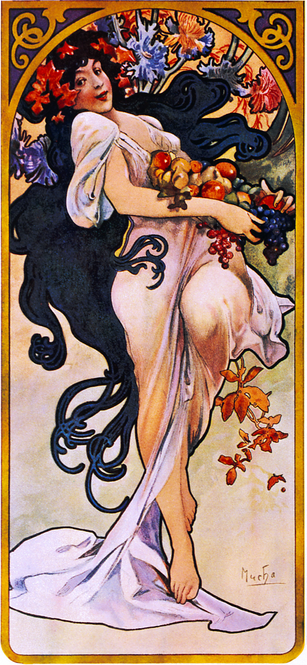
Autumn Equinox MuchaTHE AUTUMN EQUINOX CEREMONY

Also known as “The Hour of Truth”

The Word of this ceremony is ‘THELEMA’ (Theh-lay-muh). It is intoned three times in between scenes, i.e. between Scenes 1 & 2 and between Scenes 2 & 3, by the People/Congregants. 

The Talisman of this ceremony is an ostrich plume (or a smaller representation thereof).


SCENE 1: Virgo.
The End of Summer, the Threat of Winter/Death, the possibility of Immortality.

SETTING: The Kingdom at Sunset1; it is almost the time of harvest2. The King is entering Old Age. The room is lit, but dimly; the primary light comes from the West, i.e. the setting Sun. There are fields of wheat3 surrounding everyone or up on the Throne. Leaves are scattered about that are colored by Autumn. The King is enthroned in the East, facing Westward; he is wearing a white robe under his scarlet robe; the Queen is wearing a green robe over white and her hair is filled with 12 white flowers in a crown. + holds the Sword, – holds the Balances; the Staff and Lantern are hidden behind the Throne.

+ and – stand on either side of the King and speak as if announcing news to the Kingdom.

+: “Thrust in thy sickle and reap: for the time is come for thee to reap; the harvest of the earth is ripe.”4

–: “Thrust in thy sharp sickle, and gather the clusters of the vine of the earth; for her grapes are fully ripe.”5

KING: “Let there goeth forth a sickle that shall reap every flower!”6

+ and – march to the West side of the Temple and turn to face East. The Queen paces around, looking very worried.

KING: My Queen! The fruits of our labors are ripened. It is a time for reaping and rejoicing, yet you appear discontent.

QUEEN: Harvest time is indeed upon us… yet I tremble in fear at the thought of enduring another winter storm. What if our harvest does not last until the next blooming of flowers? What if you fail of an heir and we are left in darkness?

The King looks disappointed but does not respond. + and – take a few steps forward while + says:

+: My Queen, we may know of a certain solution to your sorrows.

+ and – stop before – speaks.

–: Indeed, the legend we have heard in our youth of the potion that provides permanence.

QUEEN: Ah! Yes! Yes! The Elixir of Immortality. I know this legend; how I could I have forgotten! If you could but find and drink of it, Eternal life would be granted. Winter storm would pose no threat; fear of having no heir would be banished at last!

KING: This sounds good, too good to be true. Where might I find this Elixir and what must I do?

QUEEN: It is said there is but one soul upon the Earth who has the Wisdom7 to create this Elixir.

+ and – are becoming excited by the Queen’s tale, taking further steps towards the East while + says:

+: The Priestess Nuit!

+ and – stop before – speaks.

–: Yet she lives afar off!

QUEEN: Across the great span of the wilderness to the West, you may find her at the summit of the highest, most holy mountain. There, where the Earth meets the Heavens!8 I must warn you, though, that I have heard many have tried and all have failed, for they did not persist.

+ and – take their final steps to be right next to the King in the East while + says:

+: They were turned aside by adversity.

+ and – stop before – speaks.

–: They settled for something less than that ultimate end.

+ and – turn around simultaneously to face the West.

KING: I will seek only Nuit. I will “turn not aside for aught”9.

QUEEN: Ah! Our perpetual predicament may be resolved at last! Save your Kingdom from disrepair; save your Queen from utter despair. The wasteland awaits thee, my King! Follow the footsteps of the Camel10 that lead the way through the desert.11

KING: Let the preparations be made at once!

QUEEN: But, my King, if you are gone, who will rule in your stead?

+ steps forward and raises the Sword.

+: I will rule with the severe sword!

– steps forward and raises the Balances.

–: I will rule with the benevolent balances!

KING: Only they who have the right of God and might of Will may take the throne. [+ and – step back to the sides] My Queen, you must rule in my stead.

QUEEN: How should I be worthy to ascend to the throne and administer the royal decrees to our Brothers and Sisters?

KING: The most potent power derives from the most solemn service12. Divest yourself of all pursuit of pleasure and all sin of selfishness.

QUEEN: I see “nothing but a blank midnight in this Emptying of the Soul!”13

KING: “This is the necessary condition of Illumination.”14 Even as the Sun is swallowed in Sea [The King points to the West] you too must undergo the darkness of the Night of Pan, purged of all egoity!

The King takes the Queen by the hand and slowly leads her into the West. As they walk, drums beat slowly and softly but become louder and faster.

QUEEN: “Why do I sweat with blood and dew? Blind horror catches at my breath. The path of the abyss runs through things darker, dismaller than death! …There is no memory possible of this unfathomable hell. Even the shadows that arise are things too dreadful to recount!”15

The drums become louder and more chaotic. The King and Queen approach the West; the rhythm of their words carry them onward.

KING: “This is the end of all our pain, the dissolution of the brain! For lo! in this no mortar sticks; Down come the house – a hail of bricks!”16

The drums are loud and completely chaotic; there is no rhythm.

QUEEN: “But my soul faints, my stomach sinks. Let me pass on! [The Queen pushes away the King to make the final steps to the West alone] My being drinks the nectar-poison of the Sphinx. This is a bitter medicine! Black, black, intolerably black! Go, spectre of the ages, go!”17

The drums stop suddenly. The Queen arises solemnly and turns to the East in the attitude of Resurrection, i.e. the sign of Osiris Risen.

KING: You have passed beyond… Beloved, thy stature spans the sky.18

QUEEN: Verily; but it is not I. The ego dissolves – pale phantom form blown from the black mouth of the storm. It is another that arises! …Ay, there is no more potent spell. Through life, through death, by land and sea, most surely will I follow thee.19

KING: Follow thyself, not me!20 It is complete! The Kingdom will obey thine command! My departure is nigh at hand!

END SCENE. Congregants repeatedly intone ‘THELEMA’ in between scenes.

SCENE 2: Libra.
The Installment of the Queen as Ruler of the Kingdom.

The light from the West is slightly darker; the Sun is halfway concealed by the horizon. The King stands in front of the Throne in the East and the Queen stands before him. + and – stand on either side of the Queen, facing her. + holds the Sword, – holds the Balances.

KING: The preparations for my departure into the wilderness of the West are almost complete. My final act is to raise you to the throne as Ruler21 of this Kingdom.

The King comes down from the Throne. He takes the Queen’s hand and sets her in the Throne where she sits. The King turns to address the People.

KING: I say that ‘Every man and every woman is a star.’ I do not fool and flatter women; I do not despise and abuse them. To me a woman is Herself, absolute, original, independent, free, self-justified, exactly as a man is. I dare not thwart Her Going, [The King turns to face the Queen] Goddess thee! I arrogate no right upon your will; I claim not to deflect your development, to dispose of your desires, or to determine your destiny. You are your own sole arbiter. I do not want you as a slave; I want you free and royal, whether your love fight death in my arms by night, or your loyalty ride by day beside me in the Charge of the Battle of Life.22

+ advances and hands the Sword to the Queen who holds it between her legs.

KING: Let your rule be strong yet precise. O be thou proud and mighty among men!23

advances and hands the Balances to the Queen who holds it against the hilt of the Sword. She holds both Sword and Balances at once.24

KING: Let your rule be merciful yet fair. Bring the glory of the stars into the hearts of men!25

The King takes a Crown of ostrich plumes26 and places it on the Queen’s head.

KING: May Truth stand upon your crown, eternally alert. Truth is your Path, and Truth is your Goal; [The King kneels while + and – give smaller versions of the ostrich plume to each Congregant.] Ay! there shall come to you a moment of great Light when, understanding what is Truth, you will understand your Self, for you are Truth!27

The King pauses and smiles.

KING: It is accomplished! [The King genuflects and extends his arms towards the Queen while saying:] “Unto thee is all power given.”28

The King, +, , and the People applaud.

QUEEN: “I will glorify myself and live deliciously. I sit a queen, and am no widow, and shall see no sorrow.”29 I will rule firmly with severity yet justly with mercy. I will not only uphold thine power, but it shall wax in strength to cover the world. Remember, my King: Seek only Nuit! Turn not aside for aught! I entrust unto thee this staff to support you in daytime [+ takes the staff]. I impart unto thee this lantern to guide you in darkness [– takes the lantern]30. I empower thee with this most holy word of force and fire31 that thou mayst endure unto the End: THELEMA.”

The Queen kisses the King.

QUEEN: The wasteland awaits thee, my King! Follow the footsteps of the Camel that lead the way through the desert.

END SCENE. Congregants repeatedly intone ‘THELEMA’ in between scenes.

SCENE 3: Scorpio.
The Kings leaves to wander in the wilderness.

The Light from the West is even darker; the Sun is almost set on the horizon. The King is prepared to leave the Queen32 and the Kingdom to wander in the wilderness33 for 50 days34. The King faces the Queen who is enthroned in the East.

The King closes the Veil, hiding the Queen from sight. He then turns towards the West.

KING: My Kingdom is secure with Justice enthroned.35 Her eyes of equity are etched into my brain. Her Word awakens my intent. Her kiss lingers on my lips. “Now, I goeth solitary…”36 Bearing my staff as support by day [+ raises the staff] and my lantern as guide by night [– raises the lantern].

The King points to the ground in the West.

KING: Look! The footprints of a Camel! The initiation of my journey is at hand.

The King lifts his Lance, pointing it to the Western horizon.

KING: “With my burning spear, to the wilderness I wander!”37

The King then holds the Lance upright with both hands, right over left, and begins to slowly march towards the West where the Sun sets completely and darkness envelops the Kingdom. + and – hold the staff and lantern and walk on either side of the King. + and – slowly and solemnly chant the word ‘THELEMA,’ starting loudly and slowly becoming silent.

+ and : THELEMA… THELEMA… THELEMA…

END SCENE.

Notes

1In the symbolism of day and night, this ceremony corresponds to Sunset as, in the symbolism of the seasons, it corresponds to Autumn.

2Virgo is the sign just before Libra, which is the traditional time of harvest.

3Wheat and corn are attributed to Virgo.

4Adapted from Revelation 14:15.

5Adapted from Revelation 14:18.

6From The Vision and the Voice, 7th Aethyr. The reference is to the coming month of Libra that is of harvest; Saturn, whose weapon is the sickle, is exalted in Libra.

7Virgo is Atu IX: The Hermit, Mercury or Wisdom.

8The mountain is the Holy Mountain, Abiegnus of the Rosicrucians; the Summit is where the Goat-God Pan lives, i.e. Capricorn the Winter Solstice, and it is seen symbolically as the High Altar in the Gnostic Mass.

9c.f. The Vision and the Voice, 20th Aethyr.

10The Book of Lies, chapter 73. It is not realized that Death rides this Camel of Initiation.

11This refers to the Gimel that literally means “camel,” which is the path of Atu II: The High Priestess that leads from Tiphareth across the Abyss to the Supernals.

12A reference to “Liber 194: An Intimation with Reference to the Constitution of the Order” where, when speaking about governmental positions in O.T.O., Crowley writes, “with us Government is Service, and nothing else.”

13From “AHA!”

14From “AHA!”

15From “AHA!”

16From “AHA!”

17From “AHA!”

18From “AHA!”

19From “AHA!”

20From “AHA!”

21This is seen in the Gnostic Mass when the Priest upraises the Priestess and sets her upon the summit of the Earth.

22This entire speech is adapted from the New Comment on Liber AL III:55.

23Liber AL II:77.

24This is Woman as Justice, seen in Atu VIII: Adjustment, to which is attributed the sign of Libra. It also is a reference to the liberation of Women from the subservience of the Old Aeon, c.f. Liber AL III:10, “Let the woman be girt with a sword before me.”

25Liber AL I:15.

26These are the feathers of Maat, c.f. The Book of Thoth, “She is crowned with the ostrich plumes of Maat, the Egyptian goddess of Justice.”

27This speech is adapted from the chapter “Truth” in Little Essays Towards Truth.

28A reference to Liber AL I:15, “…and in his woman called the Scarlet Woman is all power given.”

29Adapted from Revelation 18:7 where it refers to Babylon.

30The lantern and staff are the weapons of the Hermit as seen in Atu IX: The Hermit. They also reflect the Pillar of Fire that guided Moses in the desert by night and the Pillar of Cloud that guided him in the desert by day.

31Liber AL II:20.

32This is seen in the Gnostic Mass when the Priest closes the veil after raising Priestess to the summit of the Earth.

33The wilderness represents spiritual austerities as when Jesus fasted in the desert and Buddha meditated under the Bodhi tree. In terms of Thelema, it represents the Abyss. Crowley associates the Yod, which is attributed to Atu IX: The Hermit, with “Parzival in the desert. Christ taking refuge in Egypt, and on the Mount tempted by the Devil. The unconscious Will, or Word” in Magick in Theory and Practice.

3450 is the number of Nun, which is attributed to Atu XIII: Death and therefore Scorpio. It is also a reference to Christ’s wandering 40 days in the wilderness and Buddha’s 49 days of meditation under the Bodhi tree before enlightenment. In both cases this period directly precedes their temptation by Satan/Mara. This period is also seen in the Gnostic Mass after the Veil is drawn (the Sunlight dwindling in Sunset/Autumn) and the Priest circumambulating 3 times; it is seen at the beginning of the Winter Solstice ceremony.

35This represents the attainment of 7=4. The next step is to cross the Abyss and attain 8=3, which is shown in the Winter Solstice ceremony.

36A reference to The Vision and the Voice, 13th Aethyr, “The hermit goeth solitary, and giveth only of his light unto men”; it is therefore also a reference to the attainment of the Grade of Hermit.

37Adapted from The Vision and the Voice, 10th Aethyr.

Liber LXV parables

The Parables and Lessons of Liber LXV (part 5)

Liber LXV: The Heart Girt with a Serpent

The Parable of the White Swan of Ecstasy and the Little Crazy Boy of Reason

Also the Holy One came upon me, and I beheld a white swan floating in the blue. Between its wings I sate, and the æons fled away. Then the swan flew and dived and soared, yet no whither we went. A little crazy boy that rode with me spake unto the swan, and said: Who art thou that dost float and fly and dive and soar in the inane? Behold, these many æons have passed; whence camest thou? Whither wilt thou go? And laughing I chid him, saying: No whence! No whither! The swan being silent, he answered: Then, if with no goal, why this eternal journey? And I laid my head against the Head of the Swan, and laughed, saying: Is there not joy ineffable in this aimless winging? Is there not weariness and impatience for who would attain to some goal? And the swan was ever silent. Ah! but we floated in the infinite Abyss. Joy! Joy! White swan, bear thou ever me up between thy wings!

Liber LXV, II:17-25

This Parable of the White Swan of Ecstasy and the Little Crazy Boy of Reason is one of my personal favorite passages from the Holy Books of Thelema. Crowley refers to this passage in several places including his commentary on Blavatsky’s “The Voice of the Silence” and his commentary on The Book of the Law. There is also a chapter in The Book of Lies entitled “The Swan” (chapter 17) that is expands the symbolism of this passage, which I encourage you to read if this Parable particularly interests you.

Also the Holy One came upon me, and I beheld a white swan floating in the blue. Between its wings I sate, and the æons fled away.” The phrase “the Holy One came upon me” is a way to say that the Adept has entered into an ecstatic state of consciousness, similar to saying that the Holy Spirit has entered one’s heart or descended upon oneself. The Adept sees a “white swan,” which represents Ecstasy. This symbolism is developed in The Book of Lies where Crowley writes, “There is a Swan whose name is Ecstasy: it wingeth from the Deserts of the North; it wingeth through the blue; it wingeth over the fields of rice; at its coming they push forth the green.”1 Crowley comments further that “This Swan is Aum,”2 which is both the name of the swan and its nature, i.e. it is the Holy Mantra of the Hindus and whose symbolism is too deep and complex for this basic essay. Crowley comments, “The swan is the ecstatic Consciousness of the Adept.”3

This white swan “floats,” meaning it moves effortlessly. The swan floats “in the blue,” which represents infinite space (i.e. Nuit). This parallels the line from The Book of Lies where the swan “wingeth through the blue.” Crowley comments, “It is poised in infinite space.”4 The Adept sits between the wings of the swan, carried by its effortless floating of ecstasy. “The æons fled away” means that the Adept, through Ecstasy, has transcended Time. Entire aeons go past without any care or worry. Crowley comments, “In Ecstasy time does not count.”5

“Then the swan flew and dived and soared, yet no whither we went.” Despite the swan’s movements of flying, diving, and soaring, it remains essentially motionless. The aeons having fled away means Ecstasy transcends Time and now we see that this Ecstasy also transcends Space. Each movement of the Swan of Ecstasy is Joy even though there is no real movement or progress. From the perspective of the infinite, there is no goal to be attained, yet each movement through time and space is joy. From this point-of-view, one can truly say, “Existence is pure joy.”6 Crowley comments, “The Ecstasy moves from one sublimity of Joy to another; but there is no progress possible in perfection, therefore no aim to be attained by such movements.”7

“A little crazy boy that rode with me spake unto the swan, and said: Who art thou that dost float and fly and dive and soar in the inane? Behold, these many æons have passed; whence camest thou? Whither wilt thou go?” We are now introduced to a new character, the “little crazy boy” who represents the mind or Ruach, especially insofar as it is the realm of Reason. This boy of Reason questions the Swan and essentially asks, “Who are you? All this time has passed but where did you come from and where are you going?” Reason cannot understand the initiated point-of-view, just as – esoterically – the Ruach of Knowledge can never reach above the Abyss to the Supernal Triad of Understanding. The mind is embedded in space and time: it cannot comprehend That which transcends both. Crowley comments, “The boy is the human reason, which demands measurement as the first condition of intelligible consciousness. Aware of time, he cannot understand why all this motion has not brought the swan nearer to some fixed point, or how the relation of the point of origin to its present position is not an ever-present anxiety. He cannot conceive of motion without reference to fixed axes.”8

“And laughing I chid him, saying: No whence! No whither!” The Adept replies for the swan and “chids him,” which means that he rebukes or scoffs at Reason. The Adept says that He and the swan did not come from anywhere in particular nor are they going anywhere in particular, for they are beyond past and future insofar as they transcend Time itself. In being carried by spiritual Ecstasy, one does not strive to attain certain goals but partakes in each action and moment with Joy. Crowley comments, “I reply that, apprehending the continuum (Nuit) as such, no ‘space-marks’ exist.”9 Crowley is referencing The Book of the Law where it is written, “If this be not aright; if ye confound the space-marks, saying: They are one; or saying, They are many; if the ritual be not ever unto me: then expect the direful judgments of Ra Hoor Khuit!”10 The Adept and the swan are beyond the multiciplity of space, time, and causality so there are no “space-marks” to separate any one thing from any other thing. As it says in The Book of the Law, “Bind nothing! Let there be no difference made among you between any one thing & any other thing; for thereby there cometh hurt.”11

“The swan being silent, he answered: Then, if with no goal, why this eternal journey?” The swan is always silent for it is caught up in Ecstasy that transcends the duality of thought and speech. Silence represents None or non-duality as Speech represents Two or duality/multiplicity. The little crazy boy of Reason then asks why go through these motions if there is no goal or end intended? Crowley comments, “The swan is of course silent: Ecstasy transcends expression. Reason asks the motive of motion, in the absence of all destination.”12

“And I laid my head against the Head of the Swan, and laughed, saying: Is there not joy ineffable in this aimless winging? Is there not weariness and impatience for who would attain to some goal?” The Adept puts his head against that of the swan, implying that he is one with the transcendent Ecstasy represented thereby. The Adept laughs because the nature of Ecstasy is Joy, and laughing a natural response of the illuminated or enlightened consciousness in response to the questioning of the ego/mind/Ruach. The Adept asks a rhetorical question, implying that there is no aim to the “winging” or motion of existence, yet there is Joy in each motion. This is the pure will where one is “unassuaged of purpose.”13 Crowley comments, “The Adept bringing this thought closes to Ecstasy, laughs, both for pure joy, and as amused by the incongruous absurdities of ‘rational’ arguments from which he is now for ever free, expresses his idea thus: Thus free exercise of some object thereby, it would imply the pain of desire, the strain of effort, and the fear of failure.”14 One might say that if there is no target, there is no possibility of missing the mark. The mind is always caught up in worrying about goals and aims and purposes, thereby leading to anxiety over the possibility of not attaining these aims, strain over attempting to attain them, and sorrow over having not achieved them. This ecstatic consciousness to which the Adept has attained does not worry itself with these things, but – instead – takes Joy in all instances of motion and existence no matter whether they are considered “success” or “failure” by the rational mind. This line is the true core or “moral” of this Parable: one should strive to attain that ecstatic consciousness whereby the fretting over finding and finishing goals falls away.

“And the swan was ever silent. Ah! but we floated in the infinite Abyss. Joy! Joy! White swan, bear thou ever me up between thy wings!The swan, as mentioned before, is always silent, for it abides in its Ecstasy that transcends all illusion, all multiplicity, and therefore all worry. The Adept then gets absorbed into the Ecstasy of the swan, calling to the swan to always bear the mind of the Adept in its Ecstasy. Crowley comments, “Ecstasy remains undisturbed. But the dialogue has caused the Adept to reflect more deeply on his state of bliss, so that the Ecstasy becomes motionless, realising its perfect relation to the Infinity of the continuum. The Adept demands that ecstasy shall be constant.”15

SUMMARY: The Adept, being carried on the Ecstasy that transcends space and time, is not focused on the past or future, especially attaining specific goals, but instead takes Joy in every experience. While Reason is always worrying about specific aims or goals, the ecstatic consciousness of the Adept rejoices in the “aimless winging” of existence. This Parable counsels us to attain that intoxicated spiritual Ecstasy whereby we transcend our rational anxieties, strains, and sorrows so that we might take Joy in every moment. While this is a certainly lofty attainment, the Parable also has a more mundane and practical import: We must strive to see the Joy of experience in itself no matter what its character may be, which comes from not being overly absorbed in and worrying over attaining specific goals. We all have many notions about what we “should be” doing or achieving, and it is not inherently wrong to have certain aims or purposes to guide behavior. Despite this, it is easy to become entirely engrossed in these notions of what should or should not be happening, and we then get caught up in the “lust of result” whereby we become attached to a certain outcome. The Parable therefore counsels us to be on guard against the constant questioning and criticism of the mind, which always seeks as “why” or “wherefore” or “because” to justify action, yet to become caught up in this is to lead into stagnation and sorrow where the inherent Joy of all instances of experience – both comedic and tragic – is forgotten.

Crowley – in an unusual bout of clarity – explains this idea which I will quote to end this particular section:

There is no ‘reason’ why a Star should continue in its orbit. Let her rip! Every time the conscious acts, it interferes with the Subconscious, which is Hadit. It is the voice of Man, and not of a God. Any man who ‘listens to reason’ ceases to be a revolutionary… It is ridiculous to ask a dog why it barks. One must fulfil one’s true Nature, one must do one’s Will. To question this is to destroy confidence, and so to create an inhibition… We are not to calculate, to argue, to criticise; these things lead to division of will and to stagnation. They are shackles of our Going. They hamstring our Pegasus. We are to rise up — to Go — to Love — we are to be awake, alert… This is the ready test of a Star, that it whirls flaming through the sky. You cannot mistake it for an Old Maid objecting to Everything. This Universe is a wild revel of atoms, men, and stars, each one a Soul of Light and Mirth, horsed on Eternity.” 16

1The Book of Lies, chapter 17.

2The Book of Lies, commentary to chapter 17.

3Commentary to Liber LXV, II:17.

4Commentary to Liber LXV, II:17.

5Commentary to Liber LXV, II:18.

6Liber AL vel Legis, II:9.

7Commentary to Liber LXV, II:19.

8Commentary to Liber LXV, II:20.

9Commentary to Liber LXV, II:22.

10Liber AL vel Legis, I:52.

11Liber AL vel Legis, I:22.

12Commentary to Liber LXV, II:23.

13The reference is to Liber AL, I:44, “For pure will, unassuaged of purpose, delivered from the lust of result, is every way perfect.”

14Commentary to Liber LXV, II:24.

15Commentary to Liber LXV, II:25.

16New Comment to Liber AL, II:30-34.

Liber LXV parables

The Parables and Lessons of Liber LXV (part 4)

Liber LXV: The Heart Girt with a Serpent

The Parable of the Reaper and the Wise Man

Adonai spake yet again with V.V.V.V.V. and said: The earth is ripe for vintage; let us eat of her grapes, and be drunken thereon. And V.V.V.V.V. answered and said: O my lord, my dove, my excellent one, how shall this word seem unto the children of men?And He answered him: Not as thou canst see. It is certain that every letter of this cipher hath some value; but who shall determine the value? For it varieth ever, according to the subtlety of Him that made it. And He answered Him: Have I not the key thereof? I am clothed with the body of flesh; I am one with the Eternal and Omnipotent God. Then said Adonai: Thou hast the Head of the Hawk, and thy Phallus is the Phallus of Asar. Thou knowest the white, and thou knowest the black, and thou knowest that these are one. But why seekest thou the knowledge of their equivalence?And he said: That my Work may be right. And Adonai said: The strong brown reaper swept his swathe and rejoiced. The wise man counted his muscles, and pondered, and understood not, and was sad. Reap thou, and rejoice!

Liber LXV, I:50-56

 This entire parable consists of an exchange of the advanced Adept (V.V.V.V.V.) with God, (Adonai). Crowley comments that this exchange is “An elaborate Parable in dialogue.”1 The real parable comes at the very end: “The strong brown reaper swept his swathe and rejoiced. The wise man counted his muscles, and pondered, and understood not, and was sad. Reap thou, and rejoice!” However, the dialogue preceding this parable gives context to it:

“And V.V.V.V.V. answered and said: O my lord, my dove, my excellent one, how shall this word seem unto the children of men?” The Adept answers God, and wonders whether his “word” or message will be understood by humanity, i.e. “the children of men.” The Adept “returning to earth” or mundane life may doubt that her initiated expression of Truth will be received and understood rightly by the uninitiated. This can be seen, for example, in how many people misunderstand the Word of V.V.V.V.V.’s Truth, Do what thou wilt. Crowley comments, “The Adept doubts whether his doctrine will be understood rightly by mankind.”1

“And He answered him: Not as thou canst see. It is certain that every letter of this cipher hath some value; but who shall determine the value? For it varieth ever, according to the subtlety of Him that made it.” God answers the Adept and agrees that humanity may not understand his “word.” God goes further by saying that each individual interprets things differently – “it varieth ever” – reflecting the idea stated in the Parable of Light and Colors that each individual sees the one Light reflected into different colors according to their own understanding. Each individual is at a certain level of “subtlety,” i.e. of understanding or initiation. Each individual will understand the Word of the Adept in proportion to how far they have tread the Path of the Great Work, yet – even then – each individual will interpret things uniquely according to their own particular nature, history, and circumstance. Crowley comments, “The Angel agrees; but is more sceptical still, suggesting that any event may be taken as meaning anything one chooses.”2

“And He answered Him: Have I not the key thereof? I am clothed with the body of flesh; I am one with the Eternal and Omnipotent God.” The Adept answers God’s skepticism by asserting that he has the true “key” of understanding things. Although the “value” of the Adept’s “word” may be valued differently by each individual, the Adept claims that he knows the one true “value” as opposed to the many partial and false interpretations or “values.” Crowley comments, “The Adept claims to be able to interpret phenomena rightly; that there is one special relation which is true, and all others false.”3

The Adept then asserts his Adepthood insofar that he understands himself simultaneously as a finite mind and body as well as the infinite Godhead, i.e. the Adept understands that he is both None and Two. Esoterically, the Adept realizes that he is both in Malkuth as a “body of flesh” as well as in Kether as “the Eternal and Omnipotent God.” This fact of simultaneous identity with spiritual and material, None and Two, is a characteristic of advanced Adepts. Crowley comments, “He reminds the Angel that he realises Himself (as an unique Being always identical with Itself) alike in the lowest matter and the highest spirit.”4

“Then said Adonai: Thou hast the Head of the Hawk, and thy Phallus is the Phallus of Asar. Thou knowest the white, and thou knowest the black, and thou knowest that these are one. But why seekest thou the knowledge of their equivalence?” God responds to the Adept’s assertion of his initiated understanding by acknowledge his Adepthood. God says that the Adept has “the Head of the Hawk,” which is a reference to Horus and generally means that the Adept has attained the “sight” or perspective of an Adept. God says that the Adept’s “Phallus is the Phallus of Asar,” which is a reference to the phallus of Osiris that was used by Isis to give birth to Horus. This generally means that the Adept has awakened the sexual-generative power of the Unconscious or Secret Self and thereby has the ability to “make fertile” the earth, i.e. bring the Word of God down to the people of mundane existence to revitalize the world. Finally, God acknowledges that the Adept understands the pairs of opposites – black and white, yin and yang, etc. – and that he understands their ultimate equivalence. This is another way to say that the Adept understands the world as both None (where black and white “are one”) and Two (where black and white are opposites).

Despite God’s acknowledgment of the Adept’s attainment, He also questions the Adept by asking why the Adept who has attained such great spiritual heights would trouble himself with the relations between things of duality. To the mind, all things appear as multiplicity or duality, and while this is true “on its own plane,” the Adept knows that all multiplicity is actually unity. Since the Adept understands that all opposites are actually one, why would he seek to understand the relations between these illusory opposites? Crowley comments, “The Angel asks why one who possesses absolute Sight and Lordship and power to soar (the Head of the Hawk) who has creative energy able to fertilize Nature, his mother, sister, and wife (The Phallus of Asar) one who knows the pairs of opposites, and the fact of their identity, should trouble to calculate the equations which express the relations between the illusory symbols of diversity.”5

“And he said: That my Work may be right.” The Adept responds to God’s challenge by asserting that, regarding the pairs of opposites, he “seeks the knowledge of their equivalence” so that his “Work may be right.” That is, the Adept needs to understand the laws of duality (the mundane world of illusion) so that he can work effectively in the realm of duality. For example, an Adept might know that the bow, arrow, and target are actually all One Thing yet still seek to understand the relation between bow and arrow so that she may hit the target accurately. Consider also, for example, how the rules of Chess are essentially made-up illusions, but one must know and follow the rules in order to play the game. The better one knows the relationships of the different pieces and the possible combinations, the more skilled one becomes at playing Chess even though one can step back from the board and realize it is all a game. Crowley comments, “The Adept replies that he must understand the laws of illusion in order to work in the world of illusion.”6

“And Adonai said: The strong brown reaper swept his swathe and rejoiced. The wise man counted his muscles, and pondered, and understood not, and was sad. Reap thou, and rejoice!” God replies to the Adept’s assertion that he seeks to understand the laws of illusion in order to work in the realm of illusion. This is – as stated previously – the true parable of this section of the text. This parable contrasts “the strong brown reaper” with the “the wise man.”

The strong brown reaper is an image of an individual who acts without over-thinking things. He is “strong” because physical strength implies an ability to act and the actual use of one’s muscles. He is “brown” because the fertile earth is brown and able to bear harvest. He is a “reaper” because he reaps the harvest of the earth, i.e. he does his work and reaps the reward. This strong brown reaper simply “swept his swathe and rejoiced.” That is, the strong brown reaper is characterized by action, not over-thinking. Esoterically, the strong brown reaper is an image of a Master of the Temple insofar as this grade is attributed to Binah, for brown is a color of Binah and the reaper carries a scythe which is the weapon of Death.

This strong brown reaper is contrasted with the “wise man” who is focused on rational calculations. Over-thinking and hyper-rationalism is seen under the figure of the wise man counting, pondering, and not understanding: this leads to sorrow. The wise man has muscles but does not use them; instead he tries to understand them through counting and pondering.

Esoterically, the wise man is a symbol of the mind or the Ruach, which cannot reach above the Abyss that separates the bottom of the Tree of Life from the Supernal Triangle wherein the Master of the Temple abides. This refers to the Qabalistic idea that Da’ath – or “knowledge” – is the crown of the Ruach or mind, but it cannot reach beyond the mind to the Supernal Triangle for knowledge is always mired in duality or multiplicity. Binah – or “understanding” – represents the illuminated Adept that transcends the duality of thought and speech to the non-duality of the City of the Pyramids in the Supernal Triangle of the Tree of Life. This parallels the curse against Reason in The Book of the Law where it is written, “There is great danger in me; for who doth not understand these runes shall make a great miss. He shall fall down into the pit called Because, and there he shall perish with the dogs of Reason. Now a curse upon Because and his kin! May Because be accursed for ever! If Will stops and cries Why, invoking Because, then Will stops & does nought.. If Power asks why, then is Power weakness. Also reason is a lie; for there is a factor infinite & unknown; & all their words are skew-wise. Enough of Because! Be he damned for a dog! But ye, o my people, rise up & awake!”7

God then counsels, “Reap thou, and rejoice!” That is, one is to be the strong brown reaper who acts and does not over-think things. We must “rise up & awake” rather than being stuck in “the pit called Because” with “the dogs of Reason.” The first word of the Law of Thelema is “Do,” and we must do what we will, not be mired in the minutia of the mind. This parallels what is said in The Book of the Law, “Success is thy proof: argue not; convert not; talk not over much!”8 The wise man calculates, ponders, and does not understand so he is left in sadness and sorrow. The strong brown reaper simply acts in accordance with his Nature and thereby rejoices. The reason why we should not be too overly concerned with the rational calculations of the mind – the relations between illusions previously mentioned – is because they lead us to become stuck in the realm of duality rather than realizing the true Understanding of one’s identity with the non-dual Godhead. Crowley comments, “The Angel replies that such calculations lead one to believe in the reality of the illusions, to become confused by their complex falsities, and ultimately, mistrusting one’s own powers, to fail to act for fear of making mistakes; whereas it does not really matter what one does, since one set of illusions is just as good as another. The business of the Adept is to do his Work manfully and joyously, without lust of result or fear of accident. He should exercise his faculties to the full; the free fulfilment of their functions is sufficient justification. To become conscious of any organ is evidence that it is out of order.”9

SUMMARY: Adepts need to return to the material, mundane word and spread their “word” to humanity who may misunderstand the message. This may concern the Adept who claims to be able to interpret things rightly, but ultimately focusing on the “correct,” rational interpretation and knowledge of things leads us to become mired in unnecessary calculations and doubt that impede the free and full expression of the Will. If the aspirant focuses too much on calculation, analysis, and knowledge, she will fall prey the “dogs of Reason” and forget her true identity with Godhood, her Star. One should therefore not be the “wise man” who ponders over the endless and ultimately meaningless aspects of rational knowledge, but – instead – one should be the “strong brown reaper” who acts freely without over-thinking or excessive doubtfulness. That is, one should express one’s Nature in actions proper to that Nature, and one should not get caught up in the rational minutia of existence that brings no true satisfaction. By acting in accordance with our Nature, by doing our Wills, we naturally are filled with joy.

1Commentary to Liber LXV, I:51.

2Commentary to Liber LXV, I:52.

3Commentary to Liber LXV, I:53.

4Commentary to Liber LXV, I:53.

5Commentary to Liber LXV, I:54.

6Commentary to Liber LXV, I:54.

7Liber AL vel Legis, II:27-34.

8Liber AL vel Legis, III:42.

9Commentary to Liber LXV, I:56.

1Commentary to Liber LXV, I:50-58.

Liber LXV parables

The Parables and Lessons of Liber LXV (part 3)

Liber LXV: The Heart Girt with a Serpent

The Parable of the Maiden and Hades

There was a maiden that strayed among the corn, and sighed; then grew a new birth, a narcissus, and therein she forgot her sighing and her loneliness. Even instantly rode Hades heavily upon her, and ravished her away.

Liber LXV, I:47-49

There was a maiden that strayed among the corn, and sighed.” This “maiden” is a symbol of the soul in an uninitiated state, the “natural soul.” We are – each and every one of us – this maiden. Crowley comments, “Persephone [is] the earth-bound soul.”1 This maiden “strayed among the corn,” which means that the uninitiated soul only seeks material nourishment. In response, the maiden “sighed,” which shows dissatisfaction with mundane life. Crowley comments, “Corn = material nourishment; its result is sorrow.”2

More esoterically, the maiden is the Final Heh of YHVH, the Virgin Princess3, the Priestess as the Virgin in the beginning of the Gnostic Mass.4 In Qabalistic symbolism, the Final Heh (YHVH) of this Daughter/Princess/maiden unites with the Vav (YHVH) of the Son/Prince, the Holy Guardian Angel who is called Hades in this particular Parable of the Maiden. He sets the Daughter upon the Throne of the Mother (as seen in the Gnostic Mass), so she transforms from the Daughter to become the Heh of YHVH, the Queen or Mother. It is the process of the Final Heh of YHVH becoming the Heh of YHVH, and it is Malkuth becoming Binah on the Tree of Life.5 In this parable, we see the first part of this process, the Vav/Hades uniting with the Final Heh/maiden.

“then grew a new birth, a narcissus, and therein she forgot her sighing and her loneliness.” The maiden sees, amongst all the corn of mere mundane life, a new and beautiful flower bloom: the narcissus. This blooming flower represents the awareness of there being more to this world than mere mundane, material subsistence: this is the beginning of the “spiritual quest” where the flower of Truth begins to come to full blossom. This flower starting to bloom correlates, in the course of the individual’s life, to puberty. Conversely, the awakening of the sexual-generative powers corresponds to the point in the spiritual quest where the potent unconscious and spiritual forces of one’s Self have started to be accessed. This helps to explain Crowley’s cryptic comment on this line, “Narcissus = the sexual instinct flowering as Beauty.”6 The blooming of this sacred narcissus flower of spirituality amongst the profane corn of mundanity causes the maiden of the uninitiated soul to forget her sorrow. Crowley comments, “Instantly the soul forgets the corn’ and desires the flower.”7

More esoterically, the narcissus is a type of flower that is often bright yellow, has 6 petals called a “corona,”8 and has a stamen coming out of the middle: this is Solar-Phallic symbolism.9 The narcissus as “the sexual instinct flowering as Beauty” points Qabalistically to Tiphareth, which literally means “Beauty”; this Sephirah corresponds to Tiphareth as well as the attainment of Knowledge and Conversation of the Holy Guardian Angel (who is called Hades in this parable). To desire Beauty is to, symbolically, desire what Tiphareth represents the dawning of the Solar, spiritual consciousness.

“Even instantly rode Hades heavily upon her, and ravished her away.” Hades is Lord of Hell, and Hell is the concealed place of one’s unconscious Self, i.e. the Self beyond the awareness of the ego. Hades is the Holy Guardian Angel, the Secret Self or soul of the individual,10 who is awoken through the pursuit of this narcissus flower of Truth and Beauty, the spiritual path. Hades taking the maiden into Hell represents initiation. This same idea is represented more generally in this text as the Heart of the aspirant being girt with the Serpent of Godhead.

More esoterically, Hades is the Prince/Son of YHVH who marries and unites with the Princess/Daughter of YHVH (ravishing her away), setting her upon the Throne of the Mother. Crowley comments, “Hades comes and carries her off. Hades is the lord of ‘Hell,’ i.e., the dark and secret but divine Soul within every man and woman. The rape thus means that the desire for Beauty awakes the Unconscious Self who then takes possession of the Soul, and enthrones her, only allowing her return to earth (Knowledge of the material world) at certain seasons, in order to attend to the welfare of mankind.”11 Crowley here confirms the idea that Hades is a name for the “divine Soul” in everyone. He then elaborates, based loosely on the classical mythology of Persephone and Hades, that she stays in the underworld and only returns to earth at certain seasons. That is, the soul – regardless of one’s level of initiation – must return to mundane reality from time to time to attend to material necessities.

Esoterically, Crowley makes this analogous to the Masters of the Temple who are in Binah on the Tree of Life, the place of the enthroned Queen (YHVH), where they exist in a state of non-duality, or no-ego. They “come back to earth” or duality (or are cast down out of the Abyss into the other Sephiroth, in Qabalistic symbolism) in order to “attend to the welfare of mankind,” similar to the idea of the Bodhisattva. Bodhisattvas are enlightened beings who, instead of remaining in Nirvana, pledge to keep returning to the realm of illusion – Samsara or the profane, mundane, material world – in order to make sure that every being attains to Buddhahood.

SUMMARY: The natural, uninitiated soul is the “maiden.” The uninitiated soul-maiden strays among the “corn” of material, mundane nourishment, yet this causes dissatisfaction and sorrow. The possibility of spiritual Truth and the pursuit thereof unfolds the narcissus flower of aspiration to Beauty. The pursuit of this Path awakens the Unconscious Self, the Holy Guardian Angel or “Hades,” who initiates the soul by taking it into “Hell,” the secret Soul of each individual. This is an elaborate metaphor with deep Qabalistic meaning, yet its import can be stated simply: we must turn from mere material, mundane pursuits and enjoyment to seek the Beauty of Spiritual Truth, thereby awakening the Secret, Solar Self.

1Commentary to Liber LXV, I:47-48.

2Commentary to Liber LXV, I:47-48.

3The Vision and the Voice, 9th Aethyr: “This is the Daughter of the King. This is the Virgin of Eternity… For Kor they have called her, and Malkuth, and Betulah, and Persephone.”

4The Gnostic Mass specifically calls for the Priestess to be “Virgo Intacta,” she is called “VIRGIN” in the first part of the Mass, and the Priest explicitly states, “I, PRIEST and KING, take thee, Virgin pure without spot; I upraise thee; I lead thee to the East; I set thee upon the summit of the Earth.”

5This is succinctly explained by Crowley when he wrote in Book 4, “In one, the best, system of Magick, the Absolute is called the Crown, God is called the Father, the Pure Soul is called the Mother, the Holy Guardian Angel is called the Son, and the Natural Soul is called the Daughter. The Son purifies the Daughter by wedding her; she thus becomes the Mother, the uniting of whom with the Father absorbs all into the Crown.”

6Commentary to Liber LXV, I:47-48.

7Commentary to Liber LXV, I:47-48.

86 is the number of the Sephirah of Tiphareth, which is attributed to the Sun. The Sun is, of course, surrounded by a corona of light.

9The Sun is seen in its 6-fold petal and its yellow color, and its phallic nature is the stamen in the middle of the bowl of petals, the Lingam-Yoni.

10New Comment to Liber AL I:7, “He is the Wandering Knight or Prince of Fairy Tales who marries the King’s Daughter… [He] is also this same ‘Holy Ghost,’ or Silent Self of a man, or his Holy Guardian Angel… He is almost the ‘Unconscious’ of Freud, unknown, unaccountable, the silent Spirit, blowing ‘whither it listeth, but thou canst not tell whence it cometh or whither it goeth.’ It commands with absolute authority when it appears at all, despite conscious reason and judgment.”

11Commentary to Liber LXV, I:47-48.

Liber LXV parables

The Parables and Lessons of Liber LXV (part 2)

Liber LXV: The Heart Girt with a Serpent

The Parable of the Petal of Amaranth

Thou seest yon petal of amaranth, blown by the wind from the low sweet brows of Hathor? (The Magister saw it and rejoiced in the beauty of it.) Listen! (From a certain world came an infinite wail.) That falling petal seemed to the little ones a wave to engulph their continent. So they will reproach thy servant, saying: Who hath sent thee to save us? He will be sore distressed.”

Liber LXV, I:34-38

Thou seest yon petal of amaranth, blown by the wind from the low sweet brows of Hathor? (The Magister saw it and rejoiced in the beauty of it.)”” God directs the attention of the Adept to the image of the “petal of amaranth.” Amaranth is a type of flower. The line “blown by the wind from the low sweet brows of Hathor” is a poetic way of saying that the petal of the flower is blown around by the wind of Nature. The Adept’s reaction to seeing this petal is to see its beauty and rejoice therein. 

Listen! (From a certain world came an infinite wail.)” God tells the Adept to listen and the Adept hears “an infinite wail.” That is, the Adept rejoices in the beauty of the flower but another sees it and is distressed. They represent two points-of-view from which one can understand phenomena. Crowley comments, “Two points of view: as a girl’s smile involves the death of many cells in her body.”1 Crowley gives another example: a smile can be seen – from a certain perspective – as happy and rejoicing, but – from another perspective – this same smile is a genocide of life, i.e. cells in the body. Specifically, the “wide” or “macroscopic” view can see the beauty in the petal and the smile, while the “narrow” or “microscopic” view can see only destruction and therefore there is wailing and miserable.

“That falling petal seemed to the little ones a wave to engulph their continent.” The “wide” and “narrow” views are further explained. The same falling petal in which the Adept rejoiced is the petal that, to others, appears as a catastrophe. Again, the same phenomenon can be interpreted in different ways, and – if one’s vision is narrow – one can interpret a thing of beauty to be catastrophic.

“So they will reproach thy servant, saying: Who hath sent thee to save us? He will be sore distressed.”God now counsels the Adept in a particular instance of this more general idea of multiple perspectives of the same phenomenon. God says that “they will reproach thy servant,” meaning that “the little ones” with the narrow view that the petal is a catastrophe will disapprove of the Adept on the material plane. The reference to “thy servant” is, in this particular case, to Aleister Crowley the man. By extension, “thy servant” also applies to every individual’s mind/personality and body as manifested in the world.

The “petal of amaranth” is the Word of the Adept, which is beautiful to him but seen as a source of infinite wailing to those with this narrow view. The reproaching of the servant means that the people of the Earth see the Beauty and Truth of the Adept’s words and acts as catastrophic and destructive. Crowley comments, “The above explains why men should resent their savior. They misinterpret his acts as destructive.”2 A similar lesson is given in Liber Porta Lucis sub figura X, “Even as a man ascending a steep mountain is lost to sight of his friends in the valley, so must the adept seem. They shall say: He is lost in the clouds. But he shall rejoice in the sunlight above them, and come to the eternal snows. Or as a scholar may learn some secret language of the ancients, his friends shall say: ‘Look! he pretends to read this book. But it is unintelligible—it is nonsense.’ Yet he delights in the Odyssey, while they read vain and vulgar things.”3 Again, we see that the Truth of the Adept is misunderstood by the profane, and even misinterpreted to be destructive and catastrophic when the Adept’s Word is of Truth. A similar idea is expressed in The Book of the Law, “Ye are against the people, O my chosen!”4

“He will be sore distressed.” Crowley comments, “He, in his human mind, is distressed at this.”5 That is, the Adept’s rational mind is distressed that his Word and Truth is misunderstood. There is, in fact, a more esoteric interpretation that the “little ones” with the “narrow view” are actually the ideas of the rational mind or ego of the Adept. The mind may balk at the Truth, which it cannot understand and even resent the Truth as catastrophic and destructive. The mind becomes “sore distressed” at this Truth. Crowley comments, “The Ego fears to lose control of the course of the mind. This (of course) occurs in a less real sphere, that of normal consciousness. The Ego is justly apprehensive, for this ecstasy will lead to a situation when its annihilation will be decreed so that the Adept may cross the Abyss and become a Master of the Temple.”6 Even as we must pass beyond all individual symbols, images, and colors, we must more generally pass beyond the limited conception of the rational mind or ego. The ego may actually be distressed by the Truth for it displaces the ego as the center of the mind and reasserts the True Self or Will as the rightful ruler. Crowley comments, “The Ego is not really the centre and crown of the individual; indeed the whole trouble arises from its false claim to be so.”7

SUMMARY: Any phenomenon can be perceived from multiple perspectives. What is beautiful and worthy of rejoicing from one point-of-view may be seen as destructive and catastrophic from another point-of-view. Therefore, the Truth of the Adept may be misunderstood by the profane who can only see the narrow view of the situation, which distresses the rational mind of the Adept. Also, the Truth distresses the ego of the Adept him or herself, for it leads ultimately to the displacement of the ego from the center or crown of the individual to which it makes an unrightful claim. Practically, this parable of the petal of amaranth counsels us to expect opposition from others who do not understand us, especially insofar as we are “ascending the steep mountain”8 of Adepthood. This can be seen by anyone who attempts to explain spiritual truths to those who are not familiar by experience, especially when done in a symbolic language such as that of the Qabalah. This parable also counsels us to expect resistance and distress from our own ego in our path to uncover the Truth.

1Commentary to Liber LXV, I:34-36.

2Commentary to Liber LXV, I:37.

3Liber Porta Lucis sub figura X, lines 15-16.

4Liber AL vel Legis, II:25.

5Commentary to Liber LXV, I:38.

6Commentary to Liber LXV, I:60.

7Commentary to Liber LXV, I:60.

8Liber Porta Lucis sub figura X, line 15.

Liber LXV parables

The Parables and Lessons of Liber LXV (part 1)

Liber LXV: The Heart Girt with a Serpent

Introduction

Parables are succinct stories in prose or verse that illustrate a lesson of some sort. The most famous are those of Jesus such as the Good Samaritan, the Prodigal Sun, the Mustard Seed, the Friend at Night, et cetera. Liber LXV or Liber Cordis Cincti Serpente sub figura LXV is part of our Holy Books of Thelema, and it is full of symbolic teachings that resemble parables. As far as I know, no one beyond Crowley has set forth interpretations of Liber LXV, especially as parables.

Within his commentary on Liber LXV, Crowley uses the term “parable” several times, often saying things like a certain parable “requires no commentary: it is as lucid as it is sublime” or “Any comment would be impertinent: the signification of the Parable, deep though it be, is lucid as any passage in literature; and the language, exquisitely ornate as it is, a sublimity and a simplicity all its own. The moral value, in particular, challenges that of the boasted parables of the Gospels. Contrast their sectarianism, their triteness, and (too frequently) their moral obliquity with this masterpiece.” Other commentaries to parables within in Liber LXV are usually either vague or nonexistent. The reason for this is, perhaps, because of Christ’s attitude in using parables was that “those with ears to hear” will hear. Fortunately or unfortunately, it seems that the parables of Liber LXV are a bit more difficult to discern, at least at this young stage of Thelema’s growth. It may be that, once time has passed and the symbolism of the New Aeon is more widely understood, the parables will reveal themselves as plain as day, but – for the most part – a basic understanding of these supposedly “lucid” parables requires an understanding of the Hermetic Qabalah as well as familiarity with other works of Crowley’s and Thelema in general.

In this multi-sectioned essay I therefore wish to attempt to explain the meaning of several parables found within Liber LXV. This is largely because I have found them, after much study, to be as “sublime” as Crowley claimed they were, and I hope to develop the interest of Thelemites in studying the Holy Books of our most sacred Law.

The Parable of the Light and Colors

Adonai spake unto V.V.V.V.V., saying: There must ever be division in the word. For the colours are many, but the light is one. Therefore thou writest that which is of mother of emerald, and of lapis-lazuli, and of turquoise, and of alexandrite. Another writeth the words of topaz, and of deep amethyst, and of gray sapphire, and of deep sapphire with a tinge as of blood. Therefore do ye fret yourselves because of this. Be not contented with the image. I who am the Image of an Image say this. Debate not of the image, saying Beyond! Beyond! One mounteth unto the Crown by the moon and by the Sun, and by the arrow, and by the Foundation, and by the dark home of the stars from the black earth. Not otherwise may ye reach unto the Smooth Point.”

Liber LXV, I:2-10

“Adonai spake unto V.V.V.V.V., saying:” Since I do not want to get into metaphysical minutia in this essay, for simplicity’s sake Adonai can be be understood as “God,” and “V.V.V.V.V.” is a name for the Master of the Temple, a very advanced Adept. Liber LXV therefore begins with this lesson from God to the Adept.

“There must ever be division in the word.” This “word” is the word of God, the Logos. A common idea in Thelema is that there is unity, but it is always expressed in a duality or multiplicity. This is very similar to the Tao that is always expressed in Yin and Yang. Crowley writes, “the Logos is essentially an Unity, although manifested through Vibration.”1

“For the colours are many, but the light is one.” This same idea, the unity of the Word is divided, is now expressed in a metaphor: Light is a single thing but it is expressed in a multiplicity of colors. This is a physical fact. It is also a fact that the world in general is perceived in a unique and particular way by each individual.

Therefore thou writest that which is of mother of emerald, and of lapis-lazuli, and of turquoise, and of alexandrite. Another writeth the words of topaz, and of deep amethyst, and of gray sapphire, and of deep sapphire with a tinge as of blood.” These various stones simply symbolize light being reflected into various colors. We see that, because the colours are many, one writes in a certain way while another writes in a completely different way. That is, although the Light is one, each individual will only see the Light in a certain way. Crowley comments, “Each man sees Nature in his own particular way.”2

Therefore do ye fret yourselves because of this. Be not contented with the image.” Since men see the world in different ways, it causes fret and concern. Consider the plethora of arguments about the nature of God and the world that have caused everything from argument to slaughter throughout humanity’s history. God then tells the Adept to “be not contented with the image.” That is, although each individual sees different colors of the single Light, this is merely an image. Each individual should not be satisfied with their unique perception of the Light, i.e. the particular “image” that they see. If we become “contented with the image,” this means that we are satisfied with our own relative view of Truth rather than incorporating many perspectives from many different individuals. Through exploring more “colors” by understanding more perspectives, we come closer to apprehending that One Light that is expressed in the many colors or understandings. For example, if we want to know what “dog” means, and we come across a poodle, we can rest contented with the idea that dogs are poodles. If we do not rest content in this image and explore other forms of dogs, then we will see that our first image of “dog” was simply a partial representation of the entire truth. Eventually we will see that the idea of “dog” transcends any one particular image or manifestation. The same goes for Truth as reflected into different religions, philosophies, and individuals across the globe and throughout history. Crowley comments, “Each man sees Nature in his own particular way. What he sees is only an image.3

“I who am the Image of an Image say this. Debate not of the image, saying Beyond! Beyond!” Adonai or God is “the Image of an Image,” implying that even He (at least in speaking to the Adept in this Book) is simply one color or image of many. God counsels the Adept to “debate not of the image, saying Beyond! Beyond!” That is, we must not debate over the individual differences of our perception of Nature. We must go beyond individual or partial images to attempt to perceive that unified Light or Truth beyond all differences. Crowley comments, “Each man sees Nature in his own particular way. What he sees is only an image. All images must be ignored.”4 This shows a unity behind all religious and spiritual doctrines: every system is a reflected color of the One True Light. This same idea is expressed in Liber LXI vel Causae, “Now the Great Work is one, and the Initiation is one, and the Reward is one, however diverse are the symbols wherein the Unutterable is clothed.”5There are diverse symbols and systems to express the same Path and Goal of initiation or enlightenment. We must not rest contented in any one particular image or color of Truth, but we must instead go beyond all partial images.

A similar idea is expressed in the Holy Book known as Liber Porta Lucis sub figura X, “To you who yet wander in the Court of the Profane we cannot yet reveal all; but you will easily understand that the religions of the world are but symbols and veils of the Absolute Truth. So also are the philosophies. To the adept, seeing all these things from above, there seems nothing to choose between Buddha and Mohammed, between Atheism and Theism. The many change and pass; the one remains. Even as wood and coal and iron burn up together in one great flame, if only that furnace be of transcendent heat; so in the alembic of this spiritual alchemy, if only the zelator blow sufficiently upon his furnace all the systems of earth are consumed in the One Knowledge.”6 The same idea is expressed here with the added notion that the “zelator,” or spiritual aspirant, must simply strive to attain and ignore all images. If the aspiration is pure (not limited by particular images or symbols) and steadfast (blowing sufficiently upon the furnace of aspiration), these differences or varied colors are all “consumed in the One Knowledge,” the singular Light which is divided into the multiplicity of symbols or understandings of different individuals.

One mounteth unto the Crown by the moon and by the Sun, and by the arrow, and by the Foundation, and by the dark home of the stars from the black earth. Not otherwise may ye reach unto the Smooth Point.” The path of aspiration to Truth is now understood symbolically, as one image among many. The symbolism used is that of the Qabalistic Tree of Life. The idea is that one reaches Kether (“the Crown”) by the path of Gimel (“the moon”), the Sephirah of Tiphareth (“the Sun”), the path of Sagittarius (“the arrow”), by the Sephirah of Yesod (“the Foundation”), the path of Earth or Saturn (“the dark home of the stars”), and the Sephirah of Malkuth (“the black earth”). If these are all placed on the Tree of Life, one will see that they form a straight line up the Middle Pillar from the bottom (Malkuth) to the top (Kether). The idea is that one must aspire to the highest understanding of Truth in a pure and steadfast way, which was already mentioned in connection to the line from Liber Porta Lucis sub figura X. Crowley comments, “All images must be ignored; the adept must aspire single-heartedly to the Smooth Point.”7

SUMMARY: It is by necessity that the Truth is reflected into particular images for each individual. Metaphorically, each individual perceives the Light in terms of certain colors. We should not debate over these individual differences but, rather, go beyond all images. We therefore must aspire single-heartedly to the End, the Light that is beyond all multiplicity and images and symbols. The lesson is both interpersonal and personal. Interpersonally, the lesson is of tolerance: we must not debate over the various “images” or “colors” in which the Light is reflected into different individual’s understandings, i.e. the various religions and philosophies of the world. Personally, the lesson is of aspiring beyond all images: we must not rest content in any particular image or symbol of Truth but, rather, keep our aspiration steadfast unto the End.

1The Vision and the Voice, 28th Aethyr.

2Commentary to Liber LXV, I:2-11.

3Commentary to Liber LXV, I:2-11.

4Commentary to Liber LXV, I:2-11.

5Liber LXI vel Causae, line 5.

6Liber Porta Lucis sub figura X, lines 19-20.

7Commentary to Liber LXV, I:2-11.