aleister crowley

Feasts of the Times: A Feast for the First Night of the Prophet and his Bride

A feast for the first night of the Prophet and his Bride

by Frater IAO131

BACKGROUND

This feast is celebrated on August 12, and its primary purpose is to celebrate the anniversary of Crowley’s marriage to Rose that made possible the reception of The Book of the Law. Crowley comments, “There should be a special feast on the 12th day of August in every year, since it was the marriage of The Beast which made possible the revelation of the New Law. (This is not an Apology for Marriage. Hard Cases make Bad Law).”

In terms of E.G.C., this ceremony represents the Collect of Marriage, which involves the union of all things, not only the legal proceedings of marriage. In terms of M.M.M., this ceremony represents II° insofar as this shows the soul “how it may best carry out its object in the eucharist of life. It partakes, so to speak, of its own godhead in every action, but especially through the typical sacrament of marriage, understood as the voluntary union of itself with each element of its environment” (Confessions, ch.72).

This feast has five scenes that follow the basic 5-act structure. Each scene refers not only to semi-historical events but also to important parts of each star’s journey in accomplishing their Wills:

  1. The first scene involves Rose, who is the hero of this story and symbolizes each aspirant, and her Father, who symbolizes the “great dragon” of tradition and authority, being a microcosm of the Old Aeon of slave religion in general. This scene symbolizes the oppression of the values of the Old Aeon, both historically as well as individually in terms of the various constraints, beliefs, habits, and values of youth that must be discarded and transcended in the process of growth.

  2. The second scene involves the arrival of the Beast, who represents Crowley historically and the Holy Guardian Angel of each individual symbolically. Rose confides in the Beast about her arranged marriage and he resolves to marry her to absolve her of her obligation. This represents, more generally, the Trance of Sorrow where the aspirant becomes dissatisfied with the world and is given the motive to start upon the Path of the Great Work.1

  3. In the third scene, Rose is then given a choice to adhere to the security of tradition and authority as symbolized by the Father on the one hand or the Liberty and Light of the path of the Great Work as symbolized by the Beast on the other hand. Rose chooses to follow her own True Will, and leaves with the Beast. This represents every aspirant’s choice to begin the journey out of the Darkness of ignorance and into the Light, out of the Old Aeon and into the New. The scenes therefore get more and more comedic as the Laughter of the Child slowly overtakes the Sorrow of the Dying Father.

  4. The fourth scene involves the marriage of the Beast and Rose. Before being married, the Beast or Holy Guardian Angel teaches that she must be balanced in herself before uniting with him. “Equilibrium is the basis of the Work.”2 The Beast tests Rose in the Four Powers of the Sphinx as a form of acquiring balance or equilibrium of the Four Elements.

  5. The fifth scene involves the marriage of the Sphinx and Pyramid, Rose and the Beast, which is the act of conception that will eventually lead to the birth of the Child of The Book of the Law. This can be seen as symbolically reflective of the task of all individuals in uniting with their Gods or Holy Guardian Angels so they may bring forth their own Word to the world.

PERSONS

: Master of Ceremonies – Dressed in white robe with yellow stole, i.e. as a Deacon. He performs the role of narrator and conductor of the People. 

: Rose – Dressed in red/scarlet dress. She performs the role of Rose Kelly who is symbolic of the soul of the aspirant.

: The Beast – Dressed in blue/azure. He performs the role of Aleister Crowley who is symbolic of the Holy Guardian Angel/Beast.

: The Father – Dressed in black garments or a black robe. He performs the role of the father of Rose who is symbolic of the “great dragon (c.f. Zarathustra) of authority, obligation, and the Old Aeon in general.

: The People – Dressed as they will. They participate when appropriate.

* * * * *

SCENE I: Rose & her Father

: Do what thou wilt shall be the whole of the Law.

: Love is the law, love under will.

: Upon all that this day unite with love under will let fall success; may strength and skill unite to bring forth ecstasy, and beauty answer beauty.

: So mote it be.

: In the eucharist of life, the soul partakes of its own godhead in every action, but especially through the typical sacrament of marriage, understood as the voluntary union of itself with each element of its environment. Every mundane marriage is therefore symbolic of the union of the soul and the elements of its world, and – on a higher level – the union of the Adept with her God.

[pause, focus shifts to ♄ and ]

: We are gathered here tonight to celebrate the feast for the first night of the Prophet and his bride, which made possible the revelation of the New Law. We must therefore go back in time, 110 [change accordingly] years ago, before Rose and Aleister were married.

[A pause]

: My dear Rose, I have tended this garden with careful watch for many seasons. The weeds of temptation have been uprooted so they could not corrupt you; pure waters of the Lord’s word were gathered for you to be fed. I have labored for years so that you, my flower, could one day be plucked to be worn as boutonnière.3 My dear Rose, you are like the red, red rose that’s newly sprung in June. O my girl’s like the melody that’s sweetly played in tune.4

: Your words are kind and full of lightness, Father, yet I hear a dark and heavy drone that weighs down my soul.

: What mean thing could possibly besmirch your fair bosom with weight at such a joyous time? I have arranged for you to be married to a noble man, noble and gold-endowed! All the preparations have been made; there is no reason left for you to fret.

: It is just that, my lord. Make no mistake. To you I am bound for life and education. My life and education both taught me how to respect you: you are the lord of duty. I am hitherto your daughter.5 I wish I could profess such undying duty to my future husband.

: Do you doubt my judgment in selecting a suitor? I have called in every favor to make for the most profitable and secure arrangement for you.

: Yes, profitable and secure, indeed. With that I can agree.

: What else would could one wish for in the future father to one’s children?

: I would that my heart was as well-endowed as my purse.

: A heart requires health, and the greatest health is gained through comfort and security.

: [aside, said sarcastically about her father] Bright star, would I were steadfast as thou art!6

: What is that, my dear?

: Nothing, father, you are kind in your care for me, and you know me well.

: Aye, of course I know you well, and you are a worthy daughter for honoring your father. A thought almost occurred that you might be balking at my carefully cultivated arrangements.

[The father walks off mumbling to himself]

: Nobody knows this little Rose… I might a pilgrim be.7

SCENE II: The Arrival of the Beast

: Later that night, Rose attended a gathering organized by her brother Gerald Kelly. There she met the Beast in whom she confided her secret suffering.

: …and he is arriving from America in no less than a week. Though I am indebted to my father through duty, I cannot in good faith accept the suitor arranged for me. I don’t love him; I barely know him! Oh, what a troubling song my heart-strings play!

: My fair Rose, duty that is imposed by others is naught but tyranny. A rose is rightly colored with love’s strong pulse, never by the bloody stains from traitorous refusal of your soul’s decrees. [Rose is distressed] Don’t upset yourself about such a trifle.8 Luckily for such a damsel as yourself, I am pledged through a solemn oath to battle all forms of oppression.

: Such wise benevolence and incorruptible justice9 you display! What must I do to acquire your aid?

: All you must do is marry me.10 I will absolve you of your obligations, and you will be responsible only for your own conduct.

: But my father will never accept our treacherous tryst!

: I would only that your fate were free, not for any benediction of paternity.

: Bright star, would I were steadfast as thou art!11

: Ah, you speak in sweet poetry that bewitches even the Beast! Yes, we will confront your father soon, when the sun next rises! There is a budding morrow in midnight12… who knows what species of fortune may flower?

SCENE III: The Confrontation

: The next morning, Rose and the Beast went to confront her father.

[Rose enters the Father’s room]

: Good morning! What signs do your petals unfold to tell today, young Rose?13

: Father, my lord, I have come with my bridegroom.

: Here already? What great fortune! Bring him in!

[The Beast enters]

: What? Who is this ghastly beast of a man?

: Great and wild Beast to you, good sir. Although my friends may call me Little Sunshine.14 I am to wed your Rose today.

: What sins have you committed to be indebted to such a devil?

: I owe no debt but undying gratitude. I marry him of my own free will!

: How dare you! Thou shalt honor thy father and thy mother!15

: Ah, Father, every scale on your serpentine skin glitters a golden “Thou shalt.” The values of ages long-since past are etched in your scales. You are the great dragon that I am no longer inclined to call Lord. “Thou shalt,” you say, and “Thou shalt not.” To that, this man lent me a portion of his lion-spirit and now I say to you, “I will.”16

: You are indebted to me for life and education, remember? I own you and you will marry as arranged!

: There is no property in human flesh.17

: I own myself and answer only to myself!

: O Rose, you are sick. The invisible worm that flies in the night in the howling storm has found out thy bed of crimson joy, and his dark secret love does your life destroy.”18

: O Rose! Who dares to name thee! I can see you no longer roseate now, nor soft, nor sweet, but pale, and hard, and dry, as stubble-wheat. Kept twenty-eight years in a drawer…

: Twenty-nine!19

: Kept twenty-nine years in a drawer, I’m not surprised your name shames thee.20

: Where is the modest woman I raised so carefully?

: The veil of the modest woman is the veil of sorrow and the pall of death! She has torn down that lying spectre of the centuries and veils not her vices in virtuous words any more!21

: I fear that my own shock and sorrow have paralyzed me. [He leans against a table or bed] Go now, Rose. Go now, you miserable Beast! I must lie down and hopefully awake from this horrible nightmare.

[Rose starts to exit]

: A Woman under Tabu is loathsome to Life, detested by her fellows, and wretched in herself.22 To me, a woman is Herself, absolute, original, independent, free, self-justified, exactly as a man is.23

:[Rose grabs the Beast] That is enough! Indignation may stir the dragon out of his cave and we will miss our chance. Let’s go!

[They exit]

SCENE IV: The Equilibration

: Having chosen liberty over obligation, Rose set upon a dangerous path. Before the marriage, the Beast described the preliminaries that would need to be undertaken.

: Through my extensive travels in the lands of mysticism and magick, I have fashioned myself four-fold as a proud Pyramid. My sides are life, love, liberty, and light, and my apex is poised to receive the kisses of the stars.24 Being that I am such a monument of man, I will have no bride but a spotless Sphinx.25

☽: Ah, I know this riddle!26

☉: This is no riddle as there is no sure solution. I speak of the four powers of the Sphinx. One must find and learn and re-learn these: to know, to will, to dare, and to keep silence.

☽: Though these ideas are new to me, I pray that you would test my present ability.

☉: Fine then, let’s jump right in! I will put four questions before you and let’s see if you sink or swim.

☽: Although I’ve been cloistered, I believe I’ve still learned my fair share. Do your worst, ‘you miserable Beast!’

☉: First, what is true knowledge?

☽: True knowledge is not known but what’s felt as innately right, the heart’s subtle understanding is one’s sole guiding light.27

☉: A bit sentimental and a bit unclear, but I’ll accept your answer and press on, my dear. Now, tell me, what is true will?

☽: When the heart’s understanding is wed to the brain’s bright wisdom, the foot walks with a solemn swiftness towards the Lord’s kingdom.28

☉: Though harmony of the soul’s faculties is the prerequisite thereof, you will one day find that the star you seek is within and not above.29 Now, pray tell, what is true daring?

☽: A will that desires demons and dangers on all sides,30 not sett’ling in security of what comfort decides.

☉: Though father Friedrich31 said living dangerously’s the secret of success,32 even Liberty’s greatest warriors require repose and recess. Your answers are satisfactory but I require a final proof; now with Pontius Pilate33 I ask most solemnly of you… What is Truth?

[Rose takes a breath with her finger in the air to give another answer, but she hesitates, looks puzzled, and puts her forefinger to her lips in deep thought]

☉: Wise you are, indeed! Wise beyond your years! Beyond my highest hopes you’ve dispelled my fears. Who knew that a lotus and not a rose sprung, from the dark mire of your education’s dung, that your roots in blackened depths produce fruit fresh and new, that your petals hide Harpocrates in his egg of blue!34

[The Beast laughs]

Ah! this lyrical exchange has quelled all my insecurities about this arrangement. Let us defy convention and pre-emptively consummate our marriage, at least until the evening star arises35 to preside over the proper legalities.

[They exit]

SCENE V: The Marriage

[☿ stands behind the Beast and Rose but not out of sight, presiding at the priest for the marriage]

: For the many years of your youth, you have beared the weight of tradition and custom as a camel. You then defied law and convention as a lion, replacing the “Thou shalt” of tradition with the “I will” of independence. Now, having created freedom for yourself, you must become as a little Child,36 and find your own way with a holy Yea unto one’s new life.

: What a heavy burden has been lifted from me! I can feel the lightness of liberty that this new life allows!

: On the contrary, my dear Rose, for freedom is the greatest restriction of all. Having extricated yourself from the web of obligations to others, one must re-affirm with equal intensity one’s duty to oneself. Though the Child of the spirit is free from all convention, he is bound with equal obligation to his own law. You must find your true destiny, the purpose on this earth for which you were fitted, and adhere solely to it. This is the apotheosis of Freedom but it is also the strictest possible bond,37 for having begun to tread the path of the Great Work, you are bound to continue walking thereupon and never swerve therefrom.

: What a strange and terrible oath I have unknowingly taken!

: Terrible, indeed, the most daunting task that one can possibly attempt. Yet it is also the path to complete peace, true wisdom, and perfect happiness.

: What is my goal upon this long and winding road of attainment?

: One must never ask or ponder about the final goal but always focus one’s energies upon taking the Next Step.38

: My love for you is undeniable and unconquerable. Lead me to take this Next Step!

: Love is indeed the right motive and fuel for this path, yet your marriage to me is but a symbol of your true goal. Even as you wed me today, you must seek the inward marriage of the soul with your God. With all the love you love me today, it must be inflamed a thousandfold towards the attainment of the Knowledge and Conversation of the Holy Guardian Angel. Though I vow to guide you in whatever way may be of use, you must do the work and it is only you that may take the final plunge. No one can ever do that for you, nor can any man ever know the Name of another’s God. It is the most universal and unique of all goals, it is the Holy of Holies.39

: I vow to attain the Knowledge and Conversation of my Holy Guardian Angel. Nothing will deflect me from this most holy and austere obligation.

: May this ring be a seal of your solemn oath, forever reminding you of the promise you made today.

[☿ approaches to stand between the Beast and Rose]

: With your vows being made, I now proclaim you man and wife!

[The Beast whispers in ‘s ear]

: Excuse me… I now proclaim you Beast and whore! You may kiss the harlot.

: It is accomplished, the marriage is complete. What Child this union may bring we know not yet. There are many events in the womb of time which will be delivered.40 For our honeymoon we will travel to the land of the Sun. To Egypt, where the other Sphinx and Pyramid stand as we now do!

[The Beast and Rose exit]

: It was on this day of August 12, the first night of the Prophet and his bride, that the events were set in motion which would lead to the revelation of the New Aeon several months later with the reception of The Book of the Law. Even as Rose’s marriage to the Beast led to the birth of the Child of the New Aeon, so too must each individual come to unite with their own Gods and give their Words to the world. So mote it be.

[Applause]

THE FEAST

: But ye, o my people, rise up & awake!

[☿ motions for all to stand]

Let the rituals be rightly performed with joy & beauty! There are rituals of the elements and feasts of the times.41 Tonight there is a feast for the first night of the Prophet and his Bride!42

[☿ motions for the feast to be brought out and for everyone to sit at the table or stand around the table with food]

Aye! feast! rejoice! there is no dread hereafter. There is the dissolution, and eternal ecstasy in the kisses of Nu.43

[☽ stands at the head of the table and knocks 3-5-3]

: Do what thou wilt shall be the whole of the Law.

: What is thy Will?

: It is my Will to eat and to drink.

: To what end?

: That I may fortify my body thereby.

: To what end?

: That I may celebrate the feast of the first night of the Prophet and his Bride.

: To what end?

: That I may accomplish the Great Work.

: Love is the law, love under will.

[☽ knocks once]

: Now please direct your attention to the Beast.

: I’d like to make a toast, so everyone please get a drink.

[☿ and other appointed helpers give everyone a glass and pours drinks]

: First, as always, to Nuit, our Lady of the Stars!

: To Nuit!

: To Rose, who played an integral part in the revelation of the New Aeon!

: To Rose!

: To the prophet of the lovely star, the Beast!

: To the Beast!

: To our great Thelemic fraternity, the O.T.O.!

: To O.T.O.!

: To [insert local body name]!

: To [insert local body name]!

: And finally, to all of us!

: To all of us!

: You may now feast and rejoice!

Finis.

Notes

1 

IAO131 on Patreon

If you enjoy these writings, please consider pledging $1+ on my Patreon

Crowley wrote in Little Essays Toward Truth, “The Aspiration to become a Master is rooted in the Trance of Sorrow.”

2 Liber Librae sub figura XXX.

3 A boutonnière is the flower worn by men at formal occasions in general and worn on the chest of a bridegroom in particular.

4 Adapted from Robert Burns’ poem, “A Red, Red Rose.”

5 Adapted from Shakespeare’s Othello, Act I, Scene 3, lines 182-185.

6 The first line of a sonnet by John Keats, which Crowley notes in his Confessions (chapter 46) is a line that Rose often quoted.

7 Adapted from Emily Dickinson.

8 A direct quotation of what Crowley claims he said to Rose in his Confessions, chapter 45.

9 A reference to Confessions, chapter 45, where Crowley writes, “There is something in my character which makes people confide in me. I think the bottom of it is my chastity. They instinctively understand that I have no personal axe to grind; that I shall display a wise benevolence and incorruptible justice, being detached from every form of desire.”

10 Another adapted quotation of what Crowley claims he said to Rose in his Confessions, chapter 45.

11 The first line of a sonnet by John Keats, which Crowley notes in his Confessions (chapter 46) is a line that Rose often quoted. It is here said truly, to be contrasted with its sarcastic tone when directed at Rose’s father in the previous scene.

12 From Keats’ poem, “Ode to Homer.”

13 An obscure reference to the first lines of “AHA!”, “Master, ere the ruby Dawn / Gild the dew of leaf and lawn, / Bidding the petals to unclose / Of heaven’s imperishable Rose, / Brave heralds, banners flung afar / Of the lone and secret star.”

14 Crowley tried to explain this name in court when he testified in a 1934 lawsuit. He was asked, ‘Did you take to yourself the designation of ‘the Beast 666′?’ ‘Yes.’ ‘Do you call yourself the ‘Master Therion’?’ ‘Yes.’ ‘What does ‘Therion’ mean?’ ‘Great wild beast.’ ‘Do these titles convey a fair impression of your practice and outlook on life?’ ‘It depends on what they mean.’ ‘The Great Wild Beast and the Beast 666 are out of the Apocalypse?’ ‘It only means sunlight; 666 is the number of the sun. You can call me ‘Little Sunshine.”

15 One of the Ten Commandments of the Old Aeon.

16 This entire speech is adapted from the first chapter of Thus Spake Zarathustra, “The Three Metamorphoses of the Spirit.”

17 Adapted from Crowley’s Liber Aleph where he writes, “There shall be no property in human flesh.”

18 Adapted from William Blake’s poem “The Sick Rose.”

19 Rose was 29-years-old when she married Crowley, who was 28.

20 Adapted from Elizabeth Barrett Browning’s poem “A Dead Rose.”

21 Adapted from The Book of the Law, II:52.

22 Quoted from Crowley’s New Comment to Liber AL, II:52.

23 Quoted from Crowley’s New Comment to Liber AL, III:55.

24 A reference to Liber Aleph where Crowley writes, “Now then at last art thou made ready to confront the Pyramid, if thou art established as a Sphinx. For It also hath the foursquare Base of Law, and the Four Triangles of Light, Life, Love and Liberty for its Sides, that meet in a Point of Perfection that is Hadith, poised to the Kiss of Nuith.”

25 Crowley writes in Liber Aleph, “Now then this Sphinx, being perfect in true Balance, yet taketh the Aspect of the Feminine Principle that so She may be partner of the Pyramid, that is the Phallus, pure Image of Our Father the Sun, the Unity Creative.”

26 A reference to the Riddle of the Sphinx to which Oedipus famously gave a solution with the answer, “Man.”

27 This refers to the distinction between Knowledge which is below the Abyss (Da’ath), and Understanding which is above the Abyss (Binah).

28 Qabalistically, “Wisdom” is Chokmah, “Understanding” is Binah, and “the Lord’s kingdom” is Malkuth.

29 A reference to Crowley’s poem “One Star in Sight” where the last stanza is “To man I come, the number of / A man my number, Lion of Light; / I am The Beast whose Law is Love. / Love under will, his royal right— / Behold within, and not above, / One star in sight!”

30 A reference to Thus Spake Zarathustra, chapter 7, where Nietzsche writes, “The atmosphere rare and pure, danger near and the spirit full of a joyful wickedness: thus are things well matched. I want to have goblins about me, for I am courageous. The courage which scareth away ghosts, createth for itself goblins – it wanteth to laugh.”

31 A reference to Friedrich Nietzsche who Crowley claimed was a Prophet of Thelema and who is listed as a Saint in the Gnostic Mass.

32 Adapted from Crowley’s reference to Nietzsche in Liber Aleph where he writes, “Yet this I charge thee with my Might: Live Dangerously. Was not this the Word of thine Uncle Friedrich Nietzsche?” This is itself a reference to what Nietzsche wrote in his book The Gay Science, “For believe me: the secret for harvesting from existence the greatest fruitfulness and greatest enjoyment is — to live dangerously.”

33 Pontius Pilate asked Christ “What is Truth?” as in John 18:38.

34 Harpocrates or Hoor-paar-kraat is the god of Silence who is often depicted with his finger on his lips. He is also, in the Western Hermetic tradition, often depicted in an egg of blue or Spirit on top of a lotus.

35 The evening star is actually the planet Venus, which is the planet of Love and Union.

36 A reference to (1) Matthew 18:3 (“And said, Verily I say unto you, Except ye be converted, and become as little children, ye shall not enter into the kingdom of heaven”), (2) to the “Three Metamorphoses of the Spirit” in Thus Spake Zarathustra, and (3) to the fact that the New Aeon is that of the Crowned and Conquering Child of Horus.

37 A quotation from “Liber II: The Message of the Master Therion” by Aleister Crowley. This entire speech is an adaptation or paraphrase thereof.

38 The Next Step is a reference to the Knowledge and Conversation of the Holy Guardian Angel. Crowley wrote in The Vision and the Voice that he “became aware of his True Will, of the purpose for which he had undertaken Incarnation. And this was expressed thus: to aid Mankind to take the Next Step. And at the time he understood this as meaning: to lead them to aspire to the Knowledge and Conversation of the Holy Guardian Angel.”

39 A paraphrase of “One Star in Sight” where Crowley writes, “It is impossible to lay down precise rules by which a man may attain to the knowledge and conversation of His Holy Guardian Angel; for that is the particular secret of each one of us; as secret not to be told or even divined by any other, whatever his grade. It is the Holy of Holies, whereof each man is his own High Priest, and none knoweth the Name of his brother’s God, or the Rite that invokes Him.”

40 A quotation from Othello, Act I, Scene 3, lines 369-370.

41 Liber AL vel Legis, II:34-36.

42 Adapted from Liber AL vel Legis, II:37.

43 Liber AL vel Legis, II:44.

The Rituals of the Elements: Winter Solstice

Introduction

It is written in Liber AL vel Legis II:36, “There are rituals of the elements and feasts of the times.” Crowley comments, “The entry of the Sun into the cardinal signs of the elements at the Equinoxes and Solstices are suitable for festivals. The difference between ‘rituals’ and ‘feasts’ is this: by the one a particular form of energy is generated, while there is a general discharge of one’s superfluous force in the other. Yet a feast implies periodical nourishment.” This cycle of dramatic rituals are therefore invocations. They are intended to generate energy at the entrance of the Sun into the cardinal signs of elements at the four quarters of the year, i.e. the Equinoxes and Solstices.

The entire cycle of rituals simultaneously show:

  1. The macrocosmic cycle of the Sun going through the seasons
  2. The microcosmic cycle of Man going through the generations/Incarnation (birth/youth-adulthood-old age-death).
  3. The process of Attainment from 0=0 to 8=3 and back again.

The energies of each ritual correspond to each of these planes at once:

Equinox and Solstice rituals

Each ritual invokes a particular energy. Each ritual has a particular Word of Power associated therewith and it is intoned in between the scenes. The Word also appears once in each ritual within a particular Scene.

Each of the four rituals has 3 scenes for a total of 12 scenes for the entire cycle, one for each of the signs of the Zodiac. The middle scene of each ritual is the sign of the Equinox or Solstice – for example, the middle scene in Autumn is Libra. The first scene is therefore Virgo, the sign before Libra, and the last scene is Scorpio, the sign after Libra. In general, the first scene represents events leading up to the Equinox or Solstice, the middle scene represents the actual turning-point, and the last scene represents events leading to the next Equinox or Solstice.

The Basic Characters

  • (☉/♂) Priest/King – the conscious Self. The Child who grows to become King who attains and becomes a Priest and then dies and is reborn as the Child.
  • (☽/♀) Priestess/Queen the Non-Self (the unconscious self, the “higher self,” etc.)The  Mother of the Child, the Queen/Beloved of the King, the High Priestess of the Priest.
  • (+ and -) 2 Children – the duality of the World. Various roles throughout the entire cycle.
  • () The People (participants) – the inhabitants of the World; they identify (at least their conscious selves) with the Priest.


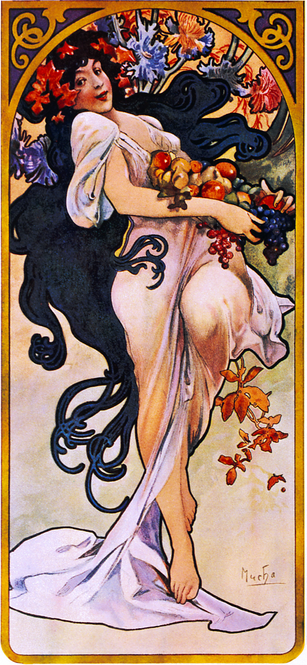
Mucha Winter SolsticeTHE WINTER SOLSTICE CEREMONY

Also known as “The Gate of Life”

The Word of this ceremony is ‘AUMGN.’ It is repeatedly intoned in between scenes, i.e. between Scenes 1 & 2 and between Scenes 2 & 3, by the People/Congregants. The Incense of this ceremony is Myrrh.1 The Talisman of this ceremony is the goblet(s) of Wine.

SCENE 1: Sagittarius.
The Wandering in the Wilderness.

The King is in the West, facing East. + and – are on either side of the King, holding the staff and lantern. The High Priestess sits behind the Veil in the East. The King circumambulates2 the Temple clockwise/deosil to symbolize his wandering in the wilderness.

[INTRO MUSIC: Frédéric Chopin’s Sonata, op. 35, Part III: “Marche funèbre” a.k.a. “Funeral March”]

The King approaches the East from the West in a winding or serpentine manner. + and – follow behind the King, + behind the King and in front of –.

KING: I have left my Beloved and my Kingdom in search for the Elixir of Immortality; I have wandered alone in the wilderness; I have endured the travails of the desert… The footprints of the Camel lead up this winding way to the Summit of the Mountain.

The King stops a few steps in front of the Veil, as if he was in front of the small altar in the Gnostic Mass. + and – stand on either side of the King, slightly behind him.

PRIESTESS: I am the Soul of the Desert; thou hast sought me in the wilderness of sand.3

The King turns to his right (deosil) and heads towards the West, starting his first circumambulation with + and – behind him in a line,.

KING: I am the voice of one crying in the wilderness. Make straight the Way of my Will!4

The King, halfway done with his circumambulation in the West, turns deosil back towards the East, + and – still following behind in a line, and finishes his first circumambulation while the Priestess says:

PRIESTESS: With courage conquering fear shall ye approach me.5

The King turns to his right (deosil) and heads towards the West with + and – behind him, starting his second circumambulation.

KING: By the word and the will, by the penance and the prayer, let me behold thy face.6

The King, halfway done with his circumambulation in the West, turns deosil back towards the East with + and – behind him, and finishes his second circumambulation while the Priestess says:

PRIESTESS: Fear not for aught; turn not aside for aught, eremite of Nuit, apostle of Hadit, warrior of Ra Hoor Khu!7 Only those who fear shall fail!8

The King turns to his right (deosil) and heads towards the West with + and – flanking him, starting his third circumambulation.

KING: I fear no power in heaven or upon the earth or under the earth.9 Success is my proof; courage is my armor; I shall turn not back for any!10

The King is halfway complete with his third circumambulation and stops in the West, facing East.

PRIESTESS: Many are the champions of life, but all are unhorsed by the lance of death.11

The King is stripped of his staff so that he has no support, i.e. + snaps the staff in two or throws it away and stands next to the King in the attitude of Resurrection (Osiris Risen).

PRIESTESS: Many are the children of the light, but their eyes shall all be put out by the Mother Darkness12

The King is then stripped of his lantern so he cannot see at night, i.e. – blows out the flame of the lantern and stands next to the King in the attitude of Resurrection (Osiris Risen). + and – then approach the King and remove his scarlet robe, throwing it on the floor, showing he is stripped of everything extraneous and unnecessary, i.e. the purging fire13 of asceticism. + and – then go to the sides of the Veil, and face outwards towards the West in the sign of Osiris Risen.

The King is exhausted but he persists to the East to finish his third and final circumambulation while saying:

KING: “Mighty and erect is this Will of mine [he lifts the Lance], this Pyramid of fire whose summit is lost in Heaven. Upon it have I burned the corpse of my desires!”14

PRIESTESS: “He who endures unto the end will have eternal life.”15

END SCENE.

No Music. A light is turned out to make the Temple slightly darker. Congregants repeatedly intone ‘AUMGN’ in between scenes.

SCENE 2: Capricorn.
The Temptation of the Buddha-Christ King and the Rending of the Veil of the High Priestess

Everyone is in the same position as the end of the first scene. + now holds a “false Grail” filled with jewels, jewelry, coins, and other things indicating material wealth. holds a “false Grail” filled with a potion (although not necessarily filled with anything, the symbolism remains). The King is three steps away from the Veil16, and with each step he undergoes a Temptation.17

The King takes his first step towards the Veil/on the dais.

+ steps down to the first step on the dais and turns to face the King, offering the “false Grail” full of coins, jewels, etc.

+: You have finished your quest. I will give you the endless pleasure of the most beautiful women of the world; I will grant you rulership over all the kingdoms of the Earth.

KING: It has been written, ‘Thou hast no right but to do thy will.’18 I am not swayed by your appeal to petty lusts. Neither pleasure nor power shall satisfy me. I seek only Nuit and will turn not aside for anything.

The King extends his Lance forward towards + (towards the South if the High Altar is in the East) to make a horizontal arm of a Cross of Light. + spins away, puts the “false Grail” away, and retreats back to the former position at the Veil in the Sign of Osiris Risen.

The King takes his second step.

descends to the second step, turns to face the King, and offers another “false Grail” containing a potion.

–: It is also written, ‘To worship me take wine and strange drugs whereof I will tell my prophet, & be drunk thereof! They shall not harm ye at all.’19 Therefore, drink this concoction and you will not be harmed.

KING: We have been warned to shun those who would interpret the Law for us as centres of pestilence.20 I have “certainty, not faith,”21 the certainty of my own Understanding won through my own struggles. I seek not to be deceived into swaying from my own path by resting content in adhering to others’ beliefs. I seek only Nuit and will turn not aside for anything.

The King extends his Lance forward towards – (towards the North if the High Altar is in the East) to make the second horizontal arm of a Cross of Light. – spins away, puts the “false Grail” away, and retreats back to the former position at the Veil in the Sign of Osiris Risen.

The King takes his third step.

Both + and – stand outward, questioning the King on the third step.

+: O man, who art thou that wouldst penetrate the Mystery?22

–: What makes you think you are worthy to speak to the High Priestess Nuit?

+: Who attests to your authority?

–: Who attests to your attainment?

KING: I am the Holy Chosen One.23 The very Earth testifies to my attainment.

The King raises the Lance and there is the sound of a lightning strike; he then strikes the ground with the Lance and there is the sound of loud thunder; he thereby makes the two vertical portions of the Cross of Light, therefore completing the entire Cross; the Earth trembles and thunders.24

+ and – retreat to the Veil, face one another, and are ready to rend the Veil.

KING: I seek only Nuit and will turn not aside for anything!

The Veil is then rent by + and –. The High Priestess sits enthroned. She has the moon under her feet, and upon her head is a crown of twelve stars.25 The golden Holy Grail is hidden behind her.26

PRIESTESS: Lonely am I and cold in the wilderness of the stars. For I am the queen of all them that dwell in Heaven, and the queen of all them that are pure upon earth, and the queen of all the sorcerers of hell. I am the lady of the stars, the Bride of them that are vowed unto loneliness.27

KING: O Lady of the Stars! I have left my Beloved and my Kingdom; I have wandered alone in the wilderness; I have endured the travails of the desert; I have followed the footprints of the Camel to the summit of the Earth… all in search for the Elixir of Immortality.

PRIESTESS: I alone have the Wisdom wherewith the Elixir may be produced… yet it requires a sacrifice.28

The High Priestess retrieves the hidden Holy Grail that was hidden behind her, and she holds it before the King.

KING: I have been stripped of all I have. What could I give as a sacrifice?

PRIESTESS: The Elixir may only work upon those who have sacrificed their body and blood.

KING: How could eternal life be given unto them who are no longer alive? I pray that you explain this paradox.

PRIESTESS: The reasoning mind cannot pass this threshold. “If Will stops and cries Why, invoking Because, then Will stops & does nought.”29 What spurned thee to this quest?

KING: Naught but Love.

PRIESTESS: Have you no Love left?

KING: The beat of my heart is the pendulum of love. The songs of me are the soft sighs: The thoughts of me are very rapture: And my deeds are the myriads of Thy children, the stars and the atoms. Let there be nothing! Let all things drop into this ocean of love!30

PRIESTESS: Give your last particle of dust31 in the ecstasy of sacrifice! Consummate Thy rapture!32

The King stabs himself in the side33 with the Lance.

KING AND PRIESTESS: Falutli!34

The Priestess and King kiss.

The King staggers and falters, and is almost dead. The Priestess fills her Cup with the blood from the King’s wound.35

PRIESTESS: It is done!36

+: He hath drunk of the waters of death!

PRIESTESS: Not otherwise could he water the Rose.

–: He hath burnt himself at the Fires of life!

PRIESTESS: Not otherwise could he sun the Rose.37

The Priestess raises the Chalice, and the King looks up at it.

Let him look upon the cup whose blood is mingled therein, for the wine of the cup is the blood of the saints. I have spilt their blood in every corner of the earth and lo! I have mingled it in the cup of my whoredom. With the breath of my kisses hath I fermented it, and it hath become the wine of the Sacrament, the wine of the Sabbath.38

The Priestess descends to fill the Congregant’s goblets with some wine from the Grail.

[MUSIC: Benedictine monks chanting of “Ave Maria” and “Alma Redemptoris Mater”39]

PRIESTESS: In the Holy Assembly hath I poured it out for my worshipers, and they had become drunken thereon, so that face to face they beheld my Father.

+: Thus are they made worthy to become partakers of the Mystery of this holy vessel.

–: For the blood is the life!40

PRIESTESS: Death is no catastrophe; it is Love.

The High Priestess raises her Grail and motions as if drinking from it, signaling to the People that they may drink the wine in their goblets.

PRIESTESS: Death is not the end; it is Life to come!41

The Priestess, +, and – all turn to face the King with arms extended towards one another to form a Hexagon.42

PRIESTESS, +, and –: AUMGN.

[MUSIC: While this is being intoned, begin to play Gustav Holst’s “Saturn” from “The Planets,” starting around ~4:15 so the crescendo comes right after the last line]

The Priestess crowns the King.

PRIESTESS: The King is dead! Long live the King!

END SCENE. 

[MUSIC: Let Holst’s ‘Saturn’ play out]

Congregants repeatedly intone ‘AUMGN’ in between scenes.

SCENE 3: Aquarius.
The Mourning of the Mother and the Portend of the Child-Savior.

The Queen (divested of her Priestess garments, now wearing her Green robe and crown of flowers) is back at the Kingdom; she is in the throne and mourning the absence of the King.

+ and – stand to the West and look concerned and distressed.

+: She is weeping…

–: Weeping…43

QUEEN: I sit solitary; I have become a widow! I weepeth sore and there is none that can comfort me! There is naught but treachery and affliction!44

The Queen gets up and starts to move towards the West.

I can neither strive nor wait. There is agony in my ears, and in my throat, and mine eyes have been so long blind that I cannot remember that there ever was such a thing as sight45. The Obelisks are broken; the stars have rushed together: the Light hath plunged into the Abyss: the Heavens are mixed with Hell… I am lost in the night of infinite pain: no hope: no God: no resurrection: no end: I fall: I fear.46

The Queen turns back towards the East and falls to her knees. + and – approach and kneel to comfort her, facing the West.

QUEEN: My mind is distraught by the bitterness of my heart.47 I doubt whether I may endure this winter storm.

The Eightfold Star48 [a Unicursal Hexagram can be substituted] then rises on the horizon (in the West) as a portend of the birth of the Child-Savior. The Queen is given Hope49 to persist through the final hours of Midnight/Winter50.

+ looks up, points with fear, and stands up.

+: Look! A great star falling from heaven, burning as if it were a lamp; it is falling upon the waters.51

+ starts to back away a few steps. – gets up and starts to back away as well while saying:

–: Beware: that is the Star called Wormwood!52 Many men will die of the waters, because they are made bitter.53

The Queen turns to look at the Star in the West, rises to her feet, and says:

QUEEN: Fear not my brothers and sisters… This is the world of the waters of Maim; this is the bitter water that becometh sweet!54

+ and – walk together to stand next to the Queen while + says:

+: Weeping may endure for a night, but joy cometh in the morning.55

–: They that sow in tears shall reap in joy.56

QUEEN: I have dreaded this midnight of the soul, for I thought it was the end. Now I welcome the herald.57 Ay! It is the end!

[MUSIC: The beginning of Glazunov’s “Winter”]

QUEEN: …the gate of the beginning!58

END SCENE.

[OUTRO MUSIC: Play out the first ~6 minutes of Alexander Glazunov’s “Winter” from “The Seasons,” starting from ~0:45]

1 Myrrh is attributed to Saturn. In the story of Christ, “myrrhbearers” were said to be those involved in the burial of Christ or finding his tomb, which corresponds to the Winter Solstice ceremony insofar as the King (who is identified with Christ) dies and the world enters into complete darkness of the middle of Winter.

2 These three circumambulations are seen in the Gnostic Mass before his three steps of approaching the Veil.

3 Liber LXV, IV:61.

4 A reference to Mark 1:3 and John 1:23 where it is put in the mouth of Christ, which is itself a reference to a similar line in the Old Testament, i.e. he is fulfilling the prophecy of the Redeemer.

5 Liber Tzaddi, line 16.

6 The Vision and the Voice, 20th Aethyr.

7 The Vision and the Voice, 20th Aethyr.

8 Liber Tzaddi, line 18.

9 Liber AL, III:17.

10 Adapted from Liber AL, III:46.

11 The Vision and the Voice, 19th Aethyr.

12 The Vision and the Voice, 19th Aethyr.

13 It is like the Sagittarian Arrow of aspiration soaring upwards, leaving behind the chaff.

14 The Book of Lies, chapter 15.

15 An adaptation of Matthew 10:22 and 24:13; it is also a reference to the motto of 666, “Perdurabo,” i.e. he who endures unto the End.

16 This is seen in the Gnostic Mass in the Three Steps of the Priest toward the Altar before rending the Veil.

17 These refer to the three Temptations of Christ by Satan on the Mount as well as the three Temptations of Buddha by Mara.

18 Liber AL, I:42.

19 Liber AL, II:22.

20 A reference to the Tunis Comment to The Book of the Law.

21 Liber AL, I:58.

22 The Vision and the Voice, 28th Aethyr.

23 Liber AL, I:65.

24 A form of Buddha in his pose of defying Mara, i.e. in Lotus position with one hand on the ground.

25 Revelation 12:1.

26 The Cup of Babalon that is mentioned in Book of Revelation as well as in The Vision and the Voice; it is seen in the Gnostic Mass.

27 Adapted from The Vision and the Voice, 27th Aethyr. At this point, the King believes he has found the mythical “High Priestess Nuit” mentioned in the Autumn Equinox ceremony.

28 This line shows a sinister turn of the character of the High Priestess. At first we think she is the benevolent Nuit, lady of the stars, but she is actually Babalon, the Mother of Abominations, the Great Whore, who has the blood of the saints in her Cup upon which she is intoxicated.

29 Liber AL, II:30.

30 Liber VII, V:21-28.

31 Liber AL, I:61, “For one kiss wilt thou then be willing to give all; but whoso gives one particle of dust shall lose all in that hour.”

32 Liber VII, V:30.

33 The final wound of Christ on the Cross, c.f. John 19:34, “But one of the soldiers with a spear pierced his side, and forthwith came there out blood and water.”

34 Liber VII, V:30; Also called “The outburst of the orgasm” in The Vision and the Voice, 2nd Aethyr, and is therefore identical to “HRILIU” as seen in the Gnostic Mass.

35 This is similar to the Crucifixion scene where Christ is stabbed in the side. His blood, in this ceremony, is collected into the Chalice by the Priestess who would be Mary Magdalene in the Crucifixion (who is often identified as a prostitute).

36 A reference to Revelation 16:17 that is itself referring to Armageddon, the End, which is here identified with the death of the self, the dissolution of the ego in the Absolute whereby 8=3 may be attained.

37 This exchange comes from The Vision and the Voice, 14th Aethyr.

38 This entire exchange comes from The Vision and the Voice, 12th Aethyr.

39 These are two of the four “Marian hymns” dedicated to the Virgin Mary. Mother Mary was the Old Aeon version of the Divine Feminine, which is equivalent to Babalon, the Whore, in the New Aeon. MARIE in Greek (Marie) = 156 = BABALON in Hebrew (n(l)b)b) as well as Greek (Babalon).

40 This entire exchange comes from The Vision and the Voice, 12th Aethyr.

41 An adaptation of The Book of Lies, chapter 18, “Verily, love is death, and death is life to come.”

42 The hexagon is a 6-sided figure, which relates it to the 6th Sephirah on the Tree of Life, Tiphareth, that is attributed to Sol, Death-and-Rebirth gods (e.g. Osiris, Christ, Orpheus, Dionysus, etc.), and the Son in whom the Father is reborn (which can be seen in the Vernal Equinox ceremony). Alternately, they form a triangle with the King in the center, representing the axle of the Wheel of Jupiter or Fortune that moves not yet undergoes the triplicity symbolized by the Sphinx, Hermanubis, and Typhon (i.e. Rajas, Tamas, and Sattvas or Sulphur, Salt, and Mercury, etc.)

43 The Vision and the Voice, 27th Aethyr.

44 Adapted from Lamentations 1:1-3.

45 The Vision and the Voice, 2nd Aethyr.

46 The Vision and the Voice, 30th Aethyr.

47 Adapted from The Heart of the Master.

48 The Star of Mercury, i.e. of the Redeemer; the Morning Star.

49 As seen in Atu XVII: The Star to which is attributed the sign of Aquarius.

50 That which is depicted in Atu XVIII: The Moon.

51 Adapted from Revelation 8:10.

52 From The Heart of the Master, also a reference to Revelation 8:11, “And the name of the star is called Wormwood…”

53 Revelation 8:11.

54 Liber LXV, III:55.

55 Psalm 30:5.

56 Psalm 126:5.

57 Adapted from AHA!, “Olympas: I dread this midnight of the soul. / Marsyas: Welcome the herald!”

58 The Vision and the Voice, 29th Aethyr.


Visions and Trances on the Path of Initiation (pt.2)

Qabalistic Map of Initiation

Do what thou wilt shall be the whole of the Law.

← Part 1  | → Part 3 → ]

Interlude: Visions of the Three Orders

The Three Orders on the Tree of Life

The Three Orders on the Tree of Life

The Tree of Life is often split into three different portions that correspond loosely (although not exactly) with the three Orders of systems like Golden Dawn and A∴A∴, the Hebrew parts of the Soul, and Tetragrammaton (YHVH):

  • The 3rd Order is in Malkuth (the 10th Sephirah). It corresponds with the Nephesh, or “Animal Soul,” in terms of the parts of the Soul, and it corresponds with the Final Heh of YHVH.
  • The 2nd Order is centered in Tiphareth (the 6th Sephirah) and encompasses the surrounding Sephiroth (Chesed, Geburah, Netzach, Hod, and Yesod). It corresponds with the Ruach, or the mind with its many faculties (e.g. memory, volition, reason, etc.), and it also corresponds with the Vav of YHVH.
  • The 1st Order includes the Supernal Triad of Kether, Chokmah, and Binah (the first three Sephiroth). It corresponds with the triad of the immortal Soul including Jechidah (the Individuality of Kether), the Chiah (the Life-Force of Chokmah), and the Neshamah (the Intuition of Binah). It also corresponds with the Yod and Heh of YHVH.

Each of the three Orders has a Trance that is characteristic of it: the 3rd Order has the Trance of Sorrow mentioned previously. The 2nd Order has Knowledge & Conversation of the Holy Guardian Angel in Tiphareth. The 1st Order has the successful crossing of the Abyss.

One could say that each of these Orders and their characteristic Trances is distinguished by a certain view of life while upon the Path of initiation:

  • 3rd Order: Man versus World. The world is seen as a force to be overcome, and it is full of sorrow, disappointment, stress, and failure. This is the Grade of Man of Earth, and it corresponds to the Trance of Sorrow.
  • 2nd Order: Man and World. The world is seen as harmonious where one is united constantly with various elements thereof, and it is full of beauty and a constant source of joy. This is the Grade of Lover, and it corresponds to Knowledge & Conversation of the Holy Guardian Angel.
  • 1st Order: Man is World. The duality or distinction between “self” & “not-self” or “ego” & “environment” or “subject” & “object” is completely dissolved: the union has become so full that there is no difference between self and other so all that is, is Unity. This is the Grade of Hermit, and it corresponds to the successful crossing of the Abyss.

Second Order Visions

There are Visions within each of the three Orders, but the Second Order has a series of Visions corresponding with each Sephirah that are all highly interrelated. These 2nd Order Visions are all centered around Tiphareth, and they all have to do with certain insights into the nature of the Cosmos. These Visions are:

  • Yesod: The Vision of the Machinery of the Universe
  • Hod: The Vision of Splendour
  • Netzach: The Vision of Beauty Triumphant
  • Tiphareth: The Vision of the Harmony of Things
  • Geburah: The Vision of Power
  • Chesed: The Vision of Love

We will go into each of these in more depth in the following sections.

2) Yesod (2°=9: Luna)

The Vision of the Machinery of the Universe

In 777, we can see that “The Vision of the Machinery of the Universe” is attributed to Yesod, the 9th Sephirah on the Tree of Life. It may also be called “The Vision of Change” or “The Vision of Stability in Change.” It is the first of several Visions that involves noetic insight into the nature of the Universe (the only previous Vision, the Vision of Adonai, deals with one’s personal pursuit of the Great Work rather than being an insight into the nature of the world).

First, some esoteric symbolism: The 9th Sephirah is called Yesod, which literally means “Foundation.” This term implies stability. Nonetheless, the Moon (also known as “Luna”) is attributed to Yesod and is characterized by its constant waxing and waning along with its effect on the constant ebb and flow of the tides: therefore, this implies constant flux or change. This Sephirah therefore contains both the ideas of stability and change. This is an esoteric way of pointing to the paradox which is often phrased as something like “Stability is Change and Change Stability” (Liber CL: De Lege Libellum). The final resolution of this antinomy or paradox is said to come in the 2nd Sephirah of Chokmah, which shows how Yesod is a reflection of Chokmah “on a lower scale,” so to speak. Esoterically, this can be seen in that the grade attributed to Yesod is 2°=9☐  and the grade attributed to Chokmah is 9°=2. This paradox has many levels of truth, but one of the most basic forms, appropriate to the “lower” sphere of Yesod, is the idea that “The Stability of the Universe is Change” (The Heart of the Master). Crowley writes further concerning this idea:

“Of all important doctrines concerning equilibrium, this is the easiest to understand, that change is stability; that stability is guaranteed by change; that if anything should stop changing for the fraction of a split second, it would go to pieces. It is the intense energy of the primal elements of Nature, call them electrons, atoms, anything you will, it makes no difference; change guarantees the order of Nature. This is why, in learning to ride a bicycle, one falls in an extremely awkward and ridiculous manner. Balance is made difficult by not going fast enough. So also, one cannot draw a straight line if one’s hand shakes.”
—Aleister Crowley, The Book of Thoth, “Small Cards”

Yesod: The Vision of the Machinery of the Universe

Yesod: The Vision of the Machinery of the Universe

With this in mind, the Vision of the Stability in Change is characterized by the perception that the Universe is a constant change or flux of all things. It is therefore equatable to understanding one of the Three Characteristics of Buddhism, that of anicca, the impermanence of everything. The self – considered as one’s mind and body – is an intertwined, constantly changing, and inseparable part of the whole. This is related to the Trance of Sorrow insofar as sorrow or dukkha stems from the fact that all things are subject to impermanence or anicca and therefore are ultimately insubstantial or unsatisfactory, yet this Vision differs from the Trance of Sorrow insofar as its focus is upon mutability, change, flux, and motion (anicca) rather than on sorrow and dissatisfaction (dukkha). As Crowley says above, this idea that everything is in flux is fairly easy to understand but, yet again, the intellectual comprehension of this idea is not the same as the Vision itself, where the fact of the impermanence of all things is known or felt or understood in the core of one’s being.

One meditation that resembles such a Vision is through the contemplation of the world as constituted by atoms: consider how everything you perceive, including your own body, is composed of atoms – the machinery of the universe, in a sense – that are swirling around at incomprehensible speeds. All the objects around you with their apparently motionless solidity are actually, when considered at the atomic level, in constant, unstoppable motion. Extend this idea to yourself, the objects around you, everything on earth, and everything in the universe. Consider how all of this perpetual flux interacts and intertwines with itself in such a perfect fashion as to create what we know as the Universe, from the most basic rock to the most elaborate technology, from the most basic amoeba to the most complex pattern of neuronal firings and structure of the human brain. In this way, we come to peer into the Machinery of the Universe, perceiving that “The Universe is Change” (The Heart of the Master) and that the structure of the Universe is a result of it.

3) Hod (3°=8: Mercury)

The Vision of Splendor

In 777, we can see that “The Vision of Splendour” is attributed to Hod, the 8th Sephirah on the Tree of Life. The planet Mercury is attributed to this sphere, and Mercury is generally associated with things like communication, language, knowledge, and intellect.

Hod: The Vision of Splendor

Hod: The Vision of Splendor

In a way, the Vision of the Machinery of the Universe in Yesod is the foundation (pun intended) of the next few visions that all developments or even reactions to it. In perceiving the Universe as constant flux, one is struct by the wonder and glory that things are constituted in this way. The mind boggles in amazement at the sheer complexity, intricacy, and even strangeness that the world works. It is, in a way, a Vision of intellectual awe. The Vision of Splendor is characterized by the mind becoming awe-stricken and enraptured by the sheer wonder and splendor of the Nature of the Universe.

Just as a scientific contemplation was used in the previous section to attempt to approximate the nature of the Vision, various scientists have spontaneously or naturally attained the Vision of Splendor – or some form thereof – through their understanding and contemplation of the Universe. A classic example is the well-known scientist Carl Sagan who was famous for instilling a sense of awe and wonder about the Universe. He wrote in Pale Blue Dot, “How is it that hardly any major religion has looked at science and concluded, ‘This is better than we thought! The Universe is much bigger than our prophets said, grander, more subtle, more elegant?’ Instead they say, ‘No, no, no! My god is a little god, and I want him to stay that way.’ A religion, old or new, that stressed the magnificence of the Universe as revealed by modern science might be able to draw forth reserves of reverence and awe hardly tapped by the conventional faiths.” Other examples include the biologist Richard Dawkins who wrote in Unweaving the Rainbow, “The feeling of awed wonder that science can give us is one of the highest experiences of which the human psyche is capable.” Another example is the astrophysicist Neil Degrasse Tyson who has said, among other things, “I know that the molecules in my body are traceable to phenomena in the cosmos. That makes me want to grab people on the street and say: ‘Have you HEARD THIS?'” These are, in a way, all expressions of the Vision of Splendor.

In this, we can see that the Vision of Splendor is like what Crowley calls “The Trance of Wonder,” at least on a “lower scale.” In speaking about this Trance of Wonder, Crowley writes:

“In all Trances of importance, and most especially in this, the Postulant should have acquired the greatest possible knowledge and Understanding of the Universe properly so called. His rational mind should have been trained thoroughly in intellectual apprehension: that is, he should be familiar with all Science. This is evidently impossible on the face of it; but he should aspire to the closest approximation to perfect Adeptship in this matter. The method most possible is to make a detached study of some chosen branch of Science, and a general study of epistemology. Then by analogy, fortified by contemplation, a certain inner apprehension of the Unity of Nature may grow up in the mind, one which will not be unduly presumptuous and misleading.”
—Aleister Crowley, Little Essays Toward Truth, “Wonder”

Crowley himself therefore saw the importance of an understanding of Science and its relationship to aiding in the attainment of Trances or Visions. This Vision of Splendor corresponding to Hod – the sphere of intellect, science, communication, mathematics, et cetera – shows that this Vision corresponds to a somewhat intellectual nature insofar as the mind is stricken with wonder and awe at the composition, patterns, and flux of the Universe. It is, in a way, the intellectual complement to the Vision of Beauty in Netzach that is similar but of the nature of aesthetics or emotion.

4) Netzach (4°=7: Venus)

The Vision of Beauty

Netzach: The Vision of Beauty

Netzach: The Vision of Beauty

In 777, we can see that “The Vision of Beauty” or “The Vision of Beauty Triumphant” is attributed to Netzach, the 7th Sephirah on the Tree of Life. The planet Venus is attributed to this sphere, and Venus is generally associated with things like sensuality, physical beauty, aesthetics, love, and devotion.

This Vision of Beauty must be distinguished from the “Beatific Vision” that is attributed to Tiphareth, for “beatific” implies holy bliss rather than the aesthetic beauty that is characteristic of this Vision of Beauty in Netzach. Just as the Vision of Splendor mentioned previously is an appreciation of the Nature of the Universe in terms of intellectual awe and wonder, the Vision of Beauty is characterized by the aesthetic appreciation and emotional rapture that results from a contemplation of the Nature of the world.

Specifically, this Beauty is not limited to what we normally consider as “beautiful” as opposed to “ugly,” but – instead – this rapture or Vision of Beauty includes absolutely all things in the cosmos from the smallest to largest, the lowest to the highest, the most peaceful to the most turbulent, the ugliest to the most beautiful. Crowley writes of this very idea when writes, “The New Aeon proclaims Man as Immortal God, eternally active to do His Will. All’s Joy, all’s Beauty; this Will we celebrate” (New Comment to Liber AL, II:35). Or: “All is a never ending Play of Love wherein our Lady Nuit and Her Lord Hadit rejoice; and every Part of the Play is Play. All pain is but sharp Sauce to the Dish of Pleasure; for it is the Nature of the Universe that hath devised this everlasting Banquet of Joy” (Liber Aleph). Or when he writes:

“The artist is he who can discover Beauty in all things, for nothing is common or unclean; and by unvarying determination to discover beauty man comes to the heaven of the artist. By beauty, moreover, We mean not any conventional type of sensuous beauty: it lies in the dwarfs of Velasquez and the monsters of Rabelais as in the women of Titian and the heroes of Homer; nor shall one brother do otherwise than lament if he be so limited in vision that he cannot see beauty in that which enchants another.”
—Aleister Crowley, Liber CXXIV: Of Eden and the Sacred Oak

This Vision of Beauty is therefore where we enraptured with beauty, “perceiving Beauty in the Harmony of the Diverse” (Liber Aleph), which is the emotional-aesthetic complement to the mental-intellectual Vision of Splendor that is based on the mind being bewildered by awe and wonder from contemplating the Universe.

[← Part 1  | → Part 3 →]

Love is the law, love under will.

Visions and Trances on the Path of Initiation (pt.1)

Qabalistic Map of Initiation

Do what thou wilt shall be the whole of the Law.

0) Introduction

In the Western tradition, the path of initiation (also known as “the Great Work”) is often laid out symbolically as “climbing” the Tree of Life from the bottom back to the top. While the map is not (nor can ever be) the territory, this map of the Tree of Life can be very useful to help elucidate the stages of the Path. The different “grades” of the Path are attributed to the different spheres or “Sephiroth” of the Tree of Life and can be characterized, to a certain extent, by the Qabalistic attributions of that Sephirah.

The Importance of Trances

If one is truly walking on the Path, one will not simply be able to pass simple tests of physical ability and mental knowledge. While these things are assuredly part of the Path and necessary thereto, real progress on this Path can be seen in changes of consciousness or the acquisition of new perspectives. Therefore, one of the indicators of having “achieved” a grade in an informal sense (i.e. outside of the rules of attaining a grade in any particular formal organization such as Golden Dawn or A∴A∴) is the attainment of a Vision and/or Trance characteristic of that grade. The importance of these Trances is stated clearly by Aleister Crowley:

“The word Trance implies a passing beyond: scil., the conditions which oppress. The whole and sole object of all true Magical and Mystical training is to become free from every kind of limitation… every Magical Operation soever is only complete when it is characterised (in one sense or another) by the occurrence of Trance.”
—Aleister Crowley, Little Essays Toward Truth, “Trance”

Definitions of Trance and Vision

Trance: A Trance is therefore an event within consciousness where one transcends the normal state of awareness, often in a “quasispasmodic” manner – that is, Trances are often (though not always) entered somewhat suddenly and the entering into Trance often comes at an unknown time. Samadhi can be seen as a special form or type of Trance characterized by “the supersession of dualistic human consciousness by the impersonal and monistic state” (Little Essays Toward Truth, “Trance”). A Trance is not necessarily in line with – and often in contradiction to – rational thinking: Samadhi is a characteristic example where whenever someone speaks about its nature they speak in paradox and contradiction. Trances are also characterized by their noetic nature – that is, they grant a felt sense of interior certainty regarding the truth of its content.

Vision: A Vision might be defined as a lesser form of Trance, where the acquisition of a new point-of-view or perspective does not necessarily require entering into a different state of consciousness, but it is still characterized by being noetic (i.e. granting a sense of interior certitude). Therefore, this distinguishes this definition of Vision from “astral visions,” which are not necessarily noetic in nature but may contain instances of Trance or Vision within them. It must also be stated that, although the term “Vision” implies sight, it really refers more to a particular type of experience or insight rather than being a series of visual sights, whether physical or mental (or astral). It is similar to the term “visualization” in occultism, which is often taken to mean focusing on visual images in the imagination but actually, in practice, refers to imagining things pertaining to all senses. Trances and Visions can therefore be distinguished from mere intellectual apprehension, for something can be intellectually grasped but not truly understood and felt as a certainty. To move beyond intellectual apprehension, one usually needs to have an experience for oneself that confirms the original idea but grants it a subject sense of truly “grasping” the idea or truly understanding it. As an illustration: a child might be told “you need to listen more carefully to others!” and grasp the idea intellectually, but not truly understand it. It requires the child having an experience – e.g., missing something important because of not listening carefully – to move from intellectual comprehension to real, certain understanding.

These definitions are not absolute, and there are blurry areas. People – including Crowley – often use these terms interchangeably. The main point is that Trance and Vision are states of consciousness that differ from normal, waking awareness and are characterized by (a) being noetic (felt sense of interior certitude) and (b) attaining a new point-of-view or perspective. This distinguishes them from both “astral visions” (both waking and dreaming) as well as from mere intellectual comprehension. The very fact of having attained a Trance or Vision inherently shows progress upon the Path insofar as they, by definition, imply a change within the individual – a shift of perspective or consciousness – whereas having an astral vision or intellectually grasping something do not necessarily imply any kind of real change in the individual at all.

We can now start to look at the various Trances or Visions in the context of the Tree of Life. Although the metaphor of “climbing the Tree of Life” implies that these steps are sequential, I believe that most of these Trances or Visions may happen at any time (depending on the right circumstances and intent), some may happen before others, some may even at the same time as others, and some may occur multiple times. There is no real test as to whether another person has attained any of these Trances or Visions, as tests must inherently be physical or intellectual, and I believe we all know that anyone can enter into a Yogic asana (physical) or say they are a Master (intellectual) but not actually be a Master at all. Therefore, this essay is intended to serve as a map for oneself – a kind of periodic table of Visions and Trances – both to show the possibilities of these Trances or Visions as well as to help understand various experiences that one may have had in the past or will have in the future (or perhaps presently if the reading of this essay somehow sends one spasmodically into a Trance – I wouldn’t exclude the possibility a priori!)

1) Malkuth (1°=10: Earth)

The Trance of Sorrow

The first Sephirah we encounter when “climbing the Tree of Life” is the 10th Sephirah that is called “Malkuth” (literally, “Kingdom”). We may attribute the Trance of Sorrow to Malkuth. The Trance of Sorrow may be defined as the Trance wherein one perceives that any and every endeavor, accomplishment, joy, connection, et cetera are ultimately insubstantial and will therefore eventually dissolve or end; essentially the Trance of Sorrow is where one realizes that nothing whatsoever lasts.

We may understand “Sorrow” as being a translation the Buddhist term dukkha, which is often translated as “suffering” (or “sorrow,” “misery,” “discontent,” “stress,” “dissatisfaction,” “anxiety,” etc.). In this way, the Trance of Sorrow represents an experiential understanding and appreciation of the First Noble Truth, which can be stated in many ways but ultimately means that “All things contain or are subject to suffering.”

The Trance of Sorrow helps to illustrate two points mentioned previously. Firstly, the “Trance of Sorrow” is called such by Crowley throughout his works, yet it is called the “Vision of Sorrow” in 777 and the “Vision of Universal Sorrow” elsewhere. This illustrates the point that “Trance” and “Vision” are terms that are often used interchangeably: one should not get too caught up in the words. Secondly, the Trance of Sorrow is a good example of how Trance is different from mere intellectual comprehension. One may intellectually grasp what has been said above – one may have previously encountered the First Noble Truth of Buddhism and grasped the idea being conveyed – yet the Trance of Sorrow goes beyond mere comprehension to a felt sense at the core of one’s being. The Trance involves an encompassing and even overwhelming sense of sorrow, dread, and even hopelessness. Although one can reach the Trance through intellectual contemplation, the Trance itself shows when this felt sense of certitude kicks in and one truly experiences the idea not merely as an idea but as an inescapable truth. A certain poetic explanation of this state can be found in Crowley’s “One Star in Sight” which begins with the lines, “Thy feet in mire, thine head in murk, / O man, how piteous thy plight, / The doubts that daunt, the ills that irk, / Thou hast nor wit nor will to fight— / How hope in heart, or worth in work? / No star in sight!”

To go further into the nature of the Trance of Sorrow: Nothing whatsoever lasts. You will inevitably die. Your family will die, your loved ones will die, your friends will die, your enemies will die, and all the people you’ve never known will all die: everyone will die. Every place you have been will change and pass away. The cycle of Life never stops; the Wheel of Samsara will never stop turning. Everything you know will eventually transform and perish.  The greatest joy and happiness you ever will achieve will eventually pass. No food, drink, idea, love, or anything else will ever truly satisfy you. Everything that you are striving for – all of your hopes, goals, and ambitions – will either remain unaccomplished or will be accomplished but will not last for long. No job lasts forever, no art piece lasts forever, no political change lasts forever, et cetera. Even if you were to become the most powerful and famous person on Earth, your memory will be distorted throughout time and eventually forgotten. If not within a few years, then it will happen in a few centuries; if not in a few centuries, it will happen when the human race no longer exists. While we may already know this to some extent and while one may grasp this idea while reading this essay, the Trance of Sorrow begins when it is truly felt and understood on a deep level that shakes the core of one’s very being.

In a sense, this Trance is one of the most crucial of all, for it is the Trance that leads one to tread the Path of the Great Work in the first place. Striving to attain the Light requires the acknowledgment that one is in Darkness. If one is completely content with oneself and one’s surroundings, there is no need to change anything or attain anything: this is the inertia of ignorance. Thus it has been said by Aleister Crowley that, “The Aspiration to become a Master is rooted in the Trance of Sorrow” (Little Essays Toward Truth, “Sorrow”) and also, “It is the Trance of sorrow that has determined one to undertake the task of emancipation. This is the energising force of Law; it is the rigidity of the fact that everything is sorrow which moves one to the task, and keeps one on the Path” (Eight Lectures on Yoga, “Niyama”). It is when one enters into this Trance that one determines to find a way to transcend it: one seeks to be liberated from the Wheel of Samsara in terms of Eastern phraseology; one seeks to find one’s immortal soul that is not subject to change, death, and sorrow in terms of Western phraseology. As Crowley once put it, one determines to enter upon the Path of “the Great Work, understanding thereby the Work of becoming a Spiritual Being, free from the constraints, accidents, and deceptions of material existence” (Magick in Theory & Practice, “Introduction and Theorems”).

As somewhat of a sidenote: In 777, the “Vision of Sorrow” is attributed to the 3rd Sephirah, Binah, and not the 10th, Malkuth. There is, in many ways, a resonance or harmony between Binah and Malkuth: they are both attributed to Heh’s in YHVH (the first Heh is attributed to Binah, the Mother, and the second or final Heh is attributed to Malkuth), and Malkuth is called the Daughter that is uplifted to the throne of Binah, the Mother (As in the 4th Aethyr of The Vision and the Voice, “And this is that which is written: Malkuth shall be uplifted and set upon the throne of Binah”). This shows that, although they are not the same, the Trance of Sorrow of Malkuth is related or harmonious with a Trance or Vision that is characteristic of Binah. In a sense, it is the Trance of Sorrow in Malkuth that gives one the impetus or motive to tread the Path of the Great Work that leads eventually to “crossing the Abyss” and landing in Binah as a Master of the Temple. To make the distinction clear, the Trance of Sorrow in Malkuth involves perceiving the insubstantiality or unsatisfactoriness of all phenomena and is therefore within the realm of duality; Binah is above the Abyss and therefore beyond duality and so not subject to “facts” or “rules” of the realm of duality. To distinguish between the two, the Trance related to Malkuth is called the “Trance of Sorrow” whereas that related to Binah is the “Trance of Compassion.” We should not get too far ahead of ourselves, though. The Path is tread step by step, and one should always seek to take the Next Step: first things first.

The Vision of Adonai / The Vision of the Holy Guardian Angel

The other Trance or Vision is called “The Vision of Adonai” or “The Vision of the Holy Guardian Angel.” Adonai is a name for God or the Lord that comes from Hebrew, and The Holy Guardian Angel is often called Adonai (for example, it is repeatedly named “Adonai” in Liber LXV, a Holy Book of Thelema). Again, it is not useful to get caught up in names: the point is that “The Vision of Adonai” and “The Vision of the Holy Guardian Angel” are two names for the same Vision.

Malkuth: The Trance of Sorrow & The Vision of Adonai

Malkuth: The Trance of Sorrow & The Vision of Adonai

The Vision of the Holy Guardian Angel is characterized by a certain awareness or perception of the Goal of the Path of the Great Work. One may get a glimpse of a certain state of consciousness that transcends the sorrow of duality, or one may even meet an aspect or form of Adonai in an astral vision or dream. Within the world of Darkness and sorrow, one catches sight of a Star that gives direction and hope: there is now “one star in sight.” In a way, the Vision of Adonai is a sort of answer to the Trance of Sorrow. Although one does not transcend the Trance of Sorrow, this Vision gives one the hope or notion of the possibility of transcending it. The Trance of Sorrow is the gravity that pulls one onto the Path that starts at Malkuth and the Vision of Adonai is the force that propels one forward to begin the climb upwards (so to speak).

To be clear: The Vision of the Holy Guardian Angel that is attributed to Malkuth is different from Knowledge and Conversation of the Holy Guardian Angel, which is attributed to Tiphareth (the 6th Sephirah). An analogy from the Golden Dawn may be useful to help explain. In the first initiation of the Hermetic Order of Golden Dawn, the “Neophyte” ritual, one is blindfolded to symbolize the darkness of ignorance. Eventually, the blindfold is removed and one is met with the sight of the Hierophant who symbolizes the Higher or True Self of the candidate. Crowley wrote:

“[The Adept] acclaims his Angel as ‘Himself Made Perfect’; adding that this Individuality is inscrutable and inviolable. In the Neophyte Ritual of G[olden] D[awn] the Hierophant is the perfected Osiris, who brings the candidate, the natural Osiris, to identity with himself. But in the new Aeon the Hierophant is Horus, therefore the Candidate will be Horus too.”
—Aleister Crowley, Liber Samekh, Point II, Part A, line 5

That is, one is given a glimpse of the goal – the True Self with whom one must become united and identified – but one has not yet attained thereto. As it is said, “the End of the ‘Path of the Wise’ is identity with Him” (“Temple of Solomon the King” in Equinox I:1). This shows how Malkuth reflects Kether in a sense (just as the grade 1°=10 has both the number of Kether,1, and Malkuth, 10), for the Goal can be grasped at the beginning of the Path, although one’s understanding of it is inherently limited by ignorance and misconception. One therefore sets upon the path to reach the Sun (the Sun or Sol is attributed to Tiphareth, the sphere where Knowledge and Conversation of the Holy Guardian Angel is attained, which is Kether “on a lower scale,” so to speak): the star is in sight and one is determined to reach it. When one has experienced the Trance of Sorrow and been granted the Vision of Adonai, one may truly be called a “neophyte,” a newly planted seed that may one day, if cultivated carefully and consistently, grow into a Flower of Truth.

→ Part 2 → ]

Love is the law, love under will.

IAO131 on Patreon

If you enjoy these writings, please consider pledging $1+ on my Patreon

Autumn Equinox Thelemic Rituals of the Elements

The Rituals of the Elements: Autumn Equinox

Introduction

It is written in Liber AL vel Legis II:36, “There are rituals of the elements and feasts of the times.” Crowley comments, “The entry of the Sun into the cardinal signs of the elements at the Equinoxes and Solstices are suitable for festivals. The difference between ‘rituals’ and ‘feasts’ is this: by the one a particular form of energy is generated, while there is a general discharge of one’s superfluous force in the other. Yet a feast implies periodical nourishment.” This cycle of dramatic rituals are therefore invocations. They are intended to generate energy at the entrance of the Sun into the cardinal signs of elements at the four quarters of the year, i.e. the Equinoxes and Solstices.

The entire cycle of rituals simultaneously show:

  1. The macrocosmic cycle of the Sun going through the seasons
  2. The microcosmic cycle of Man going through the generations/Incarnation (birth/youth-adulthood-old age-death).
  3. The process of Attainment from 0=0 to 8=3 and back again.

The energies of each ritual correspond to each of these planes at once:

Equinox and Solstice rituals

Each ritual invokes a particular energy. Each ritual has a particular Word of Power associated therewith and it is intoned in between the scenes. The Word also appears once in each ritual within a particular Scene.

Each of the four rituals has 3 scenes for a total of 12 scenes for the entire cycle, one for each of the signs of the Zodiac. The middle scene of each ritual is the sign of the Equinox or Solstice – for example, the middle scene in Autumn is Libra. The first scene is therefore Virgo, the sign before Libra, and the last scene is Scorpio, the sign after Libra. In general, the first scene represents events leading up to the Equinox or Solstice, the middle scene represents the actual turning-point, and the last scene represents events leading to the next Equinox or Solstice.

The Basic Characters

  • (☉/♂) Priest/King – the conscious Self. The Child who grows to become King who attains and becomes a Priest and then dies and is reborn as the Child.
  • (☽/♀) Priestess/Queen the Non-Self (the unconscious self, the “higher self,” etc.). The Mother of the Child, the Queen/Beloved of the King, the High Priestess of the Priest.
  • (+ and -) 2 Children – the duality of the World. Various roles throughout the entire cycle.
  • () The People (participants) – the inhabitants of the World; they identify (at least their conscious selves) with the Priest.


Autumn Equinox MuchaTHE AUTUMN EQUINOX CEREMONY

Also known as “The Hour of Truth”

The Word of this ceremony is ‘THELEMA’ (Theh-lay-muh). It is intoned three times in between scenes, i.e. between Scenes 1 & 2 and between Scenes 2 & 3, by the People/Congregants. 

The Talisman of this ceremony is an ostrich plume (or a smaller representation thereof).


SCENE 1: Virgo.
The End of Summer, the Threat of Winter/Death, the possibility of Immortality.

SETTING: The Kingdom at Sunset1; it is almost the time of harvest2. The King is entering Old Age. The room is lit, but dimly; the primary light comes from the West, i.e. the setting Sun. There are fields of wheat3 surrounding everyone or up on the Throne. Leaves are scattered about that are colored by Autumn. The King is enthroned in the East, facing Westward; he is wearing a white robe under his scarlet robe; the Queen is wearing a green robe over white and her hair is filled with 12 white flowers in a crown. + holds the Sword, – holds the Balances; the Staff and Lantern are hidden behind the Throne.

+ and – stand on either side of the King and speak as if announcing news to the Kingdom.

+: “Thrust in thy sickle and reap: for the time is come for thee to reap; the harvest of the earth is ripe.”4

–: “Thrust in thy sharp sickle, and gather the clusters of the vine of the earth; for her grapes are fully ripe.”5

KING: “Let there goeth forth a sickle that shall reap every flower!”6

+ and – march to the West side of the Temple and turn to face East. The Queen paces around, looking very worried.

KING: My Queen! The fruits of our labors are ripened. It is a time for reaping and rejoicing, yet you appear discontent.

QUEEN: Harvest time is indeed upon us… yet I tremble in fear at the thought of enduring another winter storm. What if our harvest does not last until the next blooming of flowers? What if you fail of an heir and we are left in darkness?

The King looks disappointed but does not respond. + and – take a few steps forward while + says:

+: My Queen, we may know of a certain solution to your sorrows.

+ and – stop before – speaks.

–: Indeed, the legend we have heard in our youth of the potion that provides permanence.

QUEEN: Ah! Yes! Yes! The Elixir of Immortality. I know this legend; how I could I have forgotten! If you could but find and drink of it, Eternal life would be granted. Winter storm would pose no threat; fear of having no heir would be banished at last!

KING: This sounds good, too good to be true. Where might I find this Elixir and what must I do?

QUEEN: It is said there is but one soul upon the Earth who has the Wisdom7 to create this Elixir.

+ and – are becoming excited by the Queen’s tale, taking further steps towards the East while + says:

+: The Priestess Nuit!

+ and – stop before – speaks.

–: Yet she lives afar off!

QUEEN: Across the great span of the wilderness to the West, you may find her at the summit of the highest, most holy mountain. There, where the Earth meets the Heavens!8 I must warn you, though, that I have heard many have tried and all have failed, for they did not persist.

+ and – take their final steps to be right next to the King in the East while + says:

+: They were turned aside by adversity.

+ and – stop before – speaks.

–: They settled for something less than that ultimate end.

+ and – turn around simultaneously to face the West.

KING: I will seek only Nuit. I will “turn not aside for aught”9.

QUEEN: Ah! Our perpetual predicament may be resolved at last! Save your Kingdom from disrepair; save your Queen from utter despair. The wasteland awaits thee, my King! Follow the footsteps of the Camel10 that lead the way through the desert.11

KING: Let the preparations be made at once!

QUEEN: But, my King, if you are gone, who will rule in your stead?

+ steps forward and raises the Sword.

+: I will rule with the severe sword!

– steps forward and raises the Balances.

–: I will rule with the benevolent balances!

KING: Only they who have the right of God and might of Will may take the throne. [+ and – step back to the sides] My Queen, you must rule in my stead.

QUEEN: How should I be worthy to ascend to the throne and administer the royal decrees to our Brothers and Sisters?

KING: The most potent power derives from the most solemn service12. Divest yourself of all pursuit of pleasure and all sin of selfishness.

QUEEN: I see “nothing but a blank midnight in this Emptying of the Soul!”13

KING: “This is the necessary condition of Illumination.”14 Even as the Sun is swallowed in Sea [The King points to the West] you too must undergo the darkness of the Night of Pan, purged of all egoity!

The King takes the Queen by the hand and slowly leads her into the West. As they walk, drums beat slowly and softly but become louder and faster.

QUEEN: “Why do I sweat with blood and dew? Blind horror catches at my breath. The path of the abyss runs through things darker, dismaller than death! …There is no memory possible of this unfathomable hell. Even the shadows that arise are things too dreadful to recount!”15

The drums become louder and more chaotic. The King and Queen approach the West; the rhythm of their words carry them onward.

KING: “This is the end of all our pain, the dissolution of the brain! For lo! in this no mortar sticks; Down come the house – a hail of bricks!”16

The drums are loud and completely chaotic; there is no rhythm.

QUEEN: “But my soul faints, my stomach sinks. Let me pass on! [The Queen pushes away the King to make the final steps to the West alone] My being drinks the nectar-poison of the Sphinx. This is a bitter medicine! Black, black, intolerably black! Go, spectre of the ages, go!”17

The drums stop suddenly. The Queen arises solemnly and turns to the East in the attitude of Resurrection, i.e. the sign of Osiris Risen.

KING: You have passed beyond… Beloved, thy stature spans the sky.18

QUEEN: Verily; but it is not I. The ego dissolves – pale phantom form blown from the black mouth of the storm. It is another that arises! …Ay, there is no more potent spell. Through life, through death, by land and sea, most surely will I follow thee.19

KING: Follow thyself, not me!20 It is complete! The Kingdom will obey thine command! My departure is nigh at hand!

END SCENE. Congregants repeatedly intone ‘THELEMA’ in between scenes.

SCENE 2: Libra.
The Installment of the Queen as Ruler of the Kingdom.

The light from the West is slightly darker; the Sun is halfway concealed by the horizon. The King stands in front of the Throne in the East and the Queen stands before him. + and – stand on either side of the Queen, facing her. + holds the Sword, – holds the Balances.

KING: The preparations for my departure into the wilderness of the West are almost complete. My final act is to raise you to the throne as Ruler21 of this Kingdom.

The King comes down from the Throne. He takes the Queen’s hand and sets her in the Throne where she sits. The King turns to address the People.

KING: I say that ‘Every man and every woman is a star.’ I do not fool and flatter women; I do not despise and abuse them. To me a woman is Herself, absolute, original, independent, free, self-justified, exactly as a man is. I dare not thwart Her Going, [The King turns to face the Queen] Goddess thee! I arrogate no right upon your will; I claim not to deflect your development, to dispose of your desires, or to determine your destiny. You are your own sole arbiter. I do not want you as a slave; I want you free and royal, whether your love fight death in my arms by night, or your loyalty ride by day beside me in the Charge of the Battle of Life.22

+ advances and hands the Sword to the Queen who holds it between her legs.

KING: Let your rule be strong yet precise. O be thou proud and mighty among men!23

advances and hands the Balances to the Queen who holds it against the hilt of the Sword. She holds both Sword and Balances at once.24

KING: Let your rule be merciful yet fair. Bring the glory of the stars into the hearts of men!25

The King takes a Crown of ostrich plumes26 and places it on the Queen’s head.

KING: May Truth stand upon your crown, eternally alert. Truth is your Path, and Truth is your Goal; [The King kneels while + and – give smaller versions of the ostrich plume to each Congregant.] Ay! there shall come to you a moment of great Light when, understanding what is Truth, you will understand your Self, for you are Truth!27

The King pauses and smiles.

KING: It is accomplished! [The King genuflects and extends his arms towards the Queen while saying:] “Unto thee is all power given.”28

The King, +, , and the People applaud.

QUEEN: “I will glorify myself and live deliciously. I sit a queen, and am no widow, and shall see no sorrow.”29 I will rule firmly with severity yet justly with mercy. I will not only uphold thine power, but it shall wax in strength to cover the world. Remember, my King: Seek only Nuit! Turn not aside for aught! I entrust unto thee this staff to support you in daytime [+ takes the staff]. I impart unto thee this lantern to guide you in darkness [– takes the lantern]30. I empower thee with this most holy word of force and fire31 that thou mayst endure unto the End: THELEMA.”

The Queen kisses the King.

QUEEN: The wasteland awaits thee, my King! Follow the footsteps of the Camel that lead the way through the desert.

END SCENE. Congregants repeatedly intone ‘THELEMA’ in between scenes.

SCENE 3: Scorpio.
The Kings leaves to wander in the wilderness.

The Light from the West is even darker; the Sun is almost set on the horizon. The King is prepared to leave the Queen32 and the Kingdom to wander in the wilderness33 for 50 days34. The King faces the Queen who is enthroned in the East.

The King closes the Veil, hiding the Queen from sight. He then turns towards the West.

KING: My Kingdom is secure with Justice enthroned.35 Her eyes of equity are etched into my brain. Her Word awakens my intent. Her kiss lingers on my lips. “Now, I goeth solitary…”36 Bearing my staff as support by day [+ raises the staff] and my lantern as guide by night [– raises the lantern].

The King points to the ground in the West.

KING: Look! The footprints of a Camel! The initiation of my journey is at hand.

The King lifts his Lance, pointing it to the Western horizon.

KING: “With my burning spear, to the wilderness I wander!”37

The King then holds the Lance upright with both hands, right over left, and begins to slowly march towards the West where the Sun sets completely and darkness envelops the Kingdom. + and – hold the staff and lantern and walk on either side of the King. + and – slowly and solemnly chant the word ‘THELEMA,’ starting loudly and slowly becoming silent.

+ and : THELEMA… THELEMA… THELEMA…

END SCENE.

Notes

1In the symbolism of day and night, this ceremony corresponds to Sunset as, in the symbolism of the seasons, it corresponds to Autumn.

2Virgo is the sign just before Libra, which is the traditional time of harvest.

3Wheat and corn are attributed to Virgo.

4Adapted from Revelation 14:15.

5Adapted from Revelation 14:18.

6From The Vision and the Voice, 7th Aethyr. The reference is to the coming month of Libra that is of harvest; Saturn, whose weapon is the sickle, is exalted in Libra.

7Virgo is Atu IX: The Hermit, Mercury or Wisdom.

8The mountain is the Holy Mountain, Abiegnus of the Rosicrucians; the Summit is where the Goat-God Pan lives, i.e. Capricorn the Winter Solstice, and it is seen symbolically as the High Altar in the Gnostic Mass.

9c.f. The Vision and the Voice, 20th Aethyr.

10The Book of Lies, chapter 73. It is not realized that Death rides this Camel of Initiation.

11This refers to the Gimel that literally means “camel,” which is the path of Atu II: The High Priestess that leads from Tiphareth across the Abyss to the Supernals.

12A reference to “Liber 194: An Intimation with Reference to the Constitution of the Order” where, when speaking about governmental positions in O.T.O., Crowley writes, “with us Government is Service, and nothing else.”

13From “AHA!”

14From “AHA!”

15From “AHA!”

16From “AHA!”

17From “AHA!”

18From “AHA!”

19From “AHA!”

20From “AHA!”

21This is seen in the Gnostic Mass when the Priest upraises the Priestess and sets her upon the summit of the Earth.

22This entire speech is adapted from the New Comment on Liber AL III:55.

23Liber AL II:77.

24This is Woman as Justice, seen in Atu VIII: Adjustment, to which is attributed the sign of Libra. It also is a reference to the liberation of Women from the subservience of the Old Aeon, c.f. Liber AL III:10, “Let the woman be girt with a sword before me.”

25Liber AL I:15.

26These are the feathers of Maat, c.f. The Book of Thoth, “She is crowned with the ostrich plumes of Maat, the Egyptian goddess of Justice.”

27This speech is adapted from the chapter “Truth” in Little Essays Towards Truth.

28A reference to Liber AL I:15, “…and in his woman called the Scarlet Woman is all power given.”

29Adapted from Revelation 18:7 where it refers to Babylon.

30The lantern and staff are the weapons of the Hermit as seen in Atu IX: The Hermit. They also reflect the Pillar of Fire that guided Moses in the desert by night and the Pillar of Cloud that guided him in the desert by day.

31Liber AL II:20.

32This is seen in the Gnostic Mass when the Priest closes the veil after raising Priestess to the summit of the Earth.

33The wilderness represents spiritual austerities as when Jesus fasted in the desert and Buddha meditated under the Bodhi tree. In terms of Thelema, it represents the Abyss. Crowley associates the Yod, which is attributed to Atu IX: The Hermit, with “Parzival in the desert. Christ taking refuge in Egypt, and on the Mount tempted by the Devil. The unconscious Will, or Word” in Magick in Theory and Practice.

3450 is the number of Nun, which is attributed to Atu XIII: Death and therefore Scorpio. It is also a reference to Christ’s wandering 40 days in the wilderness and Buddha’s 49 days of meditation under the Bodhi tree before enlightenment. In both cases this period directly precedes their temptation by Satan/Mara. This period is also seen in the Gnostic Mass after the Veil is drawn (the Sunlight dwindling in Sunset/Autumn) and the Priest circumambulating 3 times; it is seen at the beginning of the Winter Solstice ceremony.

35This represents the attainment of 7=4. The next step is to cross the Abyss and attain 8=3, which is shown in the Winter Solstice ceremony.

36A reference to The Vision and the Voice, 13th Aethyr, “The hermit goeth solitary, and giveth only of his light unto men”; it is therefore also a reference to the attainment of the Grade of Hermit.

37Adapted from The Vision and the Voice, 10th Aethyr.

Why Thelema Kicks Ass

Why Thelema Kicks Ass

Why Thelema Kicks Ass

One question that I have heard from friends and that I have often asked myself is, “Why Thelema?” Why not identify with any of the other religions or philosophies? I want to explain why I believe in the power of Thelema as a rule of life, and consequently why I believe that Thelema will continue to grow.

I. Do what thou wilt

The most fundamental point is that we have a certain Law under which everything else is subsumed: Do what thou wilt. It is the simple sublimity of this spiritual infrastructure that differentiates Thelema both from the various New Age religions (or “spiritualities”) that are characterized by the amorphous and cherrypicking nature of their beliefs as well as from the Old Aeon religions that are characterized by their rigid dogmatism and sectarianism. The Law of Liberty is so far-reaching that it has implications in all facets of life including metaphysics (as a philosophy), ethics (as a way of life), and theology (as a religion) yet it is so elegant that can be summed up in a single word, Thelema.

II. Tolerance

The fundamental Law of Thelema is “Do what thou wilt” which is a radical exhortation for each individual to explore and express their true nature, whatever that may be. Fundamentally, we as Thelemites uphold everyone’s right to be who they are. This involves a revolutionary form of tolerance or acceptance of diversity. Thelema itself is partially the result of a syncretism of many religions and philosophies. It says in The Book of the Law, “Aum! All words are sacred and all prophets true; save only that they understand a little.” We can also find reference to Jewish, Christian, Muslim, Egyptian, Greek, Hermetic, Buddhist, and Hindu ideas within The Book of the Law itself, let alone the other Holy Books and writings by Aleister Crowley. This speaks to Thelema’s ability to appreciate the truths that are held by the various ideologies across the globe and throughout history.

Our eclectic syncretism is not arbitrary though insofar as everything revolves around the core of “Do what thou wilt”: threads are gathered from all corners of human existence to be woven together through the harmony expressed in the word of the Law that is Thelema. The tolerant acceptance of different points-of-view is what distinguishes Thelema from virtually every other religion that has come about in human history. This can be seen very explicitly in the declaration of the rights of man in “Liber OZ,” wherein it is written, “Man has the right to live by his own law—to live in the way that he wills to do.”

We are radical in our acceptance of others as they are, however they may think, speak, or act, yet we also take up arms against dogmatism, prejudice, and superstition that impede the full expression of humanity’s liberty. This is encapsulated in a quotation where Crowley writes, “Every Star has its own Nature, which is ‘Right’ for it. We are not to be missionaries, with ideal standards of dress and morals, and such hard-ideas. We are to do what we will, and leave others to do what they will. We are infinitely tolerant, save of intolerance.”

III. Scientific Religion

Thelema is wholly against superstition and dogmatism that are so obviously a part of the various religions and philosophies of the past. We do not argue about how many angels can fit on the head of a pin, which color clothing generates bad karma on a certain day, how many times a mantra should be said to please a god, or what actions will be favorably judged by the Almighty Gaseous God-in-the-clouds.

This has implications in terms of action (morally) and thought (philosophically). Morally, we say, “Do what thou wilt shall be the whole of the Law”; this places the responsibility on the individual to find what is right for them without reference to any theological threats of the shame and guilt of sin, the eternal hellfire of damnation, an unfavorable response from a god, or even having a reincarnation in an insect. Philosophically, we do not assert anything that is blatantly contradictory to the knowledge-base of humanity, especially in terms of modern science. There are plenty of cases of people willfully denying the evidence of things as fundamental as evolution or germ theory. For example, it is not difficult to find instances in America of thinly-veiled theology being pushed in schools in the pseudo-scientific guise of “intelligent design.” Stories of people – even children – dying because their parents do not believe in medical care are not unheard of. In contrast, Thelema is a “scientific religion” that speaks to the vicissitudes of human experience that we often call “religion” or “spirituality” while remaining true to the progress of human knowledge that we often call “science.” A great article was recently written on how Aleister Crowley envisioned Thelema as a scientific religion that I recommend if you would like to know more about this particular aspect of the Law of Liberty.

Further, Thelema is a humanized religion: we place the goal of our aspiration within ourselves and we accept others for who they are. As I have written elsewhere: In the Aeon of Isis the focus was Nature, in the Aeon of Osiris the focus was God, and now in the Aeon of Horus the focus is Man, the individual. Our Goal is the fullest expression of ourselves in the True Will, our Path is towards the deepest totality of our selves, and our Community are neither in a “here-after” of Heaven nor gods or demi-gods in some plane “beyond” the world but rather the men and women here on Earth. This ideal is encapsulated in that powerful phrase, “There is no god but man.”

IV. Embracing the world while transcending materialism

Thelema embraces the world insofar as we do not believe sensual pleasures are evil or bad, and we do not believe that existence or incarnation or awareness is something to be annihilated or transcended or left behind. This attitude is encapsulated in The Book of the Law where it is written, “Be strong, o man! lust, enjoy all things of sense and rapture: fear not that any God shall deny thee for this.” As I have said elsewhere: The Earth is not a prison, but a Temple where the sacrament of Life may be enacted; the body is not corrupt, but a pulsing and thriving vessel for the expression of Energy; sex is not sinful, but a mysterious conduit of pleasure and power as well as an image of the ecstatic nature of all Experience.

While we embrace the world, we do not fall into the trap of petty materialism. This is seen in our distinguishing between want – our conscious desires, wishes, and whims that constantly come and go – and True Will. We embrace the world not to have more and bigger and shinier things but as an expression of our nature and a celebration of the joy of existence. This idea was treated in more depth in another recent essay, which can be read if you would like to know more about this particular subject.

V. Sexuality

In line with what was said before about tolerance and acceptance, Thelema specifically embraces all forms of sexual identity, orientation, exploration, and expression that is in line with the Will of the individual. Thelema is a way of life that very explicitly encourages people to be what they are sexually, not to live up to some standard whether dictated by religion or society. We do not view any particular gender identity or sexual orientation as more natural or as superior in any way. The best identity is the one that most clearly and fully is an expression of your nature. We see this encapsulated in The Book of the Law where it is written, “take your fill and will of love as ye will, when, where and with whom ye will!”

Crowley was very far ahead of his time in this way; for example, he wrote in the beginning of the 20th century, “The Beast 666 ordains by His authority that every man, and every woman, and every intermediately-sexed individual, shall be absolutely free to interpret and communicate Self by means of any sexual practices soever, whether direct or indirect, rational or symbolic, physiologically, legally, ethically, or religiously approved or no, provided only that all parties to any act are fully aware of all implications and responsibilities thereof, and heartily agree thereto.” We must remember that – as one very small example – it was more than half a century later before the American Psychological Association stopped labeling homosexuality as a form of mental illness. We as Thelemites take up the banner of acceptance of people as they are, no matter how they may choose to define and express themselves sexually.

VI. Drugs

Thelemites do not shy away from the use of alcohol and drugs based on philosophical, moral, or theological grounds. Thelema has no prohibitions against drugs (or anything, really) so long as what you are doing is in line with your Will. This requires people to take responsibility for their choices. I often think that it helps to say, “Do what thou wilt… and suffer the consequences” because saying “There is no law beyond Do what thou wilt” does not somehow absolve you of the consequences of your action; the Law of Thelema did not somehow abrogate the law of cause and effect. Abusing a substance will still lead to addiction, misusing a substance can still lead to mental imbalance, and rightly using a substance can lead to immense leaps in self-exploration and self-understanding. It is up to every individual to be informed about the use of drugs and to do them responsibly with an intent of finding, exploring, and expressing their true natures.

In a time where the use of psychedelics has only really been explored for their therapeutic potential in the past 5-10 years, this is also a radical approach to drugs. We have Crowley’s own addictions, the history of excess and abuse of drugs as can stereotypically be seen in the late 1960s, and possibly experiences of our own and those around us to warn us about the abuse of drugs. Conversely, we have Crowley’s own successes, a long history of the successful experimentation with drugs, as well as the experiences of our own and those around us to remind us of the distinct potential of using drugs in harmony with our Wills. Click here to read more about Thelema’s approach to drugs.

VII. Aleister Crowley

I believe that Aleister Crowley is exactly the prophet we need in this day and age for one fundamental reason: he was a human being. He was a genius, but he was a human being (despite his attempts to be remembered as a solar myth!). Crowley pushed the boundaries in virtually every category of life and so we may admire him in this way, but we also see things that challenge us. Crowley played with virtually every taboo he could find and in this way he challenges us to confront our own demons and find our own beliefs about how we should live. Our reaction to Crowley can be seen as a microcosm of our own reaction to taboos in general. This is a valuable task in which each individual can engage: what did Crowley do that particularly offends our sentiments? What things are “too far” or “too much,” and – more importantly – examine why it is that you believe he went too far. In this way, in studying our reaction to the prophet of Thelema we can learn more about our own blind spots, limits, and boundaries.

Crowley’s sometimes outrageous behavior also reminds us that we are not supposed to imitate Crowley in any way; we are supposed to find our own Way. That is what Thelema is about. Thelemites are united in a mutual respect and reverence for Crowley, and we are united in a mutual quest to find our Selves. We are not all trying to be Crowley like Christians try to be like Christ or Buddhists like Buddha; we are all trying to be who we really are and that is what sets us apart.

VIII. Rejoice!

Fresh Fever From the Skies: The Collected Writings of IAO131In a document that I believe every Thelemite should read for its clarity and incisiveness, Crowley wrote that one of our duties is to “Rejoice!” Thelema is a religion of joy and beauty. Humor is our armor and laughter our weapon. No longer do we look upon solemnity and self-effacement as synonymous with spirituality. Thelema is a law of Liberty that holds the keys to unlock the innate potential of every individual, to release ourselves from the burden of sorrow and fear, and to allow ourselves to be ourselves and rejoice therein. As it says in The Book of the Law, “Remember all ye that existence is pure joy.” With this knowledge, we can consciously and willfully engage in that ultimate Sacrament we know as existence. I therefore say with Crowley, “Look, brother, we are free! Rejoice with me, sister, there is no law beyond Do what thou wilt!”

IAO131 on Patreon

If you enjoy these writings, please consider pledging $1+ on my Patreon

Thelema True Will Radical Reorientation towards Becoming Who We Are

True Will: The Radical Re-orientation Towards Becoming Who We Are (pt.4)

IAO131 True Will

NOTE: Read part 1 and part 2 and part 3 before continuing on to this part.

With-ness / Interdependence

 Just as Alone-ness is an inextricable fact of our existence, so too is the inescapable fact of our being constantly with other people – the other side of the coin of our Alone-ness is our With-ness. This is not something of which we can simply opt in or opt out because it is a necessary and fundamental fact of our existing in the world. If With-ness/Interdependence is an inescapable fact, we might as well do it well, i.e. authentically rather than inauthentically. The fact of our Interdependence is, I believe, one of the most overlooked aspects of the development of the True Will and of Thelema as a whole. We can no longer take a view of the development of the individual as complete that does not take into account the fact that we are embedded, interwoven, and interacting with others.

The fact of our With-ness is actually exemplified throughout the literary corpus of Thelema. Nuit declares “the unveiling of the company of heaven”1 and that “every man and every woman is a star.”2 Crowley writes, “The ‘company of heaven’ is Mankind, and its ‘unveiling’ is the assertion of the independent godhead of every man and every woman!”3 Each of us is a star inherent in the “Heaven”4 of “Infinite Space.”5 This is the unavoidable reality of our Interdependence that co-exists simultaneously with our Independence. We are “one Star in the Company of Stars”6 and every thought we have, word we speak, and deed we do establishes us in relation to other stars and the world as a whole. Just as we are independent beings in our Alone-ness, we are interdependent beings in our With-ness. Crowley writes, “Every individual is essentially sufficient to himself. But he is unsatisfactory to himself until he has established himself in his right relation with the universe”7 and “It is surely obvious, even intellectually, that all phenomena are interdependent, and therefore involve each other.”8

Just as there is an authentic and inauthentic way to actualize one’s Independence or Alone-ness, so too is there an authentic and inauthentic way to actualize one’s Interdependence or With-ness. We saw that inauthentic Alone-ness expresses itself in the constant but fruitless searching outside of oneself to assuage one’s discontent, emptiness, and suffering. Conversely, inauthentic With-ness expresses itself in the obsessional absorption in an attitude of selfishness. Authentic Alone-ness is thwarted by misguided extroversion and authentic With-ness is thwarted by misguided introversion. Calling selfishness inauthentic may at first seem to contradict the Thelemic doctrine that enjoins us that pursuit of our own Will is the sole duty, right, and Law. That is, one might think that our one right and duty being to find and do our individual and unique True Wills is inherently selfish, yet this is not so as it neglects the fundamental With-ness or Interdependence of our existence. I believe this is precisely the reason that our With-ness is such an overlooked aspect of the development of our True Wills. The fact of our With-ness therefore deserves special attention and clarification.

As already stated, inauthentic With-ness expresses itself in the absorption in an attitude of selfishness. In doing this, we become overly introverted and concerned only for ourselves (or what we perceive to be our “selves”), and the end result is the objectification of other people. That is, when we are in a state of inauthentic With-ness, our interpersonal relations are reduced to objects, and their only value and meaning are in using them for our own concern and welfare. Once again we are immersed in the mode of want characterized by “having” – other people are simply “it’s” or objects to be used and possessed. In an inauthentic actualization of our With-ness, our Interpersonal mode becomes I-It. In reducing the other to an object, a mere “it,” we are failing to see that “every man and every woman is a star.”9 We deny that they are conscious beings of suffering and joy, confusion and clarity, just like we are; we deny that they, too, have a True Will that has an equal right and duty to be expressed as our own. In this way our mode is “having” in the form of manipulation, just as we would do with lifeless objects. We no longer authentically and genuinely encounter another living being but instead a mere role in our own drama, a piece of our world rather than a star that is sovereign in his or her own universe.

In contrast to the inauthentic I-It, an authentic actualization of our With-ness expresses itself in a Interpersonal mode of I-Thou.10 To see the other as a “Thou” and not an “it” is a distinguishing characteristic of the authentic actualization of our Interdependence. When we see others as a “Thou,” we acknowledge they are stars, co-equal with ourselves. This genuine encounter is acknowledged when we greet others with the Law – that is, we say, “Do what thou wilt shall be the whole of the Law.” It is stated in a second-person affirmation of the True Will of the individual to which we are speaking. This fact is sometimes lost when we reduce our greeting to “93,” but the same meaning can be lost in saying the whole phrase. Whether saying the whole phrase or the simple 93, what is required is a conscious, intentional act of acknowledging the other as a Thou, a star like ourselves, not a mere object. This attitude is what we as Thelemites call “Agape” or “Love.” We know that “Love is the law, love under will”11 and that “There is no bond that can unite the divided but love: all else is a curse.”12 This Love is often identified with the Greek word “Agape,” which in contrast to the erotic love of Eros and the brotherly love of Philia, refers to Divine Love or Unconditional Love. In the Old Aeon, this word meant the Love of God, and this is still true in the New Aeon except that we assert, “There is no god but man.”13 Our Love of God is therefore the Love of one another unconditionally. This is a Love that strikes at the heart of Being, both of oneself and the other, because it is an acceptance of the other as they are; it is the acknowledgment of the other as a Thou, as a star, as a God engaged in the process of knowing and enacting his or her True Will just as you are. Crowley writes, “We are all inevitably allies, even identical in our variety; to ‘love one another with burning hearts’ is one of our essential qualities”14 and we are to “respect the equal kingship of others. We are to love our brother kings with eager passion.”15

Two modes of actualizing With-ness

1) want / having →

inauthentic →

I-It →

Manipulation: seeing others as objects or “it’s” that are to be used/possessed

2)
Will / Being →

authentic →

I-Thou →

Love: Seeing and accepting others as they are

What gets in the way of having an authentic and genuine encounter with the other as a Thou rather than an “it”? How do we move from a mode of want, dominated by our own selfishness and characterized by seeing and treating others as objects, to a mode of Will, characterized by a genuine encounter and appreciation of the other as another Being with a Will? First, we need to clear away notions of the other that thwart our genuine acknowledgment of the other and then we need to foster an attitude of authentic Love for the other – that is, we need a purification and a consecration.

In order to purify ourselves of conceptions that get in the way of the authentic actualization of our With-ness, we must take into account the ways in which we perceive people in accordance with our likes, dislikes, and indifference. We each habitually react to others in a way conditioned by our like, dislike, or indifference to the other. In our like of the other we are drawn toward them, in our dislike of the other we are pushed away, and in our indifference we remain apathetic to them. Each of these represent an imbalance that must be purified, so to speak, before we can authentically encounter the other. At the bottom of these three imbalances – like, dislike, and indifference – is the fact that we act towards people and expect others to act in accordance with our preconceptions of them. Even before we actually meet people we start forming opinions as to their characteristics, whether we will like or dislike them, and how they might act toward us. As we get to know people, the tendency to form conceptions of the other becomes even more pronounced. These preconceptions of the other are a limitation, both of them and of oneself. To have a conception or an image of the other is to see our own distorted version of them and not the other as they are. These conceptions are a form of “lust of result” from which we must be “delivered.”16 Crowley comments that being delivered from the lust of result “Recommends ‘non-attachment.’”17 We must not become attached to our notions of how people might be or are. In this way, we make a limit around the person, a box, that is static and unfair to both people involved. In being attached to a notion of how people are (or should be), we become upset and agitated when they do not conform to our pre-held beliefs of them. Also, in being attached to a notion of the other, we do not allow them the freedom to be the dynamic being that they are – we do not allow them to change, and we know that “The Universe is Change.”18 To not acknowledge this fundamental characteristic of the universe and everything and everyone within it is to live in a distorted fantasy that will bring consistent annoyance and suffering. As Crowley writes, “To resist change is to ask for pain.”19 To resist change is to ask for suffering because we find that things do not match up to how we expected them to be, and it is also to thwart the Will of the other in the dynamic expression of their Being. Conversely, to accept change is to accept Love – Crowley writes, “The Universe is Change; every Change is the effect of an Act of Love; all Acts of Love contain Pure Joy.”20 Further, he writes, “We have accepted Love as the meaning of Change, Change being the Life of all Matter soever in the Universe. And we have accepted Love as the mode of Motion of the Will to Change. To us every act, as implying Change, is an act of Love. Life is a dance of delight, its rhythm an infinite rapture that never can weary or stale.”21 This is an intimation into the nature of authentic With-ness, of the expression of Love rather than selfishness.

In recognizing the fundamental equality of the self and other, we purify ourselves of the distorted conceptions that thwart us from a genuine actualization of our With-ness. This clears away misconceptions and lays the groundwork for the counterpart to purification – that is, we have wiped away what is preventing our authentic With-ness and now we must consecrate ourselves in the strengthening of those qualities that encourage and facilitate an authentic With-ness. If the inauthentic actualization of our With-ness is characterized by an absorption in self-concern, the authentic actualization of our With-ness is characterized by concern for others. This has been called many things such as “compassion” and “charity,” but – as Thelemites – we call this quality Love. It is not something that must be carefully cultivated against all odds, but it is the fundamental nature of our authentic With-ness. We need only to purify ourselves from that which prevents this and cultivate that which facilitates this, and then Love will spring naturally, spontaneously, and joyfully from the depths of our Being. That is, we come to know Love not as an option or as a good idea but as the inherent nature of our True Will.

We have seen the first step toward the authentic actualization of our Interdependence is to see people as they are, not as we wish or think them to be in conformity with our like, dislike, or indifference of them. We have purified our Love, now we must consecrate it. One very practical way to begin this process is to see the equality of oneself and the other. This is done through the act of “putting yourself in the other’s shoes,” as it is often called. This method is spoken to in “Liber Librae” where it is written, “Be not hasty to condemn others; how knowest thou that in their place, thou couldest have resisted the temptation? And even were it so, why shouldst thou despise one who is weaker than thyself?”22 At the bottom of this is the recognition that the other is a Being just like yourself: loving and hating, crying and rejoicing, frustrated and excited, struggling and succeeding. The other, like you, is a star trying to fulfill his or her Will and you are both engaged in the same struggle, the same Great Work. When we pierce the veils that we habitually construct around the other, purifying the dross that covers the gold, we may begin to approach a genuine, authentic encounter with the other as a Thou and not an “it.” This attitude is reinforced every time we greet another by saying, “Do what thou wilt shall be the whole of the Law.”23 We acknowledge the star within them, the Being that is striving to become itself fully. We must treat our fellow beings as stars, as royalty would greet royalty (i.e. with great respect and admiration) and as children would greet children (i.e. with great openness and vitality). This is the authentic expression of With-ness, the formula of the Crowned and Conquering Child on the Interpersonal plane, so to speak. This is what Crowley is speaking to when he writes, “Find thou thyself in every Star.”24 We must acknowledge the other as a Thou, not an “it” conditioned by our preconceptions of them in line with our like, dislike, or indifference; we must open ourselves to the unique and powerful presence of the other, not as an object but as a Being equal to our ourselves, i.e. as a “you” or a “Thou” and not simply a “he,” “she,” or “it.” In this way, we come to a fundamental existential insight into the nature of our Being, that we are in “the company of heaven”25 – we are with other people. Though the authentic expression of Love is spontaneous and natural, it is constantly threatened with relapses into the inauthentic distortion of selfishness. We must be ever-vigilant and gird ourselves with the method of seeing ourselves in every star, in the recognition of the other as a “Thou” and not an “it,” in the appreciation of the other as a Being equal to ourselves.

This experiential encounter, not some piece of knowledge, is what fuels the joy of participating in the world as a star among stars; it is the true foundation of Universal Brother-and-Sisterhood wherein we acknowledge the true Divinity of the other and cultivate our Love for them. When we truly are able to see and acknowledge in the depths of our being that, “every man and every woman is a star, and that every one’s will is the will of God,”26 then we have begun the authentic actualization of our With-ness. With this, we may also find that we aspire not only to the optimum and authentic actualization of our own potential but also to see other people actualize their own potential. We want them to come to the knowledge and expression of their True Wills. The genuine welfare of humanity as a whole is achieved through the authentic actualization of the potential of every Being. True Love is expressed in acknowledging the Being of the other and in the hopeful realization of their True Will.

We can now see that True Will as the Goal of our Path encompasses both our authentic Alone-ness and our authentic With-ness. We seek both our own True Will as well as to move beyond our distorted self-concern to a Love of others expressed in an encouragement of the authentic fulfillment of their potential, i.e. the accomplishment of their True Wills. Only in an authentic expression of both our Alone-ness and our With-ness can we come to a complete, total actualization of the totality of our Being, our True Wills, “the Great Work, the Summum Bonum, True Wisdom and Perfect Happiness.”27

Love and let love. Rejoice in every shape of love,
and get thy rapture and thy nourishment thereof.”
-Aleister Crowley, The Heart of the Master

Conclusion

Fresh Fever From the Skies: The Collected Writings of IAO131It should be apparent that this entire framework requires neither supernatural doctrines nor speculative metaphysics. We were driven by the Question arising from our own being and the Answer comes therefrom. Thelema represents not only a scientific religion but a humanized religion. In the Aeon of Isis the focus was Nature, in the Aeon of Osiris the focus was God, and now in the Aeon of Horus the focus is Man, the individual. Our Goal is the fullest expression of ourselves in the True Will, our Path is towards the deepest totality of our selves, and our Community are neither in a “here-after” of Heaven nor gods or demi-gods in some plane “beyond” the world but rather the men and women here on Earth. Our authentic Alone-ness is expressed in our True Will and our authentic With-ness is expressed in our Love, or Agape, wherein we see the other as a “Thou” and not an “it,” an object to be possessed or used – we experience and unite the two complementary facts of existence in every instant. Only thereby can we truly undergo a radical re-orientation from a mode of want to a mode of Will.

I am grateful to all who have made it this far through the essay. I hope you will take to heart, remember, and truly engage with what has been described throughout this text and when we say to one another:

Do what thou wilt shall be the whole of the Law. Love is the law, love under will.

References

IAO131 on Patreon

If you enjoy these writings, please consider pledging $1+ on my Patreon

1 Liber AL vel Legis I:2.

2 Liber AL vel Legis I:3.

3 New Comment to Liber AL vel Legis I:2.

4 Liber AL vel Legis I:21.

5 Liber AL vel Legis I:22.

6 “Liber XV: Ecclesiæ Gnosticæ Catholicæ Canon Missæ” also known as “The Gnostic Mass.”

7 Magick in Theory & Practice, Introduction.

8 New Comment to Liber AL vel Legis II:22.

9 Liber AL vel Legis I:3.

10 See Martin Buber’s I and Thou for a deeper discussion of I-It versus I-Thou.

11 Liber AL vel Legis I:57.

12 Liber AL vel Legis I:41.

13 “OZ: Liber LXXVII.”

14 New Comment to Liber AL vel Legis II:24.

15 “The Comment Called D,” II:24.

16 Liber AL vel Legis I:44.

17 New Comment to Liber AL vel Legis I:44.

18 The Heart of the Master.

19 The Magical Record of the Beast 666, 6/2/1920, page 146.

20 The Heart of the Master.

21 New Comment to Liber AL vel Legis I:52.

22 “Liber Librae sub figura XXX,” line 6.

23 Liber AL vel Legis I:40.

24 The Heart of the Master.

25 Liber AL vel Legis I:2.

26 The Equinox III:1 (The Blue Equinox), “The Tank.”

27 “Liber XV: Ecclesiæ Gnosticæ Catholicæ Canon Missæ” also known as “The Gnostic Mass.”


Thelema True Will Radical Reorientation towards Becoming Who We Are

True Will: The Radical Re-orientation Towards Becoming Who We Are (pt.3)

IAO131 True Will

NOTE: Read part 1 and part 2 before continuing on to this part.

Alone-ness / Independence

Our essential Alone-ness is disclosed to us by that fact that we are born into this world alone and we die alone. As we live, our awareness – our very consciousness – is always only our own. We never will totally or completely be in another’s perspective; the closest we can get is sympathy and empathy. This is nicely described by Irvin Yalom, an existential psychologist, when he writes that, beyond interpersonal isolation (isolation from others) and intrapersonal isolation (isolation from parts of oneself), “[there is] a fundamental isolation – an isolation both from creatures and the world – which cuts beneath other isolation. No matter how close each us becomes to another, there remains a final, unbridgeable gap; each of us enters existence alone and must depart from it alone.”1 This Alone-ness is a fundamental and inescapable existential fact of being in the world.

Anxiety arises in the face of our mortality, our isolation, and the apparent meaninglessness of having been thrown into a world over whose conditions we seem to have little control. We typically seek to avoid or console ourselves about this fact through wanting things. We think that, by possessing things, especially other people, we can transcend our essential Alone-ness. We seek outside of ourselves for something to have that will squelch this underlying anxiety. In our inauthentic striving to cope with our Alone-ness we unfortunately perpetuate the same discontent and misery that led us to seek distractions and coping mechanisms in the first place. For example, in having a significant other we are necessarily vigilant against any and all signs that we will be left to our Alone-ness by them, and then we consequently act out of inauthentic anxiety rather than authentic relationship based in the mode of Being. Even in “having” a significant other, we seek to possess someone as a symbolic statement that we are in fact not alone. We cannot truly feel authentic in our Alone-ness until we understand, come to terms, and accept our Alone-ness; we consequently cannot truly be with others in an authentic way until we eliminate the anxiety that naturally results from being in the mode of “wanting” and “having” and that inevitably leads to inauthentic relationships with others.

At the core of each of us, the gnawing sense of discontent produces a question in ourselves. The question is not a mental, rational, verbal question, but it arises from the ground of our being – that is, the question arises before any articulation. Our very being poses this question and articulation comes only after the fact. When the question is articulated, it takes form such as “What is the meaning of my existence?” or “What is the purpose of life?” or “To what end?” The question will never be answered by a verbal, rational utterance in the form of “the meaning of life is this or that.” The question sprung from the depths of our being and the answer must come from the same level as the question. The answer is not stated, it is lived. The answer is True Will – but those are just words. Hearing and comprehending these words doesn’t give the answer, it merely points to it. The answer is a profound reorientation of our existence from want to Will, from the mode of having to the mode of Being, from inauthentic and limited actualization of our potential to the authentic and full actualization of our potential. The answer to our question is in our Will; that is, you must, as Crowley wrote, “know Thyself through Thy Way.”2 What we need is not something else to have, some other possession whether internal (such as knowledge) or external (such as wealth or other people). We need a radical reorientation of our very way of being in the world towards the authentic actualization of our own potential, from wanting to Willing.

Conversely, no amount of knowledge in itself can ever bring us to this Will. Knowledge is simply the accumulation or “having” of more and more facts unless the knowledge is itself is understood as a pointer towards the mode of Willing, of Being authentically. Being a Thelemite doesn’t mean constructing a vast super-structure of static knowledge and data. Rather, being a Thelemite involves the transformation of life itself from a state of discontent and limit – i.e. confusion, disorder, and anxiety – into a state of wholeness and purposefulness – i.e. harmony, strength, and joy – that is understood to be the process of coming to know and do your True Will. Our knowledge should, ideally, be pointers toward this end of transformation and reminders of it. In response to the profound need or question of our being, the objects of our endeavors must be optimal reflections of that need or question. As Crowley writes, “What is necessary is not to seek after some fantastic ideal, utterly unsuited to our real needs, but to discover the true nature of those needs, to fulfill them, and rejoice therein.”3 To lose sight of this, to aim at something other than the actualization of our full potential, the fulfillment of the totality of our being, is to cut ourselves off from the vital impulse that drove us to this path in the first place. This is what Crowley speaks to when he writes, “The whole and sole object of all true Magical and Mystical training is to become free from every kind of limitation.”4 Insofar as we forget the profound existential question at the heart of our endeavor of our meaning and purpose, we are liable to fall into a mode of absorption in the dogmas and intellectual structures for their own sakes. That is, we are liable to seek knowledge to be knowledgeable rather than seeking knowledge a means to the end of knowing and Being ourselves. We become stagnant and dogmatic because we seek knowledge for knowledge’s sake rather than as a means to our coming to the fullest and most authentic actualization of the potential of our being. This is what is spoken to in the Qabalistic notion of “knowledge” being a “false Sephirah” on the Tree of Life, i.e. knowledge is the crown of the Ruach or mind that cannot reach above the Abyss to the Supernals wherein reside the Understanding, Neshamah, and the Will, Chiah.

We become so overwhelmed with our sense of isolation and dissatisfaction, as well as with the complexity of the world, that we retreat into the illusory security in “having” something that we think will assuage our gnawing discontent. Whether we are seeking security externally in owning material possessions, having fame or titles of authority, or in having a significant other or whether we are seeking security internally in a structure of knowledge, the same principle is at work. This is the basic characteristic of inauthentic Alone-ness. So long as we look outside of ourselves for the solution to the problem of isolation and anxiety, we will remain in perpetual bondage to this cycle of feeling lack, seeking to rectify this lack by having something we want, and being dissatisfied with our possessions’ inabilities to address the real issue. The Question sprang from within; so, too, must the Answer. Again, the answer is not given to us, it is lived by us – it is the reorientation of our way of being in the world from that of want to that of True Will.

Two ways of actualizing the potential of our Alone-ness

wanting/ having →

Inauthentic →

The actualization of limited potential in striving to possess material objects, social standing, relationships, or knowledge

Willing/ Being →

Authentic →

The actualization of our full potential in the discovery and expression of the True Will

In our reorientation from wanting to Willing, from having to Being, we need to be constantly on guard against tendencies to slip back into the attitudes of having. We must find the island of Being within ourselves – the island of authentic Alone-ness – and, as it is written in The Book of the Law, “Fortify it!”5 How might we fortify ourselves against these tendencies? It is useful to bring in a concept from Buddhism, though it will be reinterpreted in light of the New Aeon. This concept is that of the Three Jewels of refuge, or the Three Refuges.

It is necessary to understand that the concept of “taking refuge” in no way implies an act of retreat or hiding. To take refuge is to remind oneself, to reorient oneself from what is truly unimportant to what is truly important – one could easily call them the Three Reorientations or Three Reminders if you will. In Buddhism, one would take refuge in the Buddha, Dharma, and Sangha. These can be literally interpreted as Buddha as the person who became enlightened and promulgated Buddhism, Dharma as the teachings of Buddha, and the Sangha as the monastic community of Buddhists committed to Dharma. Buddha is, more generally, the state of being enlightened, an awakened one. Dharma is, more generally, the path taken to achieve Buddhahood. Sangha is, more generally, the community who agrees upon Buddhahood as the goal and Dharma as the path to get there. We may therefore see that in taking the Three Refuges, we are reorienting our attention towards the Goal, the Path, and the Community. In Thelema, the Goal is the authentic actualization of our full potential, the totality of our being; the Path has been called Initiation and the Great Work, the progressive shift to a mode of Being; the Community is the “company of heaven”6 of Thelemites, or one’s particular community such as O.T.O., composed of those who are committed to the Goal of True Will through the Path of Initiation. The three refuges are to help remind us to reorient the focus of our Alone-ness from an inauthentic obsession over “having” to an authentic focus on the Goal of Being through the Path we tread with our Community. I will go through each of these in further detail and explain how they can be understood in light of the New Aeon.

The Goal of True Will – In Thelema, our Goal is the achievement of an authentic actualization of the totality of the self. The attainment of the optimum mode of being that is the deepest and most complete expression of our potential is the authentic actualization of our Independence and our Dependence. We call this Goal the True Will.

This is interesting to compare to the goal of Buddhahood. It might be said that the two are identical goals when the veil of language conditioned by temporal and cultural conditions is lifted, yet there are important differences. Firstly, we understand that the expression of the True Will is unique to each person – that is, the Will won’t look the same as expressed in different people. We hold no absolute standards as to how we might expect someone to behave when doing their True Wills; some may be harsh and exuberant whereas others may be gentle and introverted, and some may both at different times. The unique and individual nature of the True Will further shows our Alone-ness; the Goal of True Will and the expression thereof can only be our own. No one can truly know or find this Goal except ourselves. Secondly, Buddhahood is a state and we may be liable to see it as a static object or goal. True Will, on the other hand, is dynamic; it is a process rather than an object, a verb rather than a noun. Crowley writes that the Thelemite understands herself “not as a fixed being of wrath but as the ‘the flying spark of light’ – a pure dynamic vibration. This conception, first formulated in Liber CCXX, and explained already in this Comment, is in fact the first condition of what the Buddhists call Samma Dithi – right views. So long as a man thinks of himself as a being rather than as an energy he attributes to himself not, as the profane suppose, stability, but stagnation, which is death.7 He also writes, “This True Self thus ultimately includes all things soever: its discovery is Initiation (the travelling inwards) and as its Nature is to move continually, it must be understood not as static, but as dynamic, not as a Noun but as a Verb.”8 The nature of True Will is a continual state of the authentic actualization of potential; the nature of Being is perpetual becoming.

This Goal is not something to obtained, yet another thing to “have” and possess. It is also not some distant, elusive, or beyond-human goal. The Goal is an authentic sense of being, the deepest and fullest expression of who we truly are. The Path is therefore the path inward towards that optimum mode of Being that we call True Will, or as Crowley writes “the true Motion of thine inmost Being”9 and “the true purpose of the totality of your Being.”10 We seek nothing other than our True Selves, the most complete expression of our nature. Crowley confirms this when he writes, “What is the meaning of Initiation? It is the Path to the realisation of your Self as the sole, the supreme, the absolute of all Truth, Beauty, Purity, Perfection!”11 and also when he writes, “Initiation means the Journey Inwards: nothing is changed or can be changed; but all is trulier understood with every step.”12 True Will is, in this sense, the most near and most human Goal of all.

The Path of Initiation – The Path is called Initiation and simply refers to the process of finding and actualizing our potential in the most authentic and complete way; it is the process of approaching the Goal. On this Crowley writes, “In all systems of religion is to be found a system of Initiation, which may be defined as the process by which a man comes to learn that unknown Crown. Though none can communicate either the knowledge or the power to achieve this, which we may call the Great Work, it is yet possible for initiates to guide others. Every man must overcome his own obstacles, expose his own illusions.”13 This does not mean the progressive initiation into the ascending grades of some temporal organization. These “outer” initiations can, even in their ideal state, be mere reflections of that inner process of moving from a mode of wanting to a mode of Willing.

This Path is called the Great Work because embarking upon and treading it involves coming to face our deepest anxieties, doubts, and fears as well as those parts of ourselves that we neglect, distort, or deny completely. This is no easy task, and as a fact of our Alone-ness, “every man must overcome his own obstacles [and] expose his own illusions.” Though others can point the way, no one can do it for you. As Morpheus says to Neo in The Matrix, “I can only show you the door. You’re the one that has to walk through it.” Our “shadow,” as Carl Jung would call it, encompasses all those parts of ourselves that we do not want to face, so our exposure and integration of them is necessarily a very Great Work. Our primary tools for treading this Path have been grouped under the two main categories of Magick and Yoga.

The Community of Thelemites – The Community involves all those who have accepted the Goal of True Will as the only satisfactory solution to human existence, a reoriented mode of being rather than constantly and frustratingly striving after the manifold and often contradictory objects of our conscious wishes, desires, and ideals. This Community includes all Thelemites in the sense that they have accepted the Goal and the Path to that Goal. They all are gathered into one fold in order to “bring the glory of the stars into the hearts of men.”14 It is also useful to think of one’s actual local community, perhaps that of O.T.O. for some readers, in this light. Those members are all bound together and united in their acceptance of the Law of Thelema, the Goal of True Will, and the Path of Initiation. Remembering this helps keep our perspective, not letting us fall so easily into the petty interpersonal drama and organizational politics that inevitably arise; instead, we reorient ourselves to remember our real Goal and the Path thereto, embracing and rejoicing in the fact that we have a Community of individuals devoted to this very ideal.

The Three Jewels or Refuges of the New Aeon

1) The Goal

True Will

2) The Path

Initiation, the Great Work

3) The Community

Thelemites

We can now see that, in the New Aeon, we may take refuge in the Buddha, Dharma, and Sangha, but these are understood as True Will, Initiation, and the Community of Thelemites. We take refuge in the Will, the Way, and the Brotherhood of Stars. To take these three refuges is to reorient one’s attitude and focus, shifting away from the inauthentic actualization of our Alone-ness in the mode of wanting characterized by striving after possessing and towards the authentic actualization of our Alone-ness in the mode of Willing characterized by the personal growth towards the fullest expression of Being, the actualization of the totality of one’s potential. Again, to take refuge is not to run away or hide from anything; on the contrary, we are reorienting ourselves to very directly confront the reality of our situations. To take refuge is nothing other than reminding oneself of and reorienting oneself to hopeful process of actualizing an the authentic mode of Being, of True Will. In this way, the Three Jewels help fortify us in our Alone-ness against the ever-present possibility of slipping back into the inauthentic mode of wanting and having.

Buddhists often take refuge in the form of a short prayer such as, “I take refuge in the Buddha, the Dharma, and the Sangha.” As Thelemites, we may recite a short prayer of “I take refuge in the True Will, in the Great Work, and the Community of Thelemites” or “I guide myself in remembering the Goal of Will, the Path of Initiation thereto, and the Community dedicated to walking this Path with me” or any other form that speaks to you in a way that feels genuine for yourself. This can be repeated as a meditation in itself, as a prayer before and after a regimen of Yoga and/or Magick, or done at certain times of day. Fresh Fever From the Skies: The Collected Writings of IAO131The important point is not to form a rigid sense of exactly when this should be done or exactly how it should be said. The underlying meaning needs to be firmly in mind, that of a radical reorientation from a mode of wanting/having to a mode of Willing/Being so that we may authentically and fully actualize our potential. With freedom comes responsibility, and the responsibility falls on you to find a way that this works most effectively. No one can truly force you to do this nor can anyone do it for you. Only you can move from an inauthentic to an authentic expression of the fact of your Alone-ness. It is only through the radical reorientation of ourselves to accept what we are and the commitment to the Path that leads to the expression of the totality of our Being that we may transcend and finally overcome the anxiety that has resulted from being absorbed in the “wants” or desires that have provided no true solace or joy.

Keep pure your highest ideal; strive ever toward it without allowing aught to stop you or turn you aside, even as a star sweeps upon its incalculable and infinite course of glory, and all is Love. The Law of your being becomes Light, Life, Love and Liberty. All is peace, all is harmony and beauty, all is joy.”
-Aleister Crowley, “The Law of Liberty”

References

1 Yalom, Irvin. Existential Psychotherapy.

2 The Heart of the Master.

3 Magick Without Tears, chapter 8.

4 Little Essays Towards Truth, “Trance.”

5 Liber AL vel Legis III:5.

6 Liber AL vel Legis II:2.

7 Commentary to “Liber Cordis Cincti Serpente sub figura LXV,” chapter V, line 2.

8 “Duty,” section A, part 2.

9 Liber Aleph, chapter 9.

10 “Duty,” Section A, part 5.

11 Magick Without Tears, chapter 71.

12 Little Essays Towards Truth, “Mastery.”

13 “Liber LXI vel Causae,” lines 2-4.

14Liber AL vel Legis I:15.


Thelema True Will Radical Reorientation towards Becoming Who We Are

True Will: The Radical Re-orientation Towards Becoming Who We Are (pt.2)

IAO131 True Will

NOTE: Read part 1 before continuing on to this part.

The Paradox of Human Existence:
Our Simultaneous Independence and Interdependence

 It has already been stated that there are two fundamental modes of existing in the world, (1) wanting, characterized by an attitude of “having” and (2) Willing, characterized by an attitude of “Being.” Wanting and having is inauthentic and the source and cause of perpetuation of anxiety. Willing and Being is authentic and the source of fulfillment. By “authentic” I mean that being in the mode of Willing is a state or process that is true to the totality one’s self, the actualization of one’s full potential. Conversely, “inauthentic” means we are limited in some way, as illustrated in the iceberg metaphor of the psyche mentioned previously where the the conscious ego is split from the unconscious potencies. To be inauthentic is therefore to avoid or limit the actualization of the full range of one’s possibilities; as it is written, “The word of Sin is Restriction.”1

These are two modes of existing in the world, but I want to turn our attention to the nature of our existence in the world. It is here that we encounter the paradox of human existence: we are always alone in the world and we are always with others in the world. There is a both an “Alone-ness” and “With-ness” that simultaneously characterize our existence in the world. We are simultaneously Independent beings and Interdependent beings; we are immersed in Alone-ness and With-ness at the same time. Though they are opposite in a way, they represent the two sides of the coin of life and are the two strands weaved together seamlessly in an inseparable unity; they are separated for convenience of explanation. Each of us is synchronously isolated in Alone-ness and immersed in With-ness. I will use Independence and Alone-ness interchangeably as well as Interdependence and With-ness interchangeably; the terms Alone-ness and With-ness emphasize that these are facts of our Being and not simply abstract or impersonal principles. Crowley speaks to the paradoxicality and inseparability of our simultaneous Independence and Interdependence when he writes, “It is not true to say either that we are separate Stars, or One Star. Each Star is individual, yet each is bound to the others by Law.”2

This dualistic unity is paralleled in the first two chapters of The Book of the Law and, by extension, in the symbols of Hadit and Nuit. Hadit characterizes the quintessence of Alone-ness and even states “I am alone.”3 Nuit characterizes the quintessence of With-ness. She discloses that we are all stars in “the company of heaven”4 and counsels us to “Bind nothing! Let there be no difference made among you between any one thing & any other thing; for thereby there cometh hurt.”5 The ultimate unity between Alone-ness and With-ness is paralleled by the identification of Nuit with Hadit.6 The Independence/ Interdependence duality can also be seen reflected in the two primary statements of our Law. “Do what thou wilt shall be the whole of the Law” is a statement of Alone-ness or Independence, i.e. that we each have an individual Will that is unique from all others. “Love is the law, love under will” is a statement of With-ness or Interdependence, i.e. that in every thought, word, and act we establish some kind of relation or union with the world. The ultimate unity between Alone-ness and With-ness is also paralleled by the identification of Will and Love.7 Finally, Alone-ness and With-ness are reflected into the two main categories of practices in which we engage as Thelemites, Yoga and Magick. Once more, they are ultimately two facets of the same method.8

2 Elements of Existence

Hadit and Nuit

Liber AL

Will and Love

Magick and Yoga

Alone-ness, Independence

Hadit, ch.2

“I am alone”

Thelema, Will

Yoga

With-ness, Interdependence

Nuit, ch.1

“Bind nothing!”

Agape, Love

Magick

Since we are constantly immersed in simultaneous Alone-ness and With-ness, we bring to these facts of existence our mode of being. Fresh Fever From the Skies: The Collected Writings of IAO131That is, in both Alone-ness and With-ness, we act either in a mode of “want” characterized by having or we act in a mode of “Will” characterized by Being. Now we will examine Alone-ness and With-ness in turn to understand their nature, how an inauthentic approach of wanting looks in each case, and how an authentic approach of Willing looks in each case.

Contemplate your own Nature. Consider every element thereof both separately and in relation to all the rest as to judge accurately the true purpose of the totality of your Being.”
-Aleister Crowley, “Duty”

References

1 Liber AL vel Legis I:41.

2 New Comment to Liber AL vel Legis I:52.

3 Liber AL vel Legis II:23.

4 Liber AL vel Legis I:2.

5 Liber AL vel Legis I:22.

6 “The Perfect and the Perfect are one Perfect and not two; nay, are none!” –Liber AL vel Legis I:45.

7 Will = Thelema = Qelhma = 93; Love = Agape = Agaph = 93. Therefore, we see that Will = Love in the number of 93.

8 On this Crowley writes, “My system can be divided into two parts. Apparently diametrically opposed, but at the end converging, the one helping the other until the final method of progress partakes equally of both elements. For convenience I shall call the first method Magick, and the second method Yoga. The opposition between these is very plain for the direction of Magick is wholly outward, that of Yoga wholly inward.” –Magick Without Tears, chapter 83.

Thelema True Will Radical Reorientation towards Becoming Who We Are

True Will: The Radical Re-orientation Towards Becoming Who We Are (pt.1)

IAO131 True Will

Wanting versus Willing

To Will and to want. These are not simply two ideas. To Will and to want are two fundamental ways of existing in the world. Our Law as Thelemites is “Do what thou wilt”; it is our sole duty and right to find and do this Will. Aleister Crowley often distinguished Will – often called True Will – from want. For example, he wrote that the purpose of each individual is “the discovery of his True Will (as opposed to his conscious ideals or wishes) by each individual”1; “It should be clear that ‘Do what thou wilt’ does not mean ‘Do what you like.’ It is the apotheosis of Freedom; but it is also the strictest possible bond.”2;“Do what thou wilt does not mean Do as you please, although it implies this degree of emancipation, that it is no longer possible to say à priori that a given action is ‘wrong.’ Each man has the right—and an absolute right—to accomplish his True Will.”3; “It will be seen that the formula – ‘Do what thou wilt shall be the whole of the Law’ has nothing to do with ‘Do as you please.’ It is much more difficult to comply with the Law of Thelema than to follow out slavishly a set of dead regulations.”4

To Will and to want are two modes of existence. They are paralleled in the contrast between “to Be” and “to have.”5 In ordinary life, we are dominated by the mode of wanting or having at the expense of losing touch with Will or Being. This ordinary mode of existence, wanting and having, can be likened to a horizontal line: we are always trying to achieve our desires, to have more things. This is everyone’s natural, “un-initiated” state of constant striving after possessing more and more. Society bombards us from all directions with the message that fulfillment is found through possessing more. Our wants are endless – there is always more to amass. We see this most evidently in the frenzy over the accumulation of wealth and material objects; we want the latest gadgets, the fastest cars, and the fanciest clothes. It can also be seen in wanting social status or authority, so we seek to have labels and titles that reflect our authority… “I am a CEO,” “I have a PhD,” “I am a 7th degree,” or “I am a High Priest.” The attitude of wanting extends into relationships: the more friends on Facebook, the better! Our possessiveness shows itself in our intimate relationships – it is even embedded in the language we use such as, “I have a boyfriend” or “I have a wife.” Wanting/having can be seen more subtly in the accumulation of knowledge. We want to have wisdom, so we accumulate facts – the person who can list the most correspondences of the Tree of Life is surely the wisest! Even our spirituality is not protected from this nefarious mode of existence. We amass (and occasionally read) shelves of books that could easily crush us under their combined weights, we strive to get the most ornate and beautiful ritual implements for our temples, we accumulate a giant encyclopedia of knowledge of rituals and spiritual dogmas… we even speak of the goal of religion as a possession! They are the ultimate “wants”: We seek to obtain the Holy Grail or to find the Philosopher’s Stone, and we say that we “have” a True Will. Our absorption in this horizontal dimension of existence knows no bounds in terms of the unfathomable plethora of “wants.”

The modern age of technology has provided us the means to get more and more of what we want – friends through social networking sites, information through search engines, and all the food we could ever want at a supermarket (et cetera ad infinitum). In spite of this, a fundamental characteristic of our modern era is widespread dissatisfaction and disenchantment. We have houses with heating and plumbing that kings could only wish for in past epochs, yet we are not content. We have 500 friends on Facebook, yet we are lonely. We sail through the air in metal contraptions at unfathomable speeds, yet we are impatient. When we get down to it, what do we all hope to gain from this relentless pursuit of wants and accumulation of possessions? It stems from this deep, underlying sense that there is something lacking in our lives despite all the things we have. There is a hole and this hole is filled with stuff, whether material objects or knowledge or whatever else. We are looking for a sense of true fulfillment but the pursuit of our wants has left us no closer to our goal. In fact, all of our striving towards “having” makes us more dissatisfied: for everything we have, we also gain a fear of losing it. We have everything backwards: our very preoccupation with wanting is the source of our lack. It is the source of our anxiety, our loneliness, our emptiness, our meaninglessness, and our sense of inauthenticity that we strove to extinguish by obtaining the objects of our desires. We want to be truly and authentically alive, yet – paradoxically – we have our hands so full with our “wants” and “haves” that we are left completely empty-handed.

In the face of this delirious engrossment in the mode of wanting, it may seem that there is no other possible way of existing in the world. In contrast to this horizontal mode of preoccupation with wants, there is the vertical dimension of True Will, of Being. It is of note that the word “being” in Greek is “to on,” giving us the word “ontology” (the study of being), and an ancient name of the sun was “On,” as is mentioned in the Gnostic Mass.6 The effulgent glory of Solar light is an apt symbol of the way of Being or True Will in contrast to the confused groping-in-the-darkness of the way of wanting. To find a sense of self that is not empty and inauthentic, we do not need more desires and more possessions nor do we need more beliefs or knowledge. We need a radical re-orientation of our way of being in the world, one where we become who we are. This is what we of Thelema call the True Will. It is also of note, at least to occultists and Masons, that the word “reorient” means to get one’s bearings and etymologically means “to face the East,” i.e. to re-orient. We reorient ourselves to the East, the place of the rising Sun, which is a symbolic way of saying we reorient ourselves towards the way of Being or of True Will, remembering our starry nature, so to speak.

This vertical mode of being shows us symbolically that we are not simply striving towards more and more as in the horizontal mode of wanting. Instead, we extend upwards towards a loftier expression of ourselves and downwards towards a deeper understanding of ourselves. In our Holy Books it is written, “My adepts stand upright; their head above the heavens, their feet below the hells.”7 Instead of seeking after abundance through wanting and having things, we seek abundance in Being ourselves more fully, our True Selves. When we operate in this vertical dimension of True Will, religion is not something we adopt or “have,” our entire Being is religious. To be present in the vertical dimension of True Will is to be authentically religious.

The fatuousness of our attempts to gain satisfaction through the pursuit of our conscious desires is illustrated by the Freudian model of the psyche as an iceberg. Above the water there is the tip of the iceberg: our sense of self or ego and our conscious desires. Beneath the water lies the immensity of the rest of our psyches, the unconscious. In our engrossment with our conscious wants, we let the mere tip of ourselves dictate our direction. The majority of the self that lies underwater, the unconscious, is left unheeded and unsatisfied. To reorient ourselves to Will instead of want, Being instead of having, is to seek to encompass and express the totality of the self. It is to actualize the vast power and potential that lies dormant and untapped as long as we remain on the horizontal dimension of want and have. In fact, Crowley himself likened the Holy Guardian Angel8 and the True Will9 to the unconscious. He wrote, “Good sense is in reality common to all men: it is the property of the Unconscious whose Omniscience matches its Omnipotence. The trouble is that in practically every particular case the Intellect insists on interfering… Remember that the Ego is not really the centre and crown of the individual; indeed the whole trouble arises from its false claim to be so.”10 It might be said that, psychologically, the mode of wanting or having keeps us in a perpetual state of conflict between the ego/conscious and the unconscious. The mode of Willing or Being involves a harmonious alignment between conscious and unconscious. Crowley writes, “A Man whose conscious will is at odds with his True Will is wasting his strength. He cannot hope to influence his environment efficiently. A Man who is doing his True Will has the inertia of the Universe to assist him.”11

Aleister Crowley’s own life serves as an archetypal template of this radical reorientation from a mode of wanting and having to that of Willing and Being. This occurred in his “Vision of Sorrow” in 1897 of which he writes in his Confessions,

The occasion was an attack of illness. It was nothing very serious and I had long been accustomed to expect to die before I came of age. But for some reason or other I found myself forced to meditate upon the fact of mortality. It was impressed upon me that I hadn’t a moment to lose. There was no fear of death or of a possible ‘hereafter’; but I was appalled by the idea of the futility of all human endeavour. Suppose, I said to myself, that I make a great success in diplomacy and become ambassador to Paris. There was no good in that — I could not so much as remember the name of the ambassador a hundred years ago. Again, I wanted to be a great poet. Well, here I was in one of the two places in England that made a specialty of poets, yet only an insignificant fraction of the three thousand men in residence knew anything about so great a man as Aeschylus. I was not sufficiently enlightened to understand that the fame of the man had little or nothing to do with his real success, that the proof of his prowess lay in the invisible influence with he had had upon generations of men. My imagination went a step further. Suppose I did more than Caesar or Napoleon in one line, or than Homer and Shakespeare in the other — my work would be automatically cancelled when the globe became uninhabitable for man. I did not go into a definite trance in this meditations; but a spiritual consciousness was born in me corresponding to that which characterizes the Vision of the Universal Sorrow, as I learnt to call it later on. In Buddhist phraesology, I perceived the First Noble Truth – Sabbé Pi Dukkham – everything is sorrow. But this perception was confined to the planes familiar to the normal human consciousness. The fatuity of any work based upon physical continuity was evident. But I had at this time no reason for supposing that the same criticism applied to any transcendental universe. I formulated my will somewhat as follows: ‘I must find a material in which to work which is immune from the forces of change.’ I suppose that I still accepted Christian metaphysics in some sense or another. I had been satisfied to escape from religion to the world. I now found that there was no satisfaction here. I was not content to be annihilated. Spiritual facts were the only things worth while. Brain and body were valueless except as the instruments of the soul.”

We see that Crowley wanted to become a great poet, a great diplomat, a great chess master… yet all of these things were found wanting, so to speak. He turned his eyes away from the possession of these titles and towards spiritual attainment, and the rest is history. In embarking upon the vertical path, he was led to the discovery of his True Will. A parallel can be found in the life of Siddhartha Gautama who – upon seeing an old man, a sick man, a dead man, and then a yogi – renounced the possibility of being a king and having all the material comforts of the world and turned his attention toward becoming awakened. He found the answer to his gnawing dissatisfaction with the suffering of the world in enlightenment, in the vertical dimension of becoming who he really was, an awakened one, a Buddha. These two particularly good examples because they were men – not transcendent gods or demi-gods or mythical heroes – who represent the possibilities the actualization of potential that is available to all of us as men and women. William Blake described this attitude concisely when he wrote, “All deities reside in the human breast,”12 and, as it says at the top of our declaration of the rights of man, “There is no god but man.”13

Fresh Fever From the Skies: The Collected Writings of IAO131To summarize, there is a horizontal dimension of being of “want” that is characterized by preoccupation with “having” or possessing, whether material objects, knowledge, or other people. We strive to assuage our anxiety about our sense of emptiness through pursuing our “wants,” which ironically leaves us feeling more empty and inauthentic. To transcend this condition, we do not need more “wants” or a new and specific “want,” but instead we need a radical reorientation of our very being towards the vertical dimension of “Will” (or True Will) that is characterized by a focus on “Being” rather than having. The process of shifting from want to Will, having to Being, horizontal to vertical, is shown symbolically or archetypally in the life of Aleister Crowley, specifically his experience of the “Vision of Sorrow.”

“It all depends on your own acceptance of this new law, and you are not asked to believe anything, to accept a string of foolish fables beneath the intellectual level of a Bushman and the moral level of a drug-fiend. All you have to do is to be yourself, to do your will, and to rejoice.”
-Aleister Crowley, “The Law of Liberty”

IAO131 on Patreon

If you enjoy these writings, please consider pledging $1+ on my Patreon

References

1 “The Constitution of the Order of Thelemites.”

2 “Liber II: The Message of the Master Therion.”

3 “The Method of Thelema.”

4 Eight Lectures on Yoga, “Yama.”

5 See Erich Fromm’s To Have or to Be?

6 “…our Lord and Father the Sun that travelleth over the Heavens in his name ΟΝ.”

7 “Liber Tzaddi vel Hamus Hermeticus,” line 40.

8 “The Holy Guardian Angel is the Unconscious Creature Self – the Spiritual Phallus.” -Liber Samekh.

9 “The Kingdom of Malkuth, the Virgin Bride, and the Child is the Dwarf-Self, the Phallic consciousness, which is the true life of Man, beyond his ‘veils’ of incarnation. We have to thank Freud — and especially Jung — for stating this part of the Magical Doctrine so plainly, as also for their development of the connexion of the Will of this ‘child’ with the True or Unconscious Will, and so for clarifying our doctrine of the ‘Silent Self’ or ‘Holy Guardian Angel’. They are of course totally ignorant of magical phenomena, and could hardly explain even such terms as ‘Augoeides’; and they are seriously to blame for not stating more openly that this True Will is not to be daunted or suppressed; but within their limits they have done excellent work.” -New Comment to Liber AL vel Legis III:22

10 Commentary to “Liber Cordis Cincti Serpente sub figura LXV.”

11 Magick in Theory & Practice, “Introduction,” part III, Theorems 8-9.

12 William Blake, The Marriage of Heaven and Hell.
13 “OZ: Liber LXXVII.”

Death in Thelema

Death in Thelema

Do what thou wilt shall be the whole of the Law.

Thelema is an all-encompassing paradigm, and therefore it deals with all aspects of life. A universal experience of all people – and all living things – is death. What then is the view of death and the afterlife in Thelema?

We may examine this question first by understanding what Thelemites do not believe. Thelema does not have a conception of death like that of the Abrahamic religions (Judaism, Christianity, and Islam). There is no notion of a heaven or hell that is beyond this world. There is no notion of Judgment for our moral actions or beliefs. This much is clear to anyone who has performed even a cursory review of the Thelemic literary corpus.

Thelema also does not have a conception of death like that of the Dharmic religions (Hinduism, Buddhism, Jainism, and Sikhism). There is no notion of a desire to escape Samsara, the wheel of birth, death, and rebirth. There is also no notion of reincarnating in order to perfect the soul or achieve enlightenment throughout several lifetimes. This topic has been treated in a previous essay entitled “New Aeon Initiation” and Crowley has written, “The idea of incarnations ‘perfecting’ a thing originally perfect by definition is imbecile.” Thelemites see life and the world of duality as providing the opportunity for the “chance of union” (Liber AL I:29), to experience the joy of “love under will.”

Several questions still remain: Does Thelema hold the belief that we have only one life (like Abrahamic religions) or that we have many lives (like Dharmic religions)? Is there anything that survives death? If there are many lives, is there something that travels from life to life or are they all distinct in some way?

The first difficulty in figuring out Thelema’s approach to death is that the term “death” is used in at least two ways: firstly, it refers to the physical death of the body and, secondly, it refers to the spiritual experience of the death of the sense of self which is called “Crossing the Abyss” in this system. We may see the distinction in many places, and Crowley himself often differentiates the two ideas such as when he writes, “The death of the individual is his awakening to the impersonal immortality of Hadit. This applies less to physical death than to the Crossing of the Abyss.”

The “soul” in Thelema is understood to be something that is eternal and without quality – it is something beyond space and beyond time and identical with God or Godhead Itself. In the above quotation, Crowley explains that the death of the individual – what is often called the ego-self – causes an identity with Hadit which is “impersonal” – that is, not having anything to do with what we might ascribe to the personality or any personal qualities whatsoever – and “immortal” – that is, it does not ever die. What Crowley is describing is “the Crossing of the Abyss” which is an experience that one has while physically alive. Initiation or the process of “spiritual progress” essentially involves coming to conscious awareness and identity with this Self or Soul. When describing this Soul in a Three-in-One fashion, composed of Jechidah, Chiah, and Neshamah, Crowley writes, “It is the work of Initiation to journey inwards to them” (emphasis in the original).

This is a very basic understanding of the “death” that is involved in the Crossing of the Abyss. But what of the death of the physical body? Again, it is difficult to determine which references to death and dying are speaking about physical or spiritual death. There are many mentions of death in the Holy Books of Thelema, but there is one clear mention of the death of the body in The Book of the Law: “Think not, o king, upon that lie: That Thou Must Die: verily thou shalt not die, but live. Now let it be understood: If the body of the King dissolve, he shall remain in pure ecstasy for ever” (Liber AL II:21). The line itself, specifically “If the body of the King dissolve, he shall remain in pure ecstasy for ever”, is not particularly clear. Does this mean that when the body dies, we enter into an eternal ecstasy rather than incarnating ever again? Does it mean that we enter into the ecstasy that is beyond time (so to speak) and then enter back into space and time with every new incarnation? Is it simply a metaphor for the Crossing of the Abyss that happens to use the image of the body? Crowley comments on this line,

“One’s ‘immortal soul’ is a different kind of thing altogether from one’s mortal vesture. This Soul is a particular Star, with its own peculiar qualities, of course; but these qualities are all ‘eternal,’ and part of the nature of the Soul. This Soul being a monistic consciousness, it is unable to appreciate itself and its qualities, as explained in a previous entry; so it realizes itself by the device of duality, with the limitations of time, space and causality.”

Here we see the clear understanding that the immortal soul is not the same as the “mortal vesture,” which presumably refers to the mind (including the personality) and body of the individual. Also, Crowley contrasts the “eternal” Soul or Star with duality, which includes “time, space, and causality.” This re-affirms the notion that the Soul is beyond these things.

In his “Djeridensis Comment” (or “The Comment Called D”), Crowley writes on this line:

“The root of all such error is the belief of Kings that they are mortal. This is confuse their essence with that basis of a certain class of events which refers to the kind of life which includes death. Aiwass insists that if the body dissolve its King remains in timeless rapture. For his events have ceased; and he stands in a single state of joy as made one with Nuit. Should he wish further knowledge of himself, he must choose some other means by which to measure it, by which to set in motion a fresh series of events.”

Here we have a little more information. The idea that the Soul is eternal and the true essence and identity of everyone is re-affirmed, and it is once again contrasted with impermanent things (“a certain class of events which refers to the kind of life which includes death”) such as the “mortal vesture” mentioned previously. More importantly, we have a clarification to the line “If the body of the King dissolve, he shall remain in pure ecstasy for ever.” After death, “events have ceased” and the Soul is in ecstasy or joy. If the Soul desires “further knowledge of himself” (which we know to mean experience in the world of duality), there needs to be “some other means” to “set in motion a fresh series of events” – that is, a new incarnation.

We now have the basic conception of death in Thelema. The true essence and identity of every person, the Soul or Star, is perfect and beyond space, time, and causality. It is essentially a “monistic consciousess” (the Zero/0 of the Thelemic ontology) so it has to incarnate into a specific mind and body in order to have experience (the Two/2 of the Thelemic ontology). When the person’s body dies, the Soul remains in formless, timeless ecstasy or joy when not incarnated.

This is a consistent and satisfactory answer to the question of death, yet some questions remain unanswered. Specifically, is there any thread temporally tying together the lives of a Soul? That is, is there any notion of reincarnation or metempsychosis (transmigration of the soul)? After all, didn’t Crowley himself claim to have “past lives”? It is indeed logically possible that we may not believe in the notion of escaping Samsara or perfecting our souls yet still believe in some form of connection between lives.

If we look, the official website of U.S. Grand Lodge O.T.O. explicitly states a belief in metempsychosis. That being said, on this website it is said that the “Body of Light” is subject to metempsychosis and not necessarily the Soul of which we have been speaking. Let’s look at what Crowley himself said about the idea of metempsychosis.

In a chapter in Liber Aleph entitled “De Morte” (“On Death”), Crowley begins with this sentence, “Thou hast made Question of me concerning Death, and this is my Opinion, of which I say not: this is the Truth.” This disclaimer is not given for any other chapter, nor is it typical of his writing on Thelema to write in such a skeptical or reticent fashion. Interestingly, he begins his short treatise “Liber ThIShARB” (a document that details the practice of going backwards in one’s memory including back to past lives) in a similar way. He starts the document with these words, “May be. It has not been possible to construct this book on a basis of pure Scepticism. This matters less, as the practice leads to Scepticism, and it may be through it.” In “Liber ThIShARB,” Crowley is extremely explicit about the validity of these “memories,” saying repeatedly that they must be viewed skeptically and be checked with facts to ascertain if they are valid. He writes, “But let him not trust his memory to assert its conclusions as fact, and act thereupon, without most adequate confirmation.” It should be clear that Crowley treated this subject of the afterlife with great caution and critical thinking.

Coming back to the chapter “De Morte” from Liber Aleph, keeping Crowley’s disclaimer in mind, we can continue to examine the rest of what he says. Crowley then explains the idea of the Soul incarnating into a mind and body. He writes that the soul “inhabiteth a Tabernacle of Illusion, a Body and Mind. And this Tabernacle is Subject to the Law of Change, for it is complex, and diffuse reacting to every Stimulus or Impression.” This affirms the previously mentioned idea that the mind and body are impermanent vehicles of the immortal Soul. He continues:

“If then the mind be attached constantly to the Body, Death hath no Power to decompose it wholly, but a decaying Shell of the dead Man, his Mind holding together for a little his Body of Light, haunteth the Earth, seeking a new Tabernacle (in its Error that feareth Change) in some other Body. These Shells are broken away utterly from the Star that did enlighten them, and they are Vampires, obsessing them that adventure themselves into the Astral World without Magical Protection, or invoke them, as do the Spiritists. For by Death is Man released only from the Gross Body, at the first, and is complete otherwise upon the Astral Plane, as he was in his Life. But this Wholeness suffereth Stress, and its Girders are loosened, the weaker first and after that the stronger.”

Here is one possibility that Crowley expounds: if your mind is attached to the body, the mind will hold together and “haunt the Earth” but it has “broken away utterly from the Star.” The idea being that the mind can, in some way, persist beyond death but it is no longer connected to the Star or Soul. These “Shells” can account for some of what is seen in the “astral world,” what Spiritists communicate with, and potentially for other phenomena such as ghosts. Crowley then continues in the next chapter, contrasting this notion with what happens to Adepts after death (I apologize for the long quotation but it is all pertinent):

“Consider now in this Light what shall come to the Adept, to him that hath aspired constantly and firmly to his Star, attuning the Mind unto the Musick of its Will. In him, if his Mind be knit perfectly together is itself, and conjoined with the Star, is so strong a Confection that it breaketh away easily not only from the Gross Body, but the fine. It is this Fine Body which bindeth it to the Astral, as did the Gross to the Material World so then it accomplisheth willingly the Sacrament of a second Death and leaveth the Body of Light. But the Mind, cleaveth closely, by Right of its Harmony, and Might of its Love, to its Star, resisteth the Ministers of Disruption, for a Season, according to its Strength. Now, if this Star be of those that are bound by the Great Oath, incarnating without Remission because of Delight in the Cosmic Sacrament, it seeketh a new Vehicle in the appointed Way, and indwelleth the Fœtus of a Child, and quickeneth it. And if at this Time the mind of its Former Tabernacle yet cling to it, then is there Continuity of Character, and it may be Memory, between the two Vehicles. This is, briefly and without Elaboration, is the Way of Asar in Amennti, according to mine Opinion, of which I say not: This is the Truth.”

The basic idea is that Adepts spend their lives attuning their minds to the Will and so the mind can “cleave closely… to its Star” and incarnate into a new body. This allows for “Continuity of Character, and it may be Memory, between the two Vehicles,” which is the basic understanding of reincarnation and the basis for the belief in past lives. It is interesting, though, that Crowley appears to believe the continuity between lives is only possible for Adepts who have trained their minds thoroughly. Also of note is that Crowley, in ending this chapter on death, says once again “according to mine Opinion, of which I say not: This is the Truth.”

We can see that Crowley did indeed entertain a notion of metempsychosis, but one that is limited in a way to Adepts. We can also see that Crowley was especially careful to be skeptical and encourage skepticism around this issue. No other chapter in Liber Aleph contains such a disclaimer, let alone one both at the beginning and end of the discussion. The Holy Books themselves are not explicitly clear about this issue. Though there is an identification between Aleister Crowley and Ankh-af-na-khonsu in Liber AL (such as I:14 and I:36), it is not explicit whether this is a literal or symbolic statement (the latter of which Liber AL is clearly full of).

In conclusion, Thelema is a system where we believe each individual has a Soul or Star which is perfect, impersonal, and also beyond space, time, causality, and any form of duality. The Soul incarnates into the world of duality through a mind and body. When the physical body dies, and when not incarnated in general, the Soul remains in a timeless, formless ecstasy. All of this can be agreed upon, being that it is consistently affirmed and re-affirmed throughout Thelemic Holy Books as well as in Crowley’s commentaries to these texts. Beyond this, Crowley maintained that it is possible for the mind to “cleave” to a Star if one is an Adept, and this can lead to a “continuity of character” as well as the memory of past lives. That being said, Crowley had an atypical skepticism and cautiousness around this issue. This idea of some kind of continuity of character through lives remains to be explored by each Thelemite, confirmed or rejected based on experience, checking the facts, and utility.

Fresh Fever From the Skies: The Collected Writings of IAO131I want to end this essay by very briefly touching upon the last of the criteria just mentioned: utility. I encourage Thelemites – and magicians in general – to consider the usefulness of believing in past lives. Supposing for a moment that it is true that you have past lives, each life presents an entirely unique situation: you are born in a different place, with a different family, a different physiology (including genetic predispositions), possibly a different language, a different culture, a different experience being raised, a different peer group, exposure to different ideas at different times, etc. It is my personal opinion that, for example, the fact you are interested in trains as a child doesn’t mean you should be a train conductor or engineer as an adult. If one’s own childhood may not necessarily supply the necessary information to discover and accomplish your Will, how much less pertinent would information about a previous life? Further, we may so easily fall victim to that demon that appears to plague occultists of all stripes: the demon of Glamor. It is plain that there is a large possibility of an “ego trip” were one to think that you were Buddha, Caesar, or any figure of importance. There is a glamor in the claim to past lives, especially the glamor in possessing some kind of strange or powerful access to memories across lifetimes. Crowley himself warned about this in Magick Without Tears when he wrote,  “You ask if we, meaning, I suppose, the English, are now reincarnating the Egyptians. When I was a boy it was the Romans, while the French undertook the same thankless office for the Greeks.  I say ‘deadly poison’ because when you analyse you see at once that this is a device for flattering yourself.  You have a great reverence for the people who produced Luxor and the Pyramids; and it makes you feel nice and comfortable inside if you think that you were running around in those days as Rameses II or a high priest in Thebes or something equally congenial.” I am not discouraging the belief in or the practice of obtaining memories of past lives, but I encourage any readers of this essay to think very critically about the utility of memories of past lives. I hope that you seriously consider the possibility and consequences of falling prey to the glamor of the idea and remember that Crowley himself was very skeptical, repeating “this is my Opinion, of which I say not: this is the Truth.”

Love is the law, love under will.

IAO131 on Patreon

If you enjoy these writings, please consider pledging $1+ on my Patreon

The Will in Thelema: Considered on Two Planes

The Will considered on two planes

The Will is completely central to Thelema. Liber AL vel Legis, the central text of Thelema states:

Do what thou wilt shall be the whole of the Law. (I:40)
Thou hast no right but to do thy will. Do that, and no other shall say nay. (I:42-43)
There is no law beyond Do what thou wilt. (III:60)

There are two “planes” that one must consider the Will on for it to be understood completely. The first plane will be labeled the “theoretical/absolute” and the second will be labeled “practical/relative.” As Aleister Crowley warns in many places we are not to “confuse the planes” – that is, we must keep the considerations of each plane within its own sphere and not let the judgments that pertain to one be confused as pertaining to the other.

On the theoretical/absolute plane, everyone and everything is already doing its “true” or “pure” Will. 

“Know firmly, o my son, that the true Will cannot err; for this is thine appointed course in Heaven, in whose order is Perfection.”— Liber Aleph, “De Somniis”

“There are much deeper considerations in which it appears that ‘Everything that is, is right’. They are set forth elsewhere; we can only summarise them here by saying that the survival of the fittest is their upshot.” — Magick in Theory and Practice, Chapter I

“The uninitiate is a “Dark Star”, and the Great Work for him is to make his veils transparent by ‘purifying’ them. This ‘purification’ is really ‘simplification’; it is not that the veil is dirty, but that the complexity of its folds makes it opaque. The Great Work therefore consists principally in the solution of complexes. Everything in itself is perfect, but when things are muddled, they become ‘evil’.” –New Comment to AL I:8

“…Each of us stars is to move on our true orbit, as marked out by the nature of our position, the law of our growth, the impulse of our past experiences. All events are equally lawful – and every one necessary, in the long run – for all of us, in theory; but in practise, only one act is lawful for each one of us at any given moment. Therefore Duty consists in determining to experience the right event from one moment of consciousness to another.” –Intro to Liber AL, part III

This last quotation touches on the pertinent issue of this short essay: “All events are equally lawful – and every one necessary, in the long run – for all of us, in theory.” This is the Will perceived from the theoretical/absolute plane – Crowley himself uses the terminology of “in theory” to describe this aspect. In an “absolute” sense, or from an “absolute” perspective, “all events are equally lawful – and every one necessary.”

He then writes, “but in practise, only one act is lawful for each one of us at any given moment… Duty consists in determining to experience the right event from one moment of consciousness to another.” This is the Will perceived from the practical/relative plane. In a relative sense, there is discrimination needed.

The first and most common “confusion of the planes” occurs when one perceives the truth of the theoretical/absolute plane of Will. In this sense, all events are lawful and necessary and there is no “wrong” or “evil.” This means in the world that no actions are to be restricted whatsoever because all things “work out in the end,” you might say. This will literally be the death of you if one decides to adopt the theoretical/absolute perspective as a practical/relative philosophy. Although the Will is “perfect” and “necessary” on the theoretical/absolute plane, there is a “Duty” that is the practical necessity of determining the action that is “right.”

The theoretical/absolute plane of Will is virtually useless on a practical level, although knowledge of the fact that Will cannot truly ever err may give rise to a certain confidence, detachment, and carefree attitude. It is on the practical/relative plane of existence that we normally function on, therefore a practical/relative understanding of Will is needed.

In Thelema, the practical/relative application of this is stated as:

Love is the law, love under will. (I:57)

Fresh Fever From the Skies: The Collected Writings of IAO131Love is the modus operandi of the Thelemite, and it must be “under will.” “Each action or motion is an act of love, the uniting with one or another part of ‘Nuit’; each such act must be ‘under will,’ chosen so as to fulfill and not to thwart the true nature of the being concerned.” (Intro to Liber AL, part III)

Therefore, the Will of Thelema must be considered as simultaneously operating on two planes: the theoretical/absolute and the practical/relative. On the plane of the theoretical/absolute, all events are perfect, pure, & necessary; on the plane of the practical/relative, the Thelemite operates under the formula of “love under will,” assimilating experience in accordance with their unique nature.

See also in the series on Will in Thelema:

IAO131 on Patreon

If you enjoy these writings, please consider pledging $1+ on my Patreon

Thelemic Thought-experiments

Thought-experiments in Thelema

Here are a couple of thought-experiments to ponder the intricacies of what many people take to be simple on the face of things… There is no “right” answer to any of these (although I definitely have my own answers) but are meant to bring some subtle complications to light

1) Addiction:
a) Suppose that someone is addicted to a substance or some behavior. Does this mean that they are
a priori NOT doing their Will?
b) If you answer yes: Suppose that this person conquers their addiction and therefore learns more about themselves – they learn about their limitations and the extent of their willpower. Now are they doing their Will?
c) Is the person doing their Will ‘better’ or ‘more completely’ because of this ordeal? If yes, then wouldn’t this imply that going through addiction is beneficial to the development of Will?

2) The problem of other Wills:
a) Suppose that person A does not enjoy what person B is doing. Does person A have a right to say that person B is not doing their Will?
b) Suppose that person A feels he is being infringed upon by what person B is doing, but person B feels she is doing their Will. Does person A have a right to say that person B is not doing their Will?
c) Suppose person A thinks person B is being irrational. Does person A have a right to say that person B is not doing their Will? Can person B point to the doctrines of Reason, Why, and Because being hindrances to assert her their position?
d) Is there any circumstance where person A can be sure about their right to tell person B that they are not doing their Will?
e) Is there any circumstance where person B can prove to person A that they are doing their Will?

3) Lust of result:
a) Suppose Person A wants circumstance X to come about (for example, getting an A on a test, retrieving groceries, getting a paycheck, wooing some person, etc.). Does this mean this person A suffers from ‘lust of result’? If so, should all desires for anything be destroyed?
b) Suppose Person A does not achieve circumstance X. Is Person A’s lamentation of this fact ‘lust of result’? Conversely: Suppose Person A does achieve circumstance X. Is Person A’s celebration of this fact ‘lust of result?’

4) Pure will & duality:
a) Suppose Person A has not attained to a Trance of Non-Duality/Unity. Is Person A
a priori not doing their Will? Not doing their Will to the full extent? Are there different extents of doing one’s Will or is it simply Doing your Will & Not doing your Will?
b) Suppose Person A has attained to a Trance of Non-Duality/Unity but has “come down” from it – back to duality. Is Person A not doing their Will while in duality? Does the Trance of Non-Duality/Unity help this person to do their Will ‘better’ or ‘more completely’?
c) Suppose Person A enjoys a constant Trance of Non-Duality/Unity. Is this person necessarily doing their Will?

5) Killing others:
a) Suppose Person A kills Person B. Was Person A
a priori not doing their Will?
b) Suppose Person A kills Person B out of self-defense. Was Person A not doing their Will?
c) Suppose Person A kills Person B because Person B is infringing on their rights (Liber OZ). Was Person A not doing their Will? Was Person B
a priori not doing their Will even if they think they are doing their Will?
d) Suppose Person A kills Person B because they BELIEVE Person B is infringing on their rights. Was Person A not doing their Will?
e) Suppose Person A kills Person B in a fit of ecstasy. Was Person A not doing their Will? Can Person A appeal to the ideas of Reason, Because, Why etc. being hindrances in justifying this act?
f) Suppose Person A decides to have an abortion. Was Person A not doing their Will? Suppose Person A knows that they do not have the means to support their baby. Was Person A not doing their Will in having an abortion?

6) A priori Will:
a) Is it possible to say
a priori that anyone else is not doing their Will in any circumstance? What circumstances?

The Philosophy of Thelema, pt.1: Metaphysics

Philosophy of Thelema

Introduction

There is an ongoing and perhaps eternal debate about whether Thelema is a religion, philosophy, or way of life (or all of them or none of them). In my view, Thelema certainly has something to offer the areas of both religion and philosophy. This essay will look at how Thelema approaches the classic divisions of philosophy including metaphysics (including ontology, cosmology, eschatology, and teleology), epistemology, and ethics.

Metaphysics is essentially the study of the nature of the world. It is traditionally split into ontology, cosmology, eschatology, and teleology.

Ontology: None & Two

Ontology is the study of being, existence, or reality. Thelema’s ontology is stated simply as “None and Two.” The world is understood as ‘Nothing’ or ‘Naught,’ which is something completely beyond all description and limit. In Liber AL vel Legis I:27, it is written “Then the priest answered & said unto the Queen of Space, kissing her lovely brows, and the dew of her light bathing his whole body in a sweet-smelling perfume of sweat: O Nuit, continuous one of Heaven, let it be ever thus; that men speak not of Thee as One but as None; and let them speak not of thee at all, since thou art continuous!” Many mystics have called it “Unity” but even this, some may argue, implies something as “not-One.” Crowley writes in “De Lege Libellum,” “All Things that are in Truth One Thing only, whose name hath been called No Thing.” From this comes the necessity of explaining the appearance of duality. Instead of a “Fall of Man” or an imprisonment of the soul in matter, Thelema explains the appearance of duality in this fashion: “None… and two. For I am divided for love’s sake, for the chance of union. This is the creation of the world, that the pain of division is as nothing, and the joy of dissolution all.” (Liber AL I:28-30). In this way, the many or divided are in such a position so they may become one and unite. This is given further explanation in Book of Lies ch.3 where it is written, “The Many is as adorable to the One as the One is to the Many. This is the Love of These; creation-parturition is the Bliss of the One; coition-dissolution is the Bliss of the Many. / The All, thus interwoven of These, is Bliss.”

…see also “Berashith” by Aleister Crowley, Magick Without Tears ch.5, Book of Lies ch.3, 12, and 46


Cosmology: Nuit, Hadit, Ra-Hoor-Khuit, and Stars

Cosmology deals with what the Universe is essentially. One might argue that there exist several similar but interchangeable cosmologies in Thelema: for example, the Creed of the Gnostic Mass gives a rudimentary cosmology, the “Matter in Motion” idea in the New Comment (to Chapter 1, Verse 1), and the Qabalistic understanding in chapter 0! of Book of Lies. In the end, the most widespread cosmology, and the one rooted in The Book of the Law, is the idea of Nuit, Hadit, and Ra-Hoor-Khuit. Thelema understands Nuit as Infinite Space which is “Heaven” that is occupied by various Points-of-View, or Hadit. Each star – “every man and every woman” – is in the Body of Infinite Space and has Hadit as its core, who is “the complement of Nu, my bride,” “the flame that burns in every heart of man, and in the core of every star,” as well as “Life, and the giver of Life.” These together create the Universe as we know it. “In the sphere [Hadit is] everywhere the centre, as [Nuit], the circumference, is nowhere found.” There are many interpretations of Nuit and Hadit – for example, with Nuit as matter and Hadit as motion and their interplay being the universe but the basic idea remains the same.

…see also Liber AL vel Legis ch.1 & 2, Book of Lies ch.0 & 11, the “Creed” of “The Gnostic Mass”


Eschatology: The destruction of the self & the dawning of the Aeon of Horus

Eschatology deals with the idea of end-times. There is certainly no Last Judgment in the philosophy of Thelema. In a sense, one can view the attainment of the Crossing of the Abyss, the destruction of the personality or ego, as the end-times of the ‘self’ and the waking to the Self. Another interpretation of eschatology is the “destruction of the world by fire” (which can also be interpreted in the former sense of the destruction of the self), which Crowley gives symbolically in Atu XX: Aeon of the Tarot. In this other interpretation, the world was “destroyed by fire” with the reception of Liber AL vel Legis in 1904. Crowley writes in The Book of Thoth, “The old card was called The Angel: or, The Last Judgment. It represented an Angel or Messenger blowing a trumpet, attached to which was a flag, bearing the symbol of the Aeon of Osiris… The card therefore represented the destruction of the world by Fire. This was accomplished in the year of the vulgar era 1904, when the fiery god Horus took the place of the airy god Osiris in the East as Hierophant.”

…see also The Book of Thoth “XX. The Aeon”

Teleology: Will

Teleology deals with the purpose or the understanding of the design of the universe. In Thelema, the teleology is clearly one of “Will.” One might contrast the teleology of Thelema with that of Schopenhauer’s Will-to-Life and Nietzsche’s Will-to-Power, where Thelema understands it as a Will-to-Love. All experiences and events are occurrences of two things uniting into a third. Fresh Fever From the Skies: The Collected Writings of IAO131The necessary formula of each star is then “love under will” – to find that Will and do it. Just as each star has its particular orbit in the macrocosm of space, every man and every woman has their particular Way on earth. As Crowley writes in the introduction to Liber AL vel Legis, “Each action or motion is an act of love, the uniting with one or another part of “Nuit”; each such act must be ‘under will,’ chosen so as to fulfil and not to thwart the true nature of the being concerned.”

Active Thelema, pt. 2: The Formula of the Child is Continual Growth

Nuit Infinite Space and the Infinite Stars thereof

“[In the Aeon of] Horus, the child… we come to perceive events as a continual growth…” -Aleister Crowley, Introduction to the Book of the Law

This new Aeon of human existence is a new dawn of a shift in our point-of-views. With the reception of Liber AL vel Legis, or the Book of the Law, in 1904 by Aleister Crowley, the paradigm of Thelema was brought to the world. Only a year after, Einstein had his famous “miracle year” which revolutionized physics and brought us, among other things, the special theory of relativity. Less than two decades later, quantum mechanics would spring onto the scene with full force and lead to technological achievements like transistors, computers, and A-bombs. In this century, not only were protons, neutrons, and quarks discovered, but so was the double-helix structure of DNA, genes, and other biological advances like stem-cell and cloning. There was the rise of psychology and neurology. There were incredible leaps in transportation (e.g. personal cars and commercial airliners) and communication (e.g., cell phones and the Internet). With the turn of the 21st century, it is an exciting time as ever to exist with much amazing growth remaining possible ahead of us.

Horus the Crowned and Conquering Child as Harpocrates

Consider how much growth has happened to the human race in the last century, especially in terms of the advances in physics, biology, and technology. Consider one’s own development and how much growth one has gone through physically, emotionally, and intellectually.


One may recognize the immense amount of growth that occurred in the period when one was a child. Childhood is a time of great openness and vitality, among other things. Being in this New Aeon of the Crowned & Conquering Child, each person may (much to their benefit) identify with this symbol of a child.

Now let us consider the characteristics of a child:

Openness to Experience

Ever-renewed Vitality & Resilience

and most importantly…

Ever-continuing Growth

As a symbol of this ideal, Thelema has Horus, the Egyptian sky and sun god, especially under the form of “Ra-Hoor-Khuit” (Ra-Horakhty was a synthesis of the gods of Ra and Horus in ancient times). Speaking in terms of the occult mysteries, Aleister Crowley writes in “Liber Samekh,”

“In the Neophyte Ritual of Golden Dawn (As it is printed in Equinox I, II, for the old aeon) the Hierophant is the perfected Osiris, who brings the candidate, the natural Osiris, to identity with himself. But in the new Aeon the Hierophant is Horus (Liber CCXX, I, 49) therefore the Candidate will be Horus too. What then is the formula of the initiation of Horus? It will no longer be that of the Man, through Death. It will be the natural growth of the Child. His experiences will no more be regarded as catastrophic. Their hieroglyph is the Fool: the innocent and impotent Harpocrates Babe becomes the Horus Adult by obtaining the Wand. ‘Der reine Thor’ seizes the Sacred Lance. Bacchus becomes Pan.” (emphasis added)

In the occult mysteries, one formerly identified with a form of the ideal man which was typified by the dying-and-resurrecting form – in this case it is the Egyptian Osiris. Now the ideal is the child with the formula of Ever-continual Growth. Just as dawn is understood to always follow the ordeals of midnight and spring always follows the ordeals of winter, we understand that all psychological ordeals – including the ‘death of the ego’ – are not catastrophic (although they, like the hour of midnight and the season of winter may seem so while living through them), but are in fact part of our Ever-continual Growth. But Thelema doesn’t just deal with the occult mysteries because, as mentioned at the beginning of this essay, Thelema is an all-encompassing paradigm and it is advantageously applicable to all facets of life. Thelemites therefore are open to all experience, however much joy or suffering may arise because all things are accepted as part of “love under will;” all experiences of all degrees add to one’s being. Crowley wrote in “Liber Tzaddi,”

My adepts stand upright; their head above the heavens, their feet below the hells.

This line perfectly captures the Thelemite’s acceptance of all facets of oneself, from the most apparently hellish to the most divine, and also all facets of Nature, spanning all degrees of beauty and terribleness.Consider how, in your life, certain events that seemed to be a time of great trouble (physically, financially, emotionally, intellectually, spiritually) eventually faded away into greater strength, energy, and insight. Consider how the events that seemed wonderful or even divine have transpired and what they have added to one’s experience. Ask oneself: how does integrating these diverse experiences of both joy & sadness into a coherent whole allow me to perform my Will more effectively?

Again, in “Liber Samekh” Crowley writes about how experience is necessary for the individual, “All experiences contribute to make us complete in ourselves. We feel ourselves subject to them so long as we fail to recognise this; when we do, we perceive that they are subject to us… To live is to change; and to oppose change is to revolt against the law… which govern[s] our lives.” Consider the many times one has needed to do something or been forced to do something that one did not want to (e.g. fold your laundry, take an entrance exam, go to the dentist, travel to a foreign country). How many times was your immediate desire (i.e. to leave the dentist’s office) in conflict with longer goals (i.e. to have healthy teeth)? How has pushing oneself to have experiences, however undesirable and uncomfortable, led to increased understanding, knowledge, strength, and adaptability?

Two different news articles have recently been released (late 2007) on the subject of growth and a ‘growth mind-set’ and its various advantages. In one case, the psychologist Carol Dweck has seen that kids who have a ‘growth mind-set’ – meaning they believe that their intelligence is mutable and liable to growth as opposed to static and unchanging – perform better in school. In another instance, Scientific American investigated the fact that, “teaching people to have a ‘growth mind-set,’ which encourages a focus on effort rather than on intelligence or talent, produces high achievers in school and in life.” These two subtly different views – one where seeing intelligence as mutable is beneficial and the other where emphasizing effort over intellect is beneficial – see the advantage of what they both label as a “growth mind-set.”

Continuing with the attributes of this ideal symbol of Horus, “the Crowned and Conquering Child,” Crowley writes in his Confessions, “The child is not merely a symbol of growth, but of complete moral independence and innocence.” This subject of morality in Thelema, related to the symbol of the child, growth, and innocence, has been treated more fully in the essay “Thelemic Values: a new view of morality” (forthcoming). We may then focus on how “innocence” is also characteristic of the Child.

Father Pan and Mother Moon with Horus the Crowned and Conquering ChildThe “innocence” of the formula of the Child in Thelema is certainly not the uninformed, unexperienced innocence of actual children but refers to their point-of-view. Children are much less unimpeded by the imposed values from their family, friends, and society. Not only are their values less imposed but even their very basic way of understanding the world is unclouded by preformed opinions, systems, and maps. Instead, the “innocence” of a Child – which is, again, an ideal that all Thelemites can advantageously identify with – refers to its openness. The child is open to experience, as mentioned previously as one of the characteristics of the Child, and is open to new and different ways of perceiving ideas. Fresh Fever From the Skies: The Collected Writings of IAO131This openness to physical experiences and mental ideas ties directly back into the formula of the Child being Ever-continuing Growth. It is this innocent openness which allows us to submerge our feet in the deepest hells and raise our heads to the highest heavens. Instead of fearing our comfortable balance may be lost, Thelemites push ever onward to new horizons, invigorated by the seemingly infinite possibilities and potential symbolized by the starry night sky of Nuit.